Classical Mechanics: The Principle Map
This classical mechanics principle map shows students what comes first, what depends on what, and when algebraic forms should stay separate from calculus forms instead of being mixed together too early. The structure follows a principle-structure view of mechanics, so you can see how reusable laws, conditions, and layers connect.
Here for retrieval practice? Jump to the practice section.
This reference map shows the classical mechanics principles in one inspectable structure. Use it to compare kinematics, force, energy, and momentum principles across translation and rotation, with the layer toggle separating core algebraic forms from calculus-based extensions.

The Classical Mechanics principle map: a complete reference map of mechanics principles organized by concept family (kinematics, force, energy, momentum), motion type (translation or rotation), and layer.
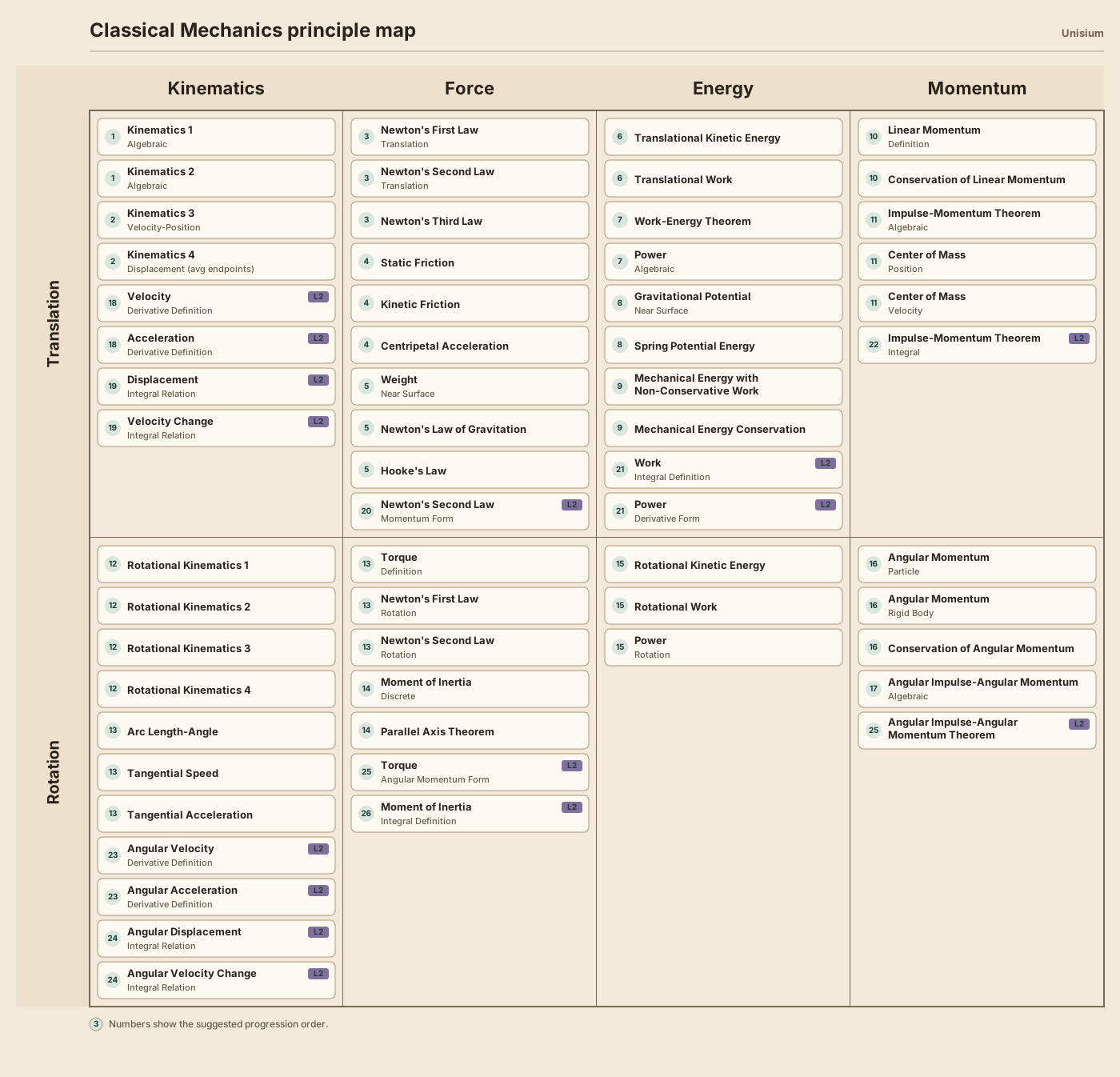
This map is for students learning classical mechanics who need to see what comes first, what depends on what, and when algebraic forms should be separated from calculus forms instead of mixed together too early. It follows the same principle structure approach used to organize mechanics around reusable principles, dependencies, and layer boundaries rather than a generic chapter-by-chapter topic list. The structure is informed by university-level classical mechanics teaching and research on principle maps in physics education.
On this page
- Why Learn Classical Mechanics?
- Prerequisites
- The Principle Map
- Practice recalling the principles
- Core Principles
- What’s Next?
- How This Fits in Unisium
Why Learn Classical Mechanics?
Classical mechanics is where physics begins. Every engineering discipline—mechanical, civil, aerospace, biomedical—builds on these foundations. If you want to understand why bridges stay up, how rockets fly, or why cars have crumple zones, you need classical mechanics.
Beyond engineering, classical mechanics teaches a way of thinking: modeling real situations with mathematical equations, identifying what quantities matter, and predicting outcomes before they happen. These skills transfer to every quantitative field.
The core principles in this subdomain aren’t just formulas to memorize—they’re reusable tools. Once you truly understand Newton’s second law (), you can apply it to any force problem. Once you internalize conservation of energy, complex multi-step problems become tractable.
Prerequisites
Mathematics:
- Algebra (solving equations, manipulating expressions)
- Basic trigonometry (sine, cosine for components)
- Comfort with vectors (direction and magnitude)
Prior Subdomains:
- None—Classical Mechanics is a foundation subdomain
The Principle Map
The principle map organizes Classical Mechanics along two axes:
Columns (Concept Families):
- Kinematics — describing motion (position, velocity, acceleration) without asking why
- Force — forces cause acceleration (Newton’s laws + specific force laws; torque as rotational analog)
- Energy — an alternative to forces: track energy flow to solve problems
- Momentum — track momentum, especially useful for collisions and explosions
Rows (Motion Types):
- Translation — motion of a point or center of mass in a straight line or curve
- Rotation — spinning motion around an axis
Progression numbers (P1, P2, …) indicate learning order. Lower numbers come first. Principles with the same progression number are at the same conceptual level.
Practice recalling the principles
This flashcard tool helps make the main classical mechanics principles stronger and easier to access from memory. You practice recalling each principle’s equation and conditions before revealing the answer.
Use it if you often recognize equations after seeing them, but struggle to remember which equation to use, what it means, or when it applies. Start with the first part of the map, then add more families, motion types, or calculus forms when you want a broader review.
Why this works
This tool is based on Vegard Gjerde’s research on structured retrieval practice of physics principle structures in introductory mechanics. Across this line of work, students practiced retrieving named principles, equations, and conditions instead of only reviewing the completed principle structure. The broader strategy is explained in the Retrieval Practice guide.
Key papers:
- Gjerde, Holst, & Kolstø (2020). Retrieval practice of a hierarchical principle structure in university introductory physics: Making stronger students. Physical Review Physics Education Research, 16(1), 013103.
- Gjerde, Havre Paulsen, Holst, & Kolstø (2022). Problem solving in basic physics: Effective self-explanations based on four elements with support from retrieval practice. Physical Review Physics Education Research, 18(1), 010136.
- Gjerde, Marisaldi, Oksavik, Olafsson, Spångberg, & Holst (2025). Mandatory retrieval test to incentivize retrieval practice of physics principles. Physical Review Physics Education Research, 21(1), 010119.
Equation/form
Conditions
No principles match those filters. Choose at least one concept family, motion type, and layer.
Core Principles
Conditions tell you when an equation is valid.
They’re intentionally short here—think of them as the main assumptions for classical mechanics. You’ll refine what they really mean through practice and problem-solving.
Conditions are purely discriminative: they tell you which form you’re using and what would make it invalid. For example, nonrelativistic signals when the Newtonian form breaks down, discrete masses tells you this is the summation form (not the integral), and instantaneous means right-now values (not averaged).
Kinematics (P1–P2)
| Principle | Equation | Condition |
|---|---|---|
| Kinematics 1 – Algebraic | ||
| Kinematics 2 – Algebraic | ||
| Kinematics 3 – Velocity–Position | ||
| Kinematics 4 – Displacement (avg endpoints) |
Newton’s Laws (P3)
| Principle | Equation | Condition |
|---|---|---|
| Newton’s First Law (Translation) | inertial | |
| Newton’s Second Law (Translation) | inertial; | |
| Newton’s Third Law | Newtonian |
Force Laws (P4–P5)
| Principle | Equation | Condition |
|---|---|---|
| Static Friction | contact; no slip | |
| Kinetic Friction | contact; slipping | |
| Centripetal Acceleration | curved path; moving | |
| Weight (Near Surface) | ||
| Newton’s Law of Gravitation | point masses | |
| Hooke’s Law | linear regime |
Work & Energy (P6–P9)
| Principle | Equation | Condition |
|---|---|---|
| Translational Kinetic Energy | nonrelativistic | |
| Translational Work | ||
| Work–Energy Theorem | inertial; | |
| Power (Algebraic) | instantaneous | |
| Gravitational Potential Energy (Near Surface) | ||
| Spring Potential Energy | linear spring | |
| Mechanical Energy with | inertial; | |
| Mechanical Energy Conservation |
Momentum & Impulse (P10–P11)
| Principle | Equation | Condition |
|---|---|---|
| Linear Momentum (Definition) | nonrelativistic | |
| Conservation of Linear Momentum | ||
| Impulse–Momentum Theorem (Algebraic) | ||
| Center of Mass (Position) | discrete masses | |
| Center of Mass (Velocity) | discrete masses |
Rotational Kinematics (P12–P13)
| Principle | Equation | Condition |
|---|---|---|
| Rotational Kinematics 1 | ||
| Rotational Kinematics 2 | ||
| Rotational Kinematics 3 | ||
| Rotational Kinematics 4 | ||
| Arc Length–Angle | radians | |
| Tangential Speed | ||
| Tangential Acceleration |
Torque & Rotational Newton Laws (P13–P14)
| Principle | Equation | Condition |
|---|---|---|
| Torque (Definition) | about point chosen | |
| Newton’s First Law (Rotation) | fixed axis; | |
| Newton’s Second Law (Rotation) | fixed axis; | |
| Moment of Inertia (Discrete) | fixed axis; discrete masses | |
| Parallel Axis Theorem | axes parallel |
Rotational Energy (P15)
| Principle | Equation | Condition |
|---|---|---|
| Rotational Kinetic Energy | rigid body; fixed axis | |
| Rotational Work | fixed axis; | |
| Power (Rotation) | fixed axis; instantaneous |
Angular Momentum (P16–P17)
| Principle | Equation | Condition |
|---|---|---|
| Angular Momentum (Particle) | about point chosen | |
| Angular Momentum (Rigid Body) | fixed axis | |
| Conservation of Angular Momentum | ||
| Angular Impulse–Angular Momentum (Algebraic) |
Layer 2: Calculus Forms (P18+)
Layer 2 principles use calculus (derivatives and integrals). They handle problems with non-constant quantities.
Translation Calculus (P18–P22)
| Principle | Equation | Condition |
|---|---|---|
| Velocity (Derivative) | ; differentiable at t | |
| Acceleration (Derivative) | ; differentiable at t | |
| Displacement (Integral) | ; interval specified | |
| Velocity Change (Integral) | ; interval specified | |
| Newton’s 2nd Law (Momentum Form) | inertial; finite forces | |
| Work (Integral) | path known; force as function of position | |
| Power (Derivative) | ; differentiable at t | |
| Impulse–Momentum (Integral) | inertial; ; interval specified |
Rotation Calculus (P23–P26)
| Principle | Equation | Condition |
|---|---|---|
| Angular Velocity (Derivative) | ; differentiable at t | |
| Angular Acceleration (Derivative) | ; differentiable at t | |
| Angular Displacement (Integral) | ; interval specified | |
| Angular Velocity Change (Integral) | ; interval specified | |
| Torque (Angular Momentum Form) | inertial; finite torque | |
| Angular Impulse–Angular Momentum (Integral) | inertial; ; interval specified | |
| Moment of Inertia (Integral) | fixed axis; continuous body; density known |
Rotation (P12–P17): The rotation row of the principle map mirrors translation: rotational kinematics, torque as the rotational analog of force, angular momentum, and rotational energy.
Enabled Subdomains:
- Electromagnetism: electric and magnetic fields build on force, energy, and vector reasoning
- Gravitation & Orbits — apply these principles to planetary motion
- Waves & Oscillations — simple harmonic motion builds on Hooke’s law and energy
- Thermodynamics — energy concepts extend to heat and work
Suggested Learning Path (Translation Core):
- Kinematics (P1–P2) — get comfortable with motion description
- Newton’s Laws (P3) — the core dynamics framework
- Force Laws (P4–P5) — build your force toolkit
- Work & Energy (P6–P9) — alternative problem-solving approach
- Momentum (P10–P11) — complete the translation toolkit
After translation, continue to rotation (P12–P17), which mirrors the same progression.
How This Fits in Unisium
Unisium trains classical mechanics in two complementary ways:
Principles in isolation (fast, targeted)
- Elaborative Encoding: answer short questions to build understanding
- Retrieval Practice: recall the equation + condition
Principles in context (real problem skill)
- Self-Explanation: step through worked solutions and justify each move
- Problem Solving: solve new problems and practice selecting the right principle under uncertainty
The principle map is your navigation layer: it shows what to learn next, and it explains why some problems feel harder (they combine more principles across columns and rows).
Planning ahead for a course? See how to get ready for physics over the summer using this map for pre-learning.
Current focus: Layer 1 (algebraic forms) provides the foundation. Layer 2 (calculus forms) extends these principles to handle non-constant forces and time-varying motion.
If you want a deck-based recall path through this subdomain, use Kinematics Anki Deck -> Forces & Newton’s Laws Anki Deck -> Work & Energy Anki Deck -> Momentum Anki Deck -> Rotational Kinematics Anki Deck -> Rotational Mechanics: Forces & Energy Anki Deck -> Rotational Mechanics: Angular Momentum Anki Deck.
Masterful Learning
The book behind these guides: a study system for physics, math, & programming built on retrieval, connection, explanation, and problem solving.
Ready to apply this strategy?
Unisium turns these evidence-based techniques into guided study sessions for math and physics. Places are limited during early access. Check current availability to start a trial; joining the mailing list is optional.
See plans and availability Read More GuidesAlready have access? Sign in