Spring Potential Energy: Elastic Energy Storage
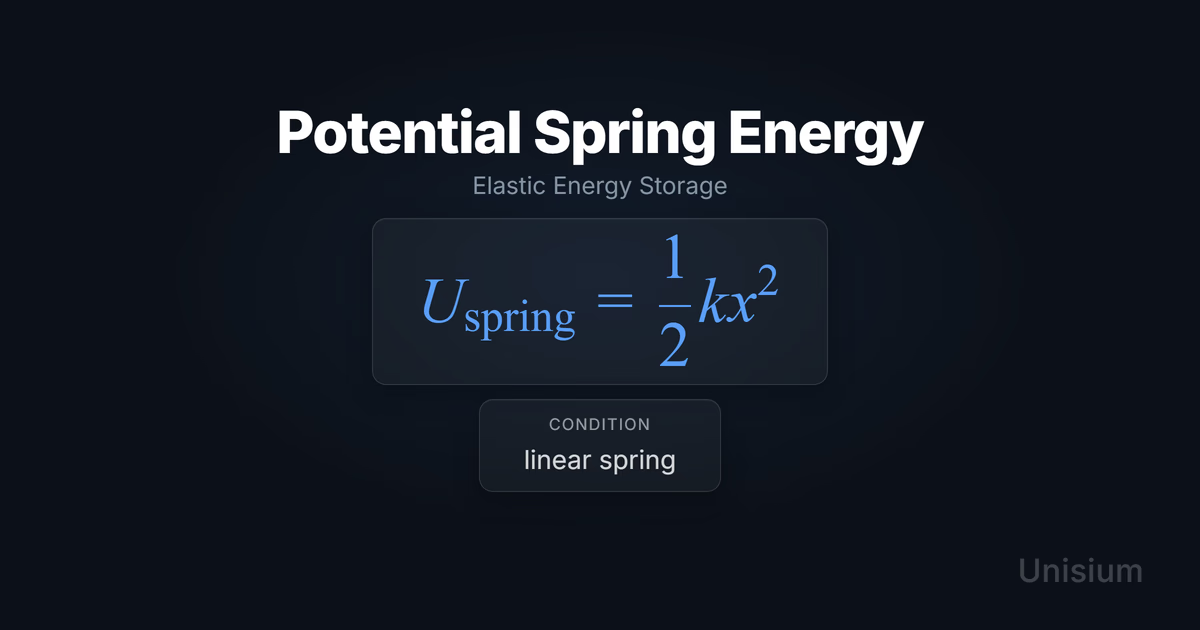
Potential Spring Energy is elastic energy stored by a linear spring: , where is displacement from equilibrium. Use it when a Hooke’s-law spring stores or releases energy in oscillations, collisions, or energy-conservation problems, as long as the spring stays in its linear regime.
Spring potential energy is foundational for understanding oscillations, collisions, and energy conservation in systems with elastic elements. Unlike gravitational potential energy, which depends linearly on displacement, spring energy scales with the square of displacement, making the restoring force stronger as the spring stretches or compresses further.
On this page: The Principle · Conditions · Misconceptions · EE Questions · Retrieval Practice · Worked Example · Solve a Problem · FAQ
The Principle
Statement
A linear spring stores potential energy when displaced from its equilibrium position. The energy stored is proportional to the square of the displacement and to the spring constant, which measures the spring’s stiffness.
Mathematical Form
Where:
- = potential energy stored in the spring (joules, J)
- = spring constant (N/m)
- = displacement from equilibrium position (m)
Alternative Forms
In different contexts, this appears as:
- Change in spring energy:
- Work done by spring:
Conditions of Applicability
Condition: linear spring
Practical modeling notes
- The spring must obey Hooke’s law () over the displacement range.
- The displacement is measured from the spring’s natural (relaxed) length, where the spring force is zero.
- The spring constant must remain constant (no plastic deformation or yielding).
- Mass of the spring itself is typically neglected (massless spring approximation).
When It Doesn’t Apply
- Non-linear springs: If the spring force doesn’t follow Hooke’s law (e.g., springs with variable stiffness or those stretched beyond their elastic limit), use instead.
- Plastic deformation: Once a spring is permanently deformed, the energy stored isn’t fully recoverable. Use energy dissipation models instead.
- Massive springs: If the spring’s mass is significant, kinetic energy of the spring itself must be included separately.
Want the complete framework behind this guide? Read Masterful Learning.
Common Misconceptions
Misconception 1: Spring energy is proportional to displacement
The truth: Spring energy is proportional to the square of displacement. Doubling the stretch quadruples the stored energy.
Why this matters: This is why it takes progressively more work to stretch a spring further. The force increases linearly with (Hooke’s law), but integrating that force over distance produces the dependence.
Misconception 2: Negative displacement gives negative energy
The truth: Because is squared, compression and extension by the same amount store the same energy. With at equilibrium, spring potential energy is non-negative (zero or positive).
Why this matters: A spring doesn’t “know” which direction it’s displaced—it stores energy either way. Sign conventions matter for force direction, but energy is non-negative in this convention.
Misconception 3: The factor is a typo or approximation
The truth: The is exact and comes from integrating Hooke’s law: . It represents the average force times distance.
Why this matters: Forgetting the leads to errors of 100% in energy calculations. This factor is not adjustable.
Elaborative Encoding
Use these questions to build deep understanding. (See Elaborative Encoding for the full method.)
Within the Principle
- Why does spring energy depend on rather than ?
- What does the spring constant tell you about the spring’s physical properties?
For the Principle
- When a spring hangs vertically under gravity, how does the equilibrium position shift, and what does that change about measuring ?
- What variable determines spring energy: the current position or the path taken to get there?
Between Principles
- How does spring potential energy relate to gravitational potential energy? When would you use both in the same problem?
Generate an Example
- Describe a situation where spring potential energy is converted entirely to kinetic energy, and explain the conditions required for this conversion.
Retrieval Practice
Answer from memory, then click to reveal and check. (See Retrieval Practice for the full method.)
State the principle in words: _____A linear spring stores potential energy proportional to the square of its displacement from equilibrium.
Write the canonical equation: _____
State the canonical condition: _____linear spring
Worked Example
Use this worked example to practice Self-Explanation.
Problem
A block of mass is attached to a horizontal spring with spring constant . The block is pulled to stretch the spring by from equilibrium and released from rest on a frictionless surface. What is the block’s speed when the spring passes through its equilibrium position?
Step 1: Verbal Decoding
Target:
Given: , , , ,
Constraints: horizontal, frictionless, linear spring
Step 2: Visual Decoding
Draw a 1D axis. Choose to the right. Mark at release and at equilibrium. Label . At equilibrium the block moves left, so . (So and is negative.)
Step 3: Physics Modeling
Step 4: Mathematical Procedures
Step 5: Reflection
- Units: The result has units of .
- Magnitude: A stiff spring stretched 15 cm giving a few m/s is plausible.
- Limiting case: If or , then .
Before moving on: self-explain the model
Try explaining Step 3 out loud (or in writing): why mechanical energy conservation applies, what the initial and final energy terms represent, and why kinetic and spring potential energies trade off.
Physics model with explanation (what “good” sounds like)
Principle: Mechanical energy conservation (or equivalently, work-energy theorem with conservative forces only).
Conditions: The surface is frictionless, so no non-conservative forces do work. The spring is linear (obeys Hooke’s law), so spring potential energy is .
Relevance: We want the final speed, which is related to kinetic energy. Energy conservation connects initial and final states without tracking forces at every instant.
Description: Initially, the block is at rest with the spring stretched, so all energy is spring potential energy: . At equilibrium, the spring is relaxed (), so spring potential energy is zero and all energy is kinetic: .
Goal: Equating initial and final total energy gives an equation with only one unknown (), which we solve algebraically.
Solve a Problem
Apply what you’ve learned with Problem Solving.
Problem
A spring with spring constant is compressed by from equilibrium. A block of mass is placed against the compressed spring and released. If the block separates from the spring when the spring reaches its natural length, what is the block’s speed at separation? (Assume a frictionless horizontal surface.)
Hint: At separation, the spring is at its natural length. What is the spring’s potential energy at that instant?
Show Solution
Step 1: Verbal Decoding
Target:
Given: , , , ,
Constraints: horizontal, frictionless, linear spring, block separates at natural length
Step 2: Visual Decoding
Draw a 1D axis. Choose to the right. Mark initial position at (compressed) and final position at (natural length). Label . At separation the block moves right, so . (So and is positive.)
Step 3: Physics Modeling
Step 4: Mathematical Procedures
Step 5: Reflection
- Units: The result has units of .
- Magnitude: A compressed spring with these parameters giving ~3 m/s is plausible.
- Limiting case: If , then .
Related Principles
- Classical Mechanics: The Complete Principle Map — see where this principle fits in the full subdomain.
| Principle | Relationship to Potential Spring Energy |
|---|---|
| Hooke’s Law | Defines the force law () that, when integrated, produces the energy formula. |
| Gravitational Potential Energy | Another form of conservative potential energy; often appears alongside spring energy in problems with vertical springs. |
| Work-Energy Theorem | Spring potential energy is derived from the work done by (or against) the spring force. |
See Principle Structures for how to organize these relationships visually.
FAQ
What is Potential Spring Energy?
Potential spring energy is the elastic energy stored in a spring when it is compressed or stretched from its equilibrium position. It is given by , where is the spring constant and is the displacement from equilibrium.
When does spring potential energy apply?
Spring potential energy applies when the spring obeys Hooke’s law (linear force-displacement relation) and the displacement is measured from the spring’s natural length. It applies equally to compression and extension.
What’s the difference between spring potential energy and gravitational potential energy?
Gravitational potential energy depends linearly on height (), while spring potential energy depends quadratically on displacement (). Both are conservative energies, meaning they depend only on position, not on the path taken.
What are the most common mistakes with spring potential energy?
The most common mistakes are: (1) forgetting the factor, (2) thinking energy is proportional to rather than , and (3) forgetting that compression and extension by the same amount store the same energy (energy is always positive).
How do I know which form of spring energy to use?
Use when you need the total energy at a position. Use when you need the change in energy between two positions. Use when you need the work done by the spring force.
Related Guides
- Principle Structures — Organize this principle in a hierarchical framework
- Self-Explanation — Learn to explain worked examples step by step
- Retrieval Practice — Make this principle instantly accessible
- Problem Solving — Apply principles systematically to new problems
How This Fits in Unisium
Unisium helps students master spring potential energy through elaborative encoding questions that deepen understanding of the dependence, retrieval practice to make the equation instantly recallable, and self-explanation of worked examples to internalize energy conservation reasoning. The platform connects this principle to related concepts like Hooke’s law and gravitational potential energy, building a coherent mental model of conservative forces.
Ready to master Potential Spring Energy? Check access and join the Unisium waitlist or explore the full learning framework in Masterful Learning.
Masterful Learning
The book behind these guides: a study system for physics, math, & programming built on retrieval, connection, explanation, and problem solving.
Ready to apply this strategy?
Unisium turns these evidence-based techniques into guided study sessions for math and physics. Places are limited during early access. Check current availability to start a trial; joining the mailing list is optional.
See plans and availability Read More GuidesAlready have access? Sign in