Weight (Near Surface): Understanding Gravitational Force in Local Contexts
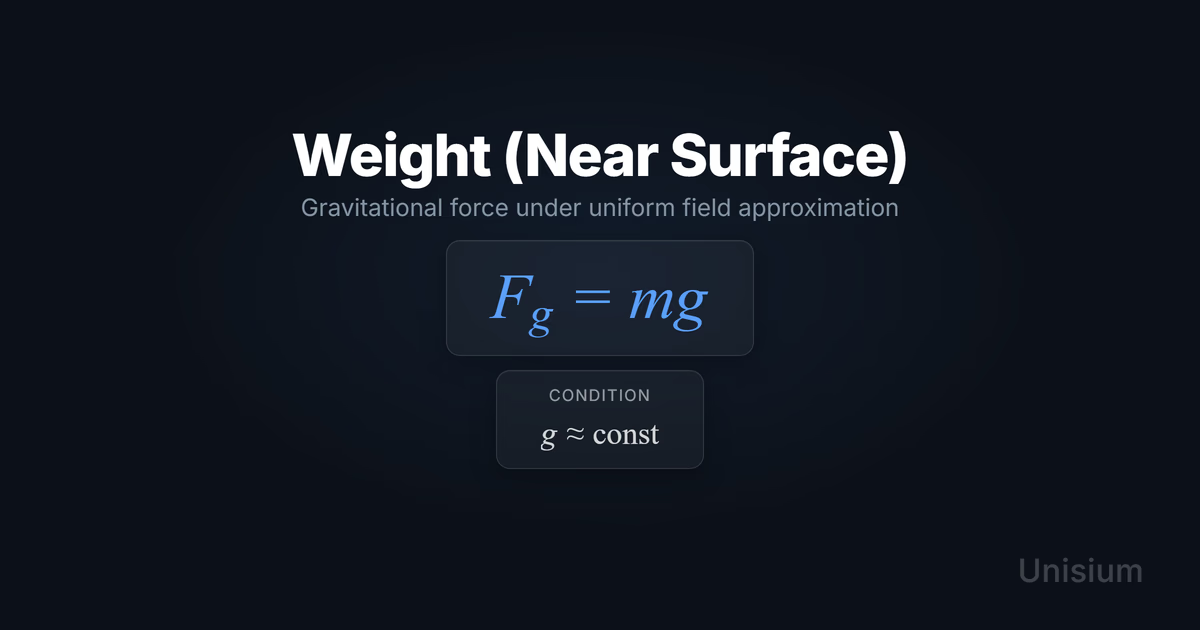
Weight near a planet surface is the gravitational force exerted on an object when the gravitational field strength is approximately constant. The magnitude is , where is the object’s mass and is the local gravitational field strength. This approximation applies when the object remains close enough to the surface that doesn’t vary significantly—a core principle taught through the Unisium Study System.
This principle lets you calculate gravitational forces without using the full inverse-square law, making many introductory mechanics problems tractable. It’s essential for free fall, projectile motion, and force analysis in Earth-bound contexts.
On this page: The Principle · Conditions · Misconceptions · EE Questions · Retrieval Practice · Worked Example · Solve a Problem · FAQ
The Principle
Statement
Weight near a planet surface is the gravitational force on an object when the gravitational field strength is approximately constant over the region of interest. The magnitude of this force is , pointing toward the planet’s center.
Mathematical Form
Where:
- = magnitude of gravitational force (weight) in newtons (N)
- = mass of the object in kilograms (kg)
- = local gravitational field strength (acceleration due to gravity) in meters per second squared (m/s²)
For vector notation:
where points downward (toward the planet center).
Alternative Forms
In different contexts, this appears as:
- Component form (choosing +y upward): (negative because gravity points down)
- On Earth’s surface: using the standard value
Conditions of Applicability
Condition:
Practical modeling notes
This approximation holds when:
- The object stays close to the planet surface compared to the planet’s radius (typically within a few kilometers for Earth)
- Altitude changes are small enough that the variation in is negligible for the problem’s precision requirements
For Earth, at sea level. At altitude above the surface: where is Earth’s radius (). For , the change is small: going from sea level to 10 km altitude changes by only about 0.3%.
When It Doesn’t Apply
This principle fails or must be modified when:
- High altitudes or space: When the distance from the planet center changes significantly, use Newton’s law of gravitation instead.
- Strong gravitational gradients: In extreme scenarios (near neutron stars, black holes), tidal effects matter and varies substantially over the object’s extent.
Want the complete framework behind this guide? Read Masterful Learning.
Common Misconceptions
Misconception 1: Mass and weight are the same thing
The truth: Mass is an intrinsic property (amount of matter, measured in kg); weight is the gravitational force (measured in N). An object’s mass is constant, but its weight depends on the local gravitational field.
Why this matters: Confusing mass and weight leads to errors like using kilograms when newtons are required, or claiming that astronauts in orbit are “weightless” because they have no mass (they’re in free fall, experiencing microgravity, not zero mass).
Misconception 2: is exactly everywhere on Earth
The truth: varies slightly with latitude (centrifugal effects from Earth’s rotation), altitude, and local geology. The standard value (or ) is an average. Values range from about at the equator to at the poles.
Why this matters: In precision experiments or GPS calculations, these variations matter. In introductory problems, using is fine, but recognize it’s an approximation.
Misconception 3: Objects with more mass fall faster
The truth: In the absence of air resistance, all objects near Earth’s surface accelerate downward at the same rate , regardless of mass. The weight is larger for more massive objects, but so is their inertia , so the acceleration is the same.
Why this matters: This confusion leads to incorrect predictions in free-fall problems and misunderstanding of Galileo’s famous thought experiment.
Elaborative Encoding
Use these questions to build deep understanding. (See Elaborative Encoding for the full method.)
Within the Principle
- What does the symbol represent physically, and why does it have units of acceleration (m/s²) even though we’re talking about a force?
- Why is weight proportional to mass? How would the relationship change if gravity didn’t produce constant acceleration?
For the Principle
- How do you decide if the uniform gravity approximation is valid for a given problem (e.g., a satellite orbit vs. a falling apple)?
- When setting up free-body diagrams, how do you choose the direction of , and how does that affect the sign in component equations?
Between Principles
- How does weight near surface () relate to Newton’s law of gravitation ()? Under what approximation does the former emerge from the latter?
Generate an Example
- Describe a situation where you cannot use and must instead use the full gravitational law.
Retrieval Practice
Answer from memory, then click to reveal and check. (See Retrieval Practice for the full method.)
State the principle in words: _____Weight near a planet surface is the gravitational force on an object when the gravitational field strength is approximately constant, given by F_g = mg.
Write the canonical equation: _____
State the canonical condition: _____
Worked Example
Use this worked example to practice Self-Explanation.
Problem
A 65 kg astronaut stands on the surface of Mars, where . What is the magnitude of the gravitational force on the astronaut?
Step 1: Verbal Decoding
Target:
Given: ,
Constraints: On surface (uniform gravity applies)
Step 2: Visual Decoding
Draw the astronaut as a point mass. Draw a vertical axis, choosing upward. Label pointing downward (in the direction).
(So has a negative -component if we want the vector form, but we’re asked for the magnitude, which is always positive.)
Step 3: Physics Modeling
Step 4: Mathematical Procedures
Step 5: Reflection
- Units: kg · m/s² = N ✓
- Magnitude: About 240 N, roughly one-third of the astronaut’s Earth weight (650 N), which makes sense because Mars’s is about 38% of Earth’s.
- Limiting case: If , then , matching the expectation that gravitational force vanishes in the absence of a gravitational field.
Before moving on: self-explain the model
Try explaining Step 3 out loud (or in writing): why the uniform gravity equation applies here, what the diagram shows about the direction of the force, and why the magnitude is simply the product .
Physics model with explanation (what “good” sounds like)
Principle: We use weight near surface () because we’re at Mars’s surface, where is approximately constant over the astronaut’s height.
Conditions: The astronaut is standing on the surface (not orbiting or at high altitude), so the uniform gravity approximation is valid.
Relevance: This is a direct application—no need for the full gravitational law because we know the local value.
Description: The astronaut has mass 65 kg and experiences Mars’s gravitational field. The force magnitude is the product of these two quantities.
Goal: Find the force magnitude. The equation gives it immediately; we just substitute the known values.
Solve a Problem
Apply what you’ve learned with Problem Solving.
Problem
A 1200 kg car is parked on a hill on Earth (where ). What is the magnitude of the gravitational force on the car?
Hint: Even though the car is on a hill, the gravitational force magnitude is still pointing vertically downward.
Show Solution
Step 1: Verbal Decoding
Target:
Given: ,
Constraints: Near Earth’s surface (uniform gravity)
Step 2: Visual Decoding
Draw the car as a point. Draw a vertical axis with upward. Label pointing straight down.
(The hill’s slope affects other forces like normal and friction, but gravity always points toward Earth’s center—vertically downward.)
Step 3: Physics Modeling
Step 4: Mathematical Procedures
Step 5: Reflection
- Units: kg · m/s² = N ✓
- Magnitude: About 12,000 N, which is reasonable for a car (roughly 1.2 metric tons of force).
- Limiting case: If , then , consistent with the idea that massless objects experience no gravitational force.
Related Principles
- Classical Mechanics: The Complete Principle Map — see where this principle fits in the full subdomain.
| Principle | Relationship to Weight Near Surface |
|---|---|
| Newton’s Law of Gravitation | Weight near surface is a special case when (planet radius) and is treated as constant |
| Newton’s Second Law | Weight is one force among others; governs how weight (and other forces) produce acceleration |
| Gravitational Potential Energy (Near Surface) | Weight appears in the derivation ; the constant makes the potential linear in height |
See Principle Structures for how to organize these relationships visually.
FAQ
What is weight near a planet surface?
Weight near a planet surface is the gravitational force on an object when the gravitational field strength is approximately constant. It’s calculated as , where is the object’s mass and is the local gravitational field strength (typically on Earth).
When does the uniform gravity approximation apply?
The approximation applies when the object stays close to the planet surface—typically within a few kilometers for Earth—so that doesn’t vary significantly. For example, it’s valid for ground-level physics, building heights, and low-altitude flights, but not for satellite orbits or interplanetary trajectories.
What’s the difference between weight near surface and Newton’s law of gravitation?
Weight near surface () assumes is constant, which is a simplification of Newton’s law of gravitation (). The latter accounts for how gravity weakens with distance. When (the planet’s radius), is nearly constant, and the simpler formula suffices.
What are the most common mistakes with weight near surface?
- Confusing mass (kg) with weight (N): mass is intrinsic; weight is a force
- Using for other planets (each has its own )
- Forgetting that weight is a vector pointing downward, not just a magnitude
How do I know when to use versus the full gravitational law?
Use when the problem involves objects near a planet surface (buildings, projectiles, free fall). Use when distances vary significantly (orbits, space missions, comparing forces at different altitudes).
Related Guides
- Principle Structures — Organize weight and related principles in a hierarchical framework
- Newton’s Second Law — See how weight combines with other forces to produce acceleration
- Self-Explanation — Learn to explain worked examples step by step
- Problem Solving — Apply principles systematically to new problems
How This Fits in Unisium
Unisium helps students master specific principles like weight near surface through elaborative encoding (understanding the uniform gravity approximation and when it breaks), retrieval practice (instant recall of ), self-explanation (articulating why the model applies in worked examples), and problem solving (applying it to new contexts). These strategies form the core of the Unisium Study System.
Ready to master weight near surface? Check access and join the Unisium waitlist or explore the full learning framework in Masterful Learning.
Masterful Learning
The book behind these guides: a study system for physics, math, & programming built on retrieval, connection, explanation, and problem solving.
Ready to apply this strategy?
Unisium turns these evidence-based techniques into guided study sessions for math and physics. Places are limited during early access. Check current availability to start a trial; joining the mailing list is optional.
See plans and availability Read More GuidesAlready have access? Sign in