Angular Velocity - Derivative Definition: How Rotation Rate Changes
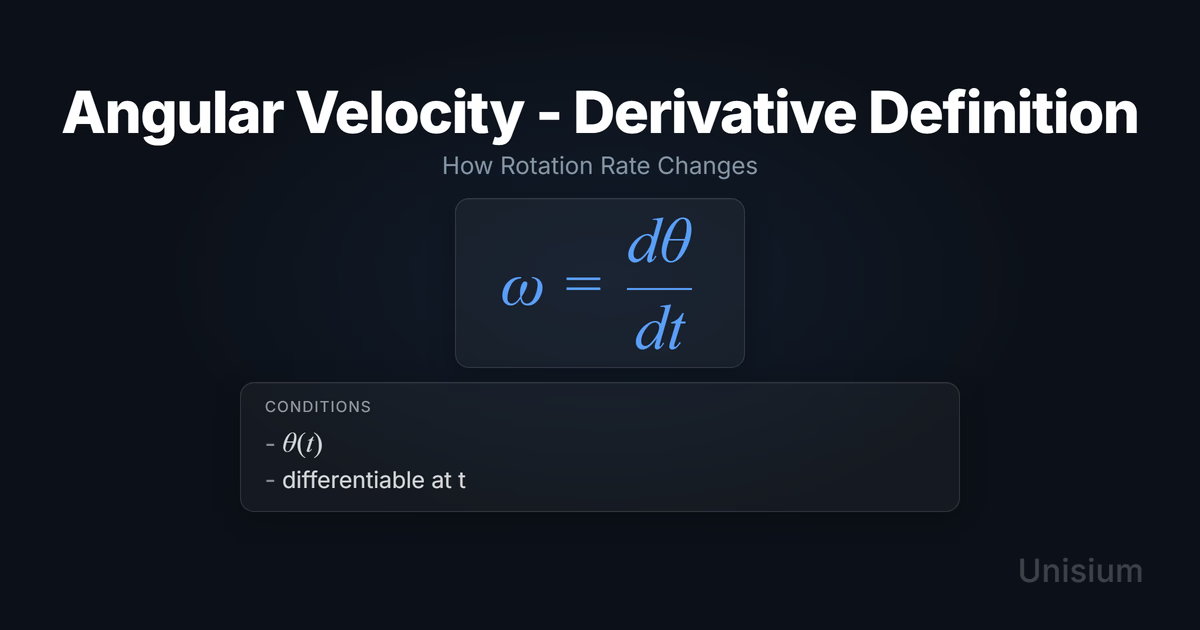
Angular velocity (derivative definition) says that instantaneous rotation rate is the time-derivative of angular position: . It applies at times where is differentiable, so an “instantaneous” rate is well-defined. This is the rotational twin of , so it helps you connect angular position, angular velocity, and angular acceleration without relying on average rates or sign guessing.
This definition is central to rotational kinematics. It provides the bridge between angular position and angular acceleration, enabling precise analysis of spinning wheels, rotating shafts, and planetary motion. Understanding the derivative definition builds the foundation for torque, angular momentum, and energy analysis in rotation.
On this page: The Principle | Conditions | Misconceptions | EE Questions | Retrieval Practice | Worked Example | Solve a Problem | FAQ
The Principle
Statement
Angular velocity is the instantaneous rate of change of angular position with respect to time. For a rotating object, if describes how the angular position changes with time, then the angular velocity at any instant is the derivative of with respect to .
Mathematical Form
Where:
- = angular velocity (rad/s)
- = angular position (rad)
- = time (s)
Alternative Forms
In different contexts, this appears as:
- Average angular velocity (over an interval):
Conditions of Applicability
Condition: ; differentiable at t
The function must be differentiable at the time of interest. This means the angular position must vary smoothly—no sudden jumps or discontinuities in the rotation.
Practical modeling notes
- Most physical rotation problems involve smooth motion, so differentiability holds.
- For objects with constant angular velocity, is inherently differentiable.
- For piecewise motion (e.g., a disk that suddenly stops), the derivative may not exist at transition points. Use average angular velocity across the interval instead.
When It Doesn’t Apply
- Discontinuous rotation: If an object teleports to a new angle instantaneously (non-physical but possible in simulations), is not continuous, let alone differentiable.
- Discrete steps: In digital encoders or stepper motors modeled discretely, use instead of the derivative definition.
Want the complete framework behind this guide? Read Masterful Learning.
Common Misconceptions
Misconception 1: Angular velocity is the same as linear velocity
The truth: Angular velocity measures how fast the angle changes (rad/s), while linear velocity measures how fast position changes (m/s). They’re related by for a point at radius from the axis, but they measure fundamentally different quantities.
Why this matters: Confusing and leads to dimensional errors. A wheel with large but small can have smaller than a wheel with smaller but larger .
Misconception 2: You can use this definition even when has a corner or jump
The truth: The derivative definition requires to be differentiable. At a corner (where the slope changes abruptly) or jump (discontinuity), the derivative does not exist. Use average angular velocity over an interval instead.
Why this matters: Applying at a non-differentiable point produces undefined results or mathematical errors in symbolic computation.
Misconception 3: Angular velocity is always positive
The truth: can be positive or negative depending on the direction of rotation. By convention, counterclockwise is positive and clockwise is negative.
Why this matters: Sign errors in propagate to angular acceleration and torque calculations, leading to wrong predictions about which way an object will speed up or slow down.
Elaborative Encoding
Use these questions to build deep understanding. (See Elaborative Encoding for the full method.)
Within the Principle
- What does the derivative represent physically? How does it differ from average angular velocity ?
- Why are the units of radians per second? What happens if you use degrees per second instead?
For the Principle
- How do you decide whether to use the derivative definition or the average definition in a given problem?
- If is not differentiable at a certain instant (e.g., a motor that suddenly stops), what alternative approach should you use?
Between Principles
- How does the angular velocity definition relate to the angular acceleration definition ? What role does each play in rotational kinematics?
Generate an Example
- Describe one situation where is constant and one where it increases with time. For each, sketch what vs. would look like (no calculation).
Retrieval Practice
Answer from memory, then click to reveal and check. (See Retrieval Practice for the full method.)
State the principle in words: _____Angular velocity is the instantaneous rate of change of angular position with respect to time.
Write the canonical equation: _____
State the canonical condition: _____
Worked Example
Use this worked example to practice Self-Explanation.
Problem
A turntable’s angular position is given by for . What is the angular velocity at ?
Step 1: Verbal Decoding
Target:
Given:
Constraints: ; smooth
Step 2: Visual Decoding
Draw a 2D plot with horizontal axis and vertical axis . Mark on the -axis and draw the tangent line to at that point. Label the tangent slope as . (So the slope is positive.)
Step 3: Physics Modeling
Step 4: Mathematical Procedures
Step 5: Reflection
- Units: ✓
- Magnitude: revolutions per second, reasonable for a turntable.
- Limiting case: As , . The turntable starts from rest and speeds up, which matches the given starting at with zero initial slope.
Before moving on: self-explain the model
Try explaining Step 3 out loud (or in writing): why the chosen principle applies, what the diagram implies, and how the equations encode the situation.
Physics model with explanation (what “good” sounds like)
Principle: Angular velocity - derivative definition. We use because we need the instantaneous rate of change of angular position at a specific time.
Conditions: is a polynomial, so it’s differentiable everywhere. The condition is satisfied.
Relevance: The problem asks for at a specific instant, not averaged over an interval, so the derivative definition is the right tool.
Description: The turntable starts at and its angle increases quadratically with time. The rate of increase (the slope of vs. ) grows linearly, which we find by differentiating.
Goal: Find at by taking the derivative of and evaluating at that time. The result is , meaning the turntable is rotating at about revolutions per second at that instant.
Solve a Problem
Apply what you’ve learned with Problem Solving.
Problem
A spinning wheel has angular position . Find the angular velocity at .
Hint: Take the derivative term by term, then substitute .
Show Solution
Step 1: Verbal Decoding
Target:
Given:
Constraints: Polynomial ;
Step 2: Visual Decoding
Draw a 2D plot with horizontal axis and vertical axis . Mark on the -axis and draw the tangent line to at that point. Label the tangent slope as . (So the tangent slope at is positive.)
Step 3: Physics Modeling
Step 4: Mathematical Procedures
Step 5: Reflection
- Units: ✓
- Magnitude: revolutions per second, a modest rotation rate.
- Limiting case: At , (rotating clockwise). The term eventually dominates, causing to become positive (counterclockwise) at later times. At , the wheel has reversed direction and is now spinning counterclockwise.
Related Principles
- Classical Mechanics: The Complete Principle Map — see where this principle fits in the full subdomain.
| Principle | Relationship to Angular Velocity - Derivative |
|---|---|
| Angular Acceleration - Derivative | extends the derivative chain: from to to . |
| Linear Velocity - Derivative | is the translational analog; related by for circular motion. |
| Rotational Kinematics (Average) | is discretized version; derivative definition is the continuum limit. |
See Principle Structures for how to organize these relationships visually.
FAQ
What is angular velocity - derivative definition?
Angular velocity is the instantaneous rate of change of angular position with respect to time, defined as . It measures how fast an object is rotating at a specific instant.
When does this definition apply?
It applies when is differentiable at the time of interest. This is true for smooth, continuous rotation but not at discontinuities or corners in .
What’s the difference between and ?
The derivative definition gives the instantaneous angular velocity at a single moment. The average definition gives the constant angular velocity that would produce the same net angular displacement over a time interval. They’re equal only when is constant.
What are the most common mistakes with angular velocity?
Confusing angular velocity with linear velocity (they have different units and meanings), forgetting that can be negative (clockwise rotation), and trying to use the derivative definition when is not differentiable.
How do I know when to use the derivative vs. average definition?
Use the derivative definition when you need the instantaneous rate at a specific time and when is given as a smooth function. Use the average definition when you only know the net change in angle over a time interval, or when is not differentiable everywhere.
Related Guides
- Principle Structures — Organize this principle in a hierarchical framework
- Self-Explanation — Learn to explain worked examples step by step
- Retrieval Practice — Make this principle instantly accessible
- Problem Solving — Apply principles systematically to new problems
How This Fits in Unisium
Unisium helps students master angular velocity through structured elaborative encoding (building connections to linear motion and calculus), retrieval practice (active recall of the derivative definition), self-explanation (articulating why captures instantaneous rotation rate), and problem solving (applying it to turntables, wheels, and planetary motion). This integrated approach transforms the principle from a memorized formula into a flexible tool for analyzing rotational systems.
Ready to master angular velocity? Check access and join the Unisium waitlist or explore the full learning framework in Masterful Learning.

Masterful Learning
The book behind these guides: a study system for physics, math, & programming built on retrieval, connection, explanation, and problem solving.
Ready to apply this strategy?
Unisium turns these evidence-based techniques into guided study sessions for math and physics. Places are limited during early access. Check current availability to start a trial; joining the mailing list is optional.
See plans and availability Read More GuidesAlready have access? Sign in