Kinematics Anki Deck: Motion Equations (Physics)
Download the deck
Get new deck drops (and deck updates)
One email per new deck release. No spam.
Use this deck to build fast recall of the motion equations and when they apply, so kinematics problems stop feeling like formula roulette.
What this deck is for
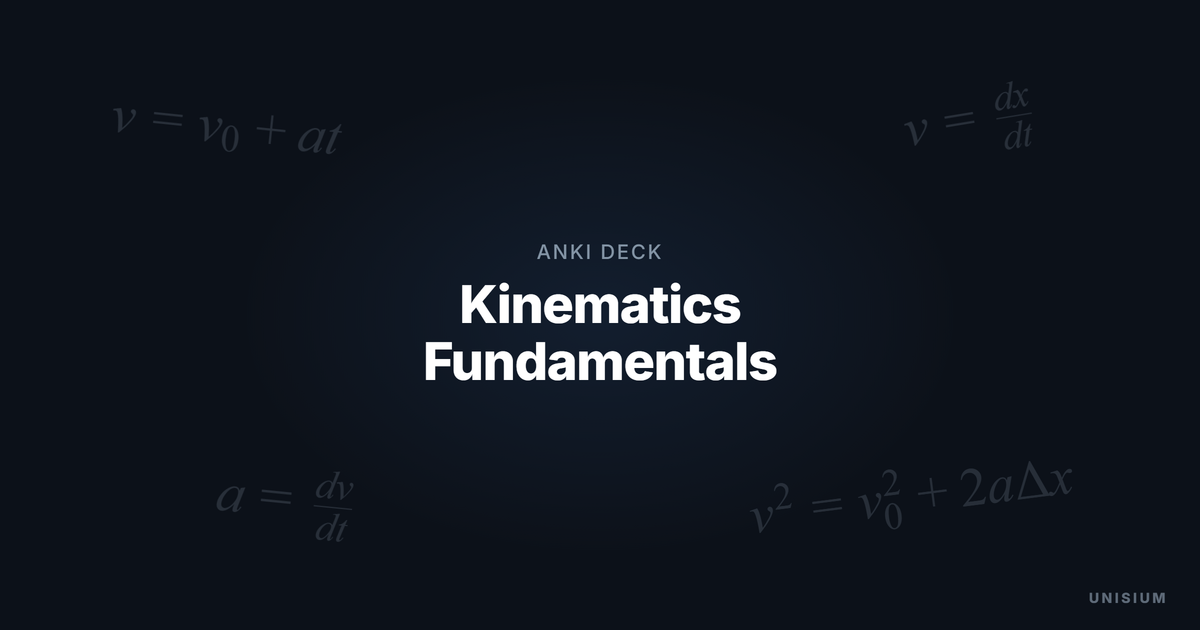
This deck drills instant recall of the kinematics equations — what each symbol means, the units, and the conditions that make each equation valid.
The cards prompt retrieval or elaboration of key concepts and connections. You’ll also get at least one problem with a structured solution that you can self-explain.
This deck does not cover force laws or problem setups. It’s the “equation + meaning + validity” layer you need before problem practice pays off.
Coverage
Core ideas
- Velocity as the derivative of position
- Acceleration as the derivative of velocity
- The constant-acceleration equations (and when they apply)
- Integral forms linking position, velocity, and acceleration
Equations in this deck
Constant-acceleration equations:
Derivative definitions:
Integral forms:
Common traps in kinematics
Before you drill cards, know the classic failure modes:
- Using constant-accel equations when acceleration varies: The “big four” (, etc.) require constant . If changes, use calculus or break into segments.
- Sign errors in 1D motion: Pick a positive direction once and stick with it. If you choose rightward and the object moves left, its velocity is negative.
- Confusing equation output: gives , not . Take the square root and choose the correct sign based on direction.
- Forgetting that is instantaneous: Average velocity is not the same as instantaneous velocity unless motion is uniform.
- Mixing up displacement and distance: can be negative (displacement); distance traveled is always positive.
What this deck does not do
- It does not teach you to solve full mechanics problems by itself.
- It does not cover force models (free-body diagrams, friction, interaction pairs). Use: Forces & Newton’s Laws Anki Deck.
How to use it (so it sticks)
- Download the deck and import into Anki (File → Import)
- Study daily — keep it small and consistent
- When you miss a card, write a one-line rule: “This equation needs constant acceleration.”
- Apply recall immediately with setup practice: Problem-Solving Strategies
Where this fits in a typical mechanics sequence
- Previous: How to Study Physics and Math with Anki
- Next up: Forces & Newton’s Laws Anki Deck
If you’re using Unisium
Anki is strong at recall. Unisium adds more guided work in the full loop: retrieval practice, elaboration, self-explanation, and problem solving.
If you are deciding whether to keep building around Anki or move to a guided system, compare Unisium vs Anki.
Related guides
Want more than recall?
Use Unisium to practice retrieval, self-explanation, and problem solving with guided sessions.
See plans and availability Read More Guides