Center of Mass (Position): Locating the Balance Point
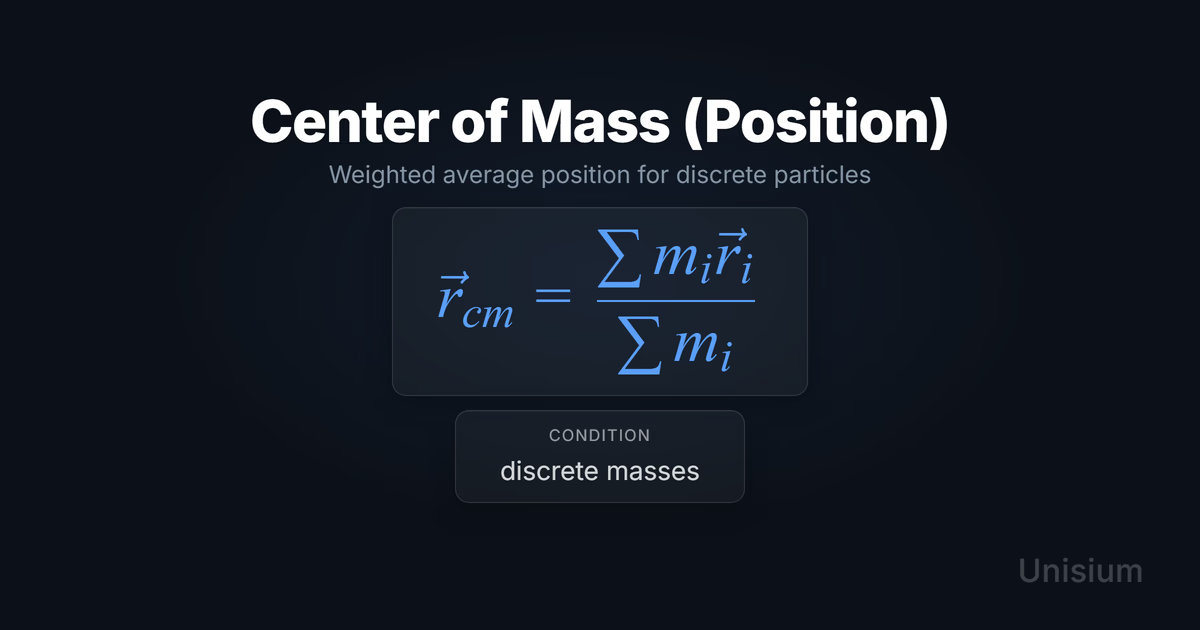
Center of Mass (Position) defines the weighted average location of a system’s mass. The position vector equals the sum of each particle’s mass times its position, divided by the total mass. Use it to locate a system’s balance point or translational position from the mass distribution.
Finding the center of mass gives you a single location that summarizes how mass is distributed in a system. Once you can locate it, you can later describe the system’s translational motion using center-of-mass motion principles—without tracking every individual particle. This makes analyzing projectile trajectories, collisions, and orbital mechanics tractable.
On this page: The Principle · Conditions · Misconceptions · EE Questions · Retrieval Practice · Worked Example · Solve a Problem · FAQ
The Principle
Statement
The center of mass of a system is the mass-weighted average position of all particles in the system. For a collection of discrete point masses, the center of mass position vector locates a convenient reference point for describing translational motion (when combined with center-of-mass motion principles).
Mathematical Form
Where:
- = position vector of the center of mass (m)
- = mass of the -th particle (kg)
- = position vector of the -th particle (m)
- = total mass of the system (kg)
Alternative Forms
In different contexts, this appears as:
- One-dimensional systems: (or , for other axes)
- Continuous mass distributions: Require integral calculus (not covered in this guide)
Conditions of Applicability
Condition: discrete masses This summation formula applies when you model a system as discrete point masses with specified positions. Use an integral form for continuous mass distributions (not covered in this guide).
Practical modeling notes
- The formula assumes you can treat objects as point masses located at specific positions. For extended objects with continuous mass distributions, integral calculus is required (not covered in this guide).
- Coordinate choice is arbitrary—the center of mass location is physical and independent of your chosen origin, though the numerical values of depend on where you place your origin.
- For symmetric objects with uniform density, the center of mass coincides with the geometric center. For asymmetric or non-uniform objects, it can lie outside the physical object itself (e.g., a boomerang).
When the Discrete Form Doesn’t Apply
The discrete summation form requires identifiable point masses. For extended rigid bodies or continuous distributions:
- Subdivide the object: Treat it as many small pieces, each with mass , and approximate with the summation
- Continuous distributions: Require a calculus-based integral form (not covered in this guide)
Want the complete framework behind this guide? Read Masterful Learning.
Common Misconceptions
Misconception 1: The center of mass must be inside the object
The truth: The center of mass can lie outside the physical material. For a hollow ring, horseshoe, or boomerang, the center of mass is in empty space.
Why this matters: If you assume the center of mass must touch the object, you’ll struggle with collision problems involving irregular shapes or misinterpret rotational motion about the center of mass.
Misconception 2: Heavier particles “pull” the center of mass toward them
The truth: The center of mass isn’t created by forces between particles. It’s a geometric averaging process. Each particle contributes proportionally to its mass, but there’s no physical pulling—just weighted averaging.
Why this matters: Students sometimes think of the center of mass as a result of gravitational attraction between particles. This leads to confusion when analyzing systems in free fall or in space, where all particles share the same acceleration regardless of internal forces.
Misconception 3: Changing the origin changes the center of mass location in space
The truth: The center of mass is a physical point in space. Changing your coordinate origin changes the numerical values of , but not the physical location. The center of mass remains at the same spot in the room, regardless of where you put your ruler’s zero mark.
Why this matters: Mixing up “the value of ” with “the location of the center of mass” causes errors when solving problems in multiple reference frames or when combining subsystems.
Elaborative Encoding
Use these questions to build deep understanding. (See Elaborative Encoding for the full method.)
Within the Principle
- Why does the formula divide by the total mass instead of by the number of particles ? What would happen if you divided by instead?
- The center of mass formula involves vector addition . In two dimensions, what does it mean to add position vectors multiplied by scalars?
For the Principle
- How do you decide whether you can model a real object as discrete point masses versus needing a continuous distribution approach?
- If you have a system of three masses arranged in an L-shape, how would you choose a coordinate system to make the center of mass calculation simplest?
Between Principles
- How does the center of mass position relate to the center of mass velocity ? What mathematical operation connects them?
Generate an Example
- Describe a physical system where the center of mass lies outside any material (such as a bent coat hanger or a collection of orbiting satellites). How would you verify its location experimentally?
Retrieval Practice
Answer from memory, then click to reveal and check. (See Retrieval Practice for the full method.)
State the principle in words: _____The center of mass is the mass-weighted average position of all particles in a system.
Write the canonical equation: _____
State the canonical condition: _____discrete masses
Worked Example
Use this worked example to practice Self-Explanation.
Problem
Three point masses lie along the -axis: at , at , and at . Find the -coordinate of the center of mass.
Step 1: Verbal Decoding
Target:
Given: , , , , ,
Constraints: One-dimensional system along the -axis, discrete point masses
Step 2: Visual Decoding
Draw a 1D axis. Choose to the right. Mark points at , , . Label each mass at its point and mark an unknown on the same axis.
(All listed positions are positive on this axis.)
Step 3: Physics Modeling
Step 4: Mathematical Procedures
Step 5: Reflection
- Units: kg·m divided by kg yields meters, correct for a position coordinate.
- Magnitude: The result 4.7 m lies between 4.0 m and 7.0 m, shifted right because the heaviest mass is at 7 m.
- Limiting case: If all masses were equal, m; the weighted average at 4.7 m reflects the unequal masses.
Before moving on: self-explain the model
Try explaining Step 3 out loud (or in writing): why the center of mass formula applies, what the weighted average means physically, and how the masses and positions combine in the numerator.
Physics model with explanation (what “good” sounds like)
Principle: Center of mass position for discrete point masses.
Conditions: Discrete point masses with known positions (summation form).
Relevance: The problem asks for the center-of-mass location, which is exactly what this formula computes.
Description: Multiply each position by its mass to weight its contribution, sum, then divide by the total mass to get a weighted-average position.
Goal: Substitute values and compute m. This point summarizes where the system’s mass is effectively “located” for later motion analysis.
Solve a Problem
Apply what you’ve learned with Problem Solving.
Problem
Two masses are placed on a table: at position and at position . Find the and coordinates of the center of mass.
Hint: Apply the center of mass formula separately to each coordinate direction.
Show Solution
Step 1: Verbal Decoding
Target: ,
Given: , , , , ,
Constraints: Two-dimensional system, discrete point masses
Step 2: Visual Decoding
Draw an -plane. Choose to the right and upward. Plot point at and point at with their respective masses labeled. Mark to be determined.
(Both masses have positive coordinates on this plane.)
Step 3: Physics Modeling
Step 4: Mathematical Procedures
Step 5: Reflection
- Units: kg·m divided by kg gives meters in both directions, correct for coordinates.
- Magnitude: m is between 2.0 and 3.0 m (closer to 3.0); m is 75% of the way from 0 to 4.0 m, matching the 3:1 mass ratio.
- Limiting case: If , the midpoint would be m; the weighted average shifts toward ‘s coordinates as expected.
Related Principles
- Classical Mechanics: The Complete Principle Map — see where this principle fits in the full subdomain.
| Principle | Relationship to Center of Mass Position |
|---|---|
| Center of Mass Velocity | Time derivative of |
| Conservation of Linear Momentum | Total momentum equals ; momentum conservation implies constant |
| Newton’s Second Law | External forces determine center of mass acceleration |
See Principle Structures for how to organize these relationships visually.
FAQ
What is center of mass position?
Center of mass position is the mass-weighted average location of all particles in a system. It’s a single reference point summarizing the mass distribution, and it becomes powerful when combined with center-of-mass motion principles.
When does the center of mass formula apply?
The center of mass is a definition, so it always applies. You can compute it for any system where you know the masses and positions. This guide covers the discrete summation form for identifiable point masses.
What’s the difference between center of mass and center of gravity?
Center of mass is the mass-weighted average position. Center of gravity is the point where the total gravitational torque is zero. In a uniform gravitational field (like near Earth’s surface), these two points coincide. In a non-uniform field (like a tall object in space), they differ slightly.
What are the most common mistakes with center of mass?
The top mistakes are: (1) assuming the center of mass must be inside the physical object, (2) forgetting to divide by the total mass, and (3) confusing the numerical value of (which depends on your coordinate choice) with the physical location (which does not).
How do I know which form of center of mass to use?
Use the discrete summation when you have identifiable point masses or can treat objects as points. For continuous mass distributions like rods, disks, or irregular solids, integral calculus is required (not covered in this guide).
Related Guides
- Principle Structures — Organize center of mass concepts in a hierarchical framework
- Elaborative Encoding — Understand why weighted averaging produces the balance point
- Problem Solving — Apply the center of mass formula systematically to multi-particle systems
- Self-Explanation — Learn to explain why the formula captures the system’s translational behavior
How This Fits in Unisium
Unisium helps you master the center of mass formula through spaced retrieval practice (recalling the equation and its meaning), elaborative encoding exercises (exploring why it’s a weighted average and how it simplifies system analysis), and problem-solving sessions (applying it to two-body, three-body, and multi-particle systems). By integrating these strategies, you build fluency with the center of mass concept and its role in momentum and dynamics.
Ready to master center of mass position? Check access and join the Unisium waitlist or explore the full learning framework in Masterful Learning.
Masterful Learning
The book behind these guides: a study system for physics, math, & programming built on retrieval, connection, explanation, and problem solving.
Ready to apply this strategy?
Unisium turns these evidence-based techniques into guided study sessions for math and physics. Places are limited during early access. Check current availability to start a trial; joining the mailing list is optional.
See plans and availability Read More GuidesAlready have access? Sign in