Rotational Work: Energy from Constant Net Torque
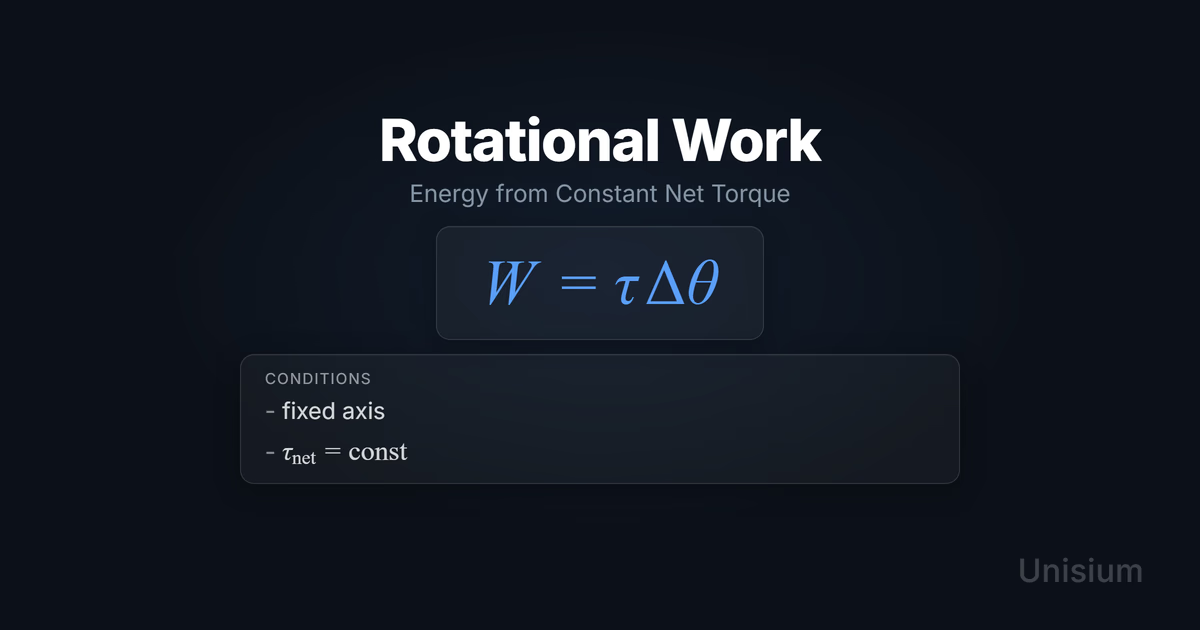
Work in rotation quantifies energy transfer when a constant net torque causes angular displacement about a fixed axis. The equation applies when the net torque remains constant and rotation occurs about a fixed axis.
This principle extends the concept of work from linear motion to rotational motion. Just as force times displacement gives work in translation, torque times angular displacement gives work in rotation. Understanding when and how to apply this relationship is essential for solving energy problems in rotational systems.
On this page: The Principle · Conditions · Misconceptions · EE Questions · Retrieval Practice · Worked Example · Solve a Problem · FAQ
The Principle
Statement
Work done by a constant net torque acting on a rigid body rotating about a fixed axis equals the product of the net torque and the angular displacement. This relationship quantifies energy transfer in rotational motion when the torque magnitude and direction remain constant throughout the displacement.
Mathematical Form
Where:
- = work done by the torque (joules, J)
- = constant net torque acting on the body (newton-meters, N·m)
- = angular displacement (radians, rad)
The diagram shows the constant-torque case geometrically: the net torque acts around the fixed axis while the body sweeps an angular displacement in the same rotational sense. That is the rotational version of “push through distance,” with angle replacing linear displacement.
Alternative Forms
In different contexts, this appears as:
- Integral form (variable torque): when torque varies with position
- Component form: for rotation about the z-axis, emphasizing the axis-specific nature
Conditions of Applicability
Condition: fixed axis; The work-rotation principle as stated requires two conditions: the body must rotate about a fixed axis (the axis does not translate or change orientation), and the net torque acting on the body must remain constant in magnitude and direction throughout the angular displacement.
Practical modeling notes
- Angular displacement must be measured in radians for dimensional consistency
- The torque used is the net torque (sum of all torques about the rotation axis)
- The axis must be fixed in an inertial reference frame
- Sign convention: positive work increases rotational kinetic energy; negative work decreases it
When It Doesn’t Apply
- Variable torque: When torque changes with angular position or time, use the integral form or calculate work in small increments
- Moving axis: When the rotation axis translates or changes orientation (such as a rolling wheel on an incline), you must be explicit about which axis the torque is taken about; often it’s cleaner to compute work from forces and use energy methods
- Non-rigid body: If the body deforms during rotation, the relationship between applied torque and energy transfer becomes more complex due to internal energy dissipation
Want the complete framework behind this guide? Read Masterful Learning.
Common Misconceptions
Misconception 1: Angular displacement can be measured in any angular unit
The truth: Angular displacement must be in radians for the equation to be dimensionally correct. Using degrees or revolutions requires conversion factors.
Why this matters: If you use degrees directly, your calculated work will be off by a factor of , leading to significant quantitative errors in energy analysis.
Misconception 2: Any torque times angular displacement gives work
The truth: Only the net torque (sum of all torques about the axis) determines the work done on the system. Individual torques may do positive or negative work, but only their sum appears in the rotational work equation.
Why this matters: Failing to use net torque leads to incorrect energy accounting. For example, in a rotating disk with friction, you must subtract the friction torque from the applied torque to find the net torque doing work.
Misconception 3: Rotational work is the same as translational work
The truth: While analogous, rotational work and translational work are distinct. They apply to different types of motion and require different state variables (angular vs. linear displacement).
Why this matters: In problems involving both translation and rotation (like rolling objects), you must calculate work contributions from both linear forces and torques separately, then combine them appropriately.
Elaborative Encoding
Use these questions to build deep understanding. (See Elaborative Encoding for the full method.)
Within the Principle
- What does the product represent physically? How is it similar to in translational work?
- Why must be measured in radians rather than degrees or revolutions for dimensional consistency?
For the Principle
- How do you determine whether to use rotational work, translational work, or both in a given problem?
- When torque varies with position, why can’t you simply use average torque in ?
Between Principles
- How does rotational work relate to the change in rotational kinetic energy ?
Generate an Example
- Describe a real-world situation where a non-constant torque does work on a rotating object, making the simple form inapplicable without integration.
Retrieval Practice
Answer from memory, then click to reveal and check. (See Retrieval Practice for the full method.)
State the principle in words: _____Work done by a constant net torque acting on a rigid body rotating about a fixed axis equals the product of the net torque and the angular displacement.
Write the canonical equation: _____
State the canonical condition: _____
Worked Example
Use this worked example to practice Self-Explanation.
Problem
A motor applies a constant torque of 15 N·m to a flywheel initially at rest. The flywheel rotates through 8.0 complete revolutions before reaching its final angular velocity. How much work does the motor do on the flywheel?
Step 1: Verbal Decoding
Target:
Given: ,
Constraints: constant torque, fixed axis, starts from rest
Step 2: Visual Decoding
Draw a side view of the flywheel with the rotation axis through the center. Choose positive rotation in the direction of the applied torque. Mark as the swept angle in that positive sense. (So and .)
Step 3: Physics Modeling
Step 4: Mathematical Procedures
Step 5: Reflection
- Units: N·m times rad gives J (since rad is dimensionless), which is correct for work
- Magnitude: About 750 J for 8 revolutions with 15 N·m torque seems reasonable—comparable to lifting a 75 kg mass by 1 meter
- Limiting case: If the flywheel rotated zero revolutions, , so , which makes sense
Before moving on: self-explain the model
Try explaining Step 3 out loud (or in writing): why the chosen principle applies, what the diagram implies, and how the equation encodes the situation.
Physics model with explanation (what “good” sounds like)
Principle: Rotational work is the appropriate principle because we have a constant torque causing angular displacement about a fixed axis.
Conditions: The axis is fixed (the flywheel doesn’t translate), and the motor applies a constant torque throughout the motion, satisfying both conditions exactly.
Relevance: This principle directly connects the applied torque and the resulting angular displacement to the energy transferred to the flywheel, allowing us to calculate work without needing to know the flywheel’s moment of inertia or final angular velocity.
Description: The motor exerts a steady 15 N·m torque on the flywheel, causing it to rotate through 8 complete revolutions. The equation captures this energy transfer: torque (the rotational “push”) times angular displacement (the rotational “distance”) gives the work done.
Goal: We’re finding the total energy input from the motor. By converting revolutions to radians and multiplying by the constant torque, we obtain the work done, which equals the kinetic energy gained by the flywheel (assuming no friction losses).
Solve a Problem
Apply what you’ve learned with Problem Solving.
Problem
A disk-shaped pottery wheel is slowing down due to a constant friction torque of magnitude 2.4 N·m. The wheel rotates through 5.0 radians before coming to rest. How much work does friction do on the wheel during this process?
Hint: Consider the sign of the work done by friction. Does friction increase or decrease the wheel’s energy?
Show Solution
Step 1: Verbal Decoding
Target:
Given: ,
Constraints: constant friction torque, opposes motion, fixed axis, comes to rest
Step 2: Visual Decoding
Draw a top view of the pottery wheel with the vertical axis through its center. Choose positive rotation in the initial direction of motion; friction torque points opposite. Label in the positive sense. (So while .)
Step 3: Physics Modeling
Step 4: Mathematical Procedures
Step 5: Reflection
- Units: N·m times rad gives J, correct for work
- Magnitude: 12 J removed from rotational kinetic energy seems plausible for a pottery wheel slowing to rest over 5 radians with modest friction
- Limiting case: If , then , meaning no angular displacement implies no work done, which is correct
Related Principles
- Classical Mechanics: The Complete Principle Map — see where this principle fits in the full subdomain.
| Principle | Relationship to Work (Rotation) |
|---|---|
| Torque Definition | Torque is the rotational analog of force; work in rotation extends torque to energy transfer |
| Rotational Kinetic Energy | Work done by net torque equals the change in rotational kinetic energy: |
| Work-Energy Theorem (Translation) | Rotational work is the rotational analog of translational work |
| Work (Constant Force) | Translation analog: force times displacement. |
See Principle Structures for how to organize these relationships visually.
FAQ
What is rotational work?
Rotational work is the energy transferred when a torque causes angular displacement about a fixed axis. For constant torque, it equals the product of torque and angular displacement: .
When does rotational work apply?
Rotational work applies when a rigid body rotates about a fixed axis under the action of torques. The simple form requires constant net torque; variable torques require the integral form .
What’s the difference between rotational work and translational work?
Rotational work involves torque and angular displacement for rotation about an axis, while translational work involves force and linear displacement for motion along a line. They are analogous but apply to different types of motion.
What are the most common mistakes with rotational work?
The most common mistakes are: (1) using angular displacement in degrees instead of radians, (2) using individual torques instead of net torque, and (3) forgetting the sign—friction and other resistive torques do negative work.
How do I know when to use rotational work vs. translational work?
Use rotational work when analyzing energy changes in rotating bodies (wheels, pulleys, turbines). Use translational work for linear motion. For objects that both translate and rotate (like rolling balls), you may need both: translational work from forces and rotational work from torques.
Related Guides
- Principle Structures — Organize this principle in a hierarchical framework
- Self-Explanation — Learn to explain worked examples step by step
- Problem Solving — Apply principles systematically to new problems
- Retrieval Practice — Make this principle instantly accessible
How This Fits in Unisium
Unisium helps you master rotational work through elaborative encoding questions that build deep conceptual understanding, retrieval practice that makes the principle instantly accessible during problem solving, self-explanation exercises that teach you to articulate the physics model, and systematic problem-solving practice that develops fluency with the Five-Step Strategy.
Ready to master rotational work? Check access and join the Unisium waitlist or explore the full learning framework in Masterful Learning.
Masterful Learning
The book behind these guides: a study system for physics, math, & programming built on retrieval, connection, explanation, and problem solving.
Ready to apply this strategy?
Unisium turns these evidence-based techniques into guided study sessions for math and physics. Places are limited during early access. Check current availability to start a trial; joining the mailing list is optional.
See plans and availability Read More GuidesAlready have access? Sign in