Translational Kinetic Energy Formula: When 1/2mv^2 Applies
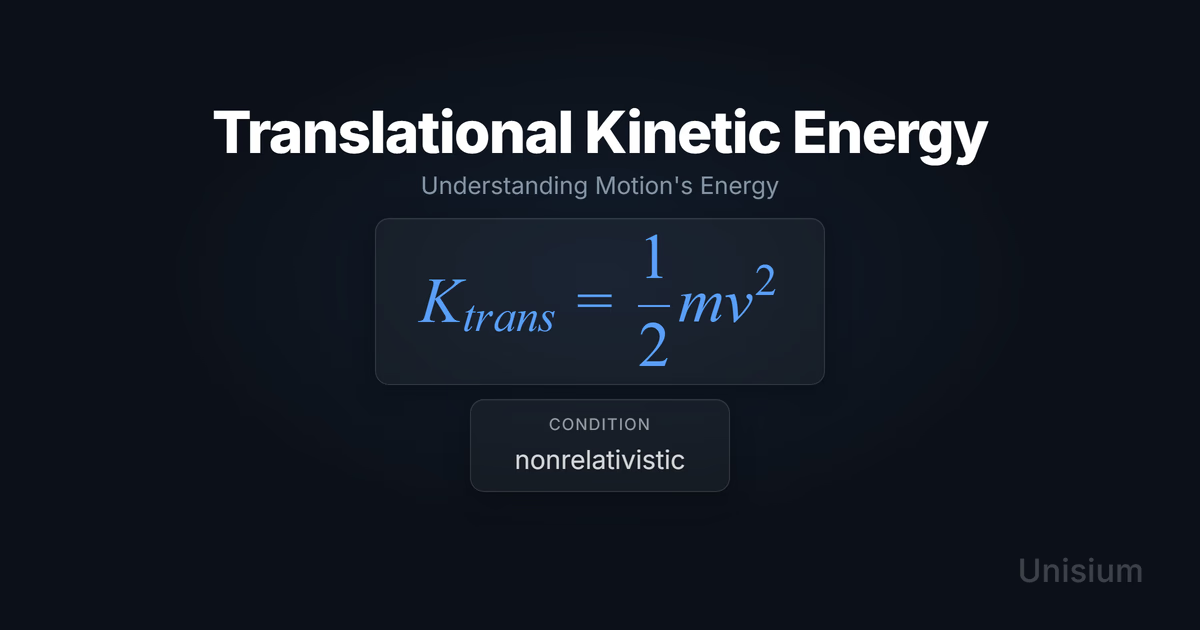
Translational kinetic energy is the energy an object has because its center of mass moves relative to a chosen reference frame. In nonrelativistic classical mechanics, the formula is , where is mass and is speed in that frame. For an extended or spinning object, this is only the center-of-mass translational part; add rotational kinetic energy separately when total kinetic energy matters.
This guide helps you make part of your mechanics toolkit: what the formula means, why speed is squared, when the Newtonian form is valid, and how it appears in work-energy, conservation, momentum, and collision problems. Translational kinetic energy tracks center-of-mass motion in a chosen reference frame. If the object is also spinning, translational kinetic energy tracks the motion through space; rotational kinetic energy tracks the spin.
On this page: The Principle · Conditions · Misconceptions · EE Questions · Retrieval Practice · Worked Example · Solve a Problem · FAQ
The Principle
Statement
Translational kinetic energy is the energy associated with the motion of an object’s center of mass through space. It depends on both the object’s mass and the square of its speed.
Mathematical Form
Where:
- = translational kinetic energy (joules, J)
- = mass of the object (kilograms, kg)
- = speed of the object relative to the reference frame (meters per second, m/s)
Alternative Forms
In different contexts, this appears as:
- Using momentum: where
- Vector form:
Conditions of Applicability
Condition: nonrelativistic The Newtonian formula applies for nonrelativistic motion in a chosen reference frame. The concept of translational kinetic energy is broader, but this specific formula breaks down at speeds approaching the speed of light (), where relativistic kinetic energy is needed.
Practical modeling notes
- The speed is always measured relative to a specific reference frame. Different frames give different kinetic energies.
- This form assumes the object can be treated as a particle (or you’re calculating the kinetic energy of the center of mass).
- This is the translational part of kinetic energy. Total kinetic energy may include rotational or internal contributions:
- The Newtonian definition breaks down at relativistic speeds (approaching ). Use relativistic kinetic energy:
Want the complete framework behind this guide? Read Masterful Learning.
Common Misconceptions
Misconception 1: “Kinetic energy depends on velocity, so it can be negative”
The truth: Kinetic energy is always positive or zero. It depends on (speed squared), not velocity. Squaring eliminates direction and sign.
Why this matters: Students sometimes try to plug in negative velocity values and get negative kinetic energy, leading to nonsensical results in energy conservation problems.
Misconception 2: “If I double the speed, I double the kinetic energy”
The truth: Kinetic energy scales with . Doubling the speed quadruples the kinetic energy.
Why this matters: This quadratic relationship explains why high-speed collisions are so much more damaging than low-speed ones, and why braking distance increases dramatically with speed.
Misconception 3: “Kinetic energy is the same in all reference frames”
The truth: Kinetic energy depends on the choice of reference frame. An object at rest in one frame has zero kinetic energy there but non-zero kinetic energy in a frame moving relative to it.
Why this matters: In collision problems, choosing the right reference frame (like the center-of-mass frame) can simplify calculations dramatically.
Elaborative Encoding
Use these questions to build deep understanding. (See Elaborative Encoding for the full method.)
Within the Principle
- Why does kinetic energy scale with instead of ? What does this tell you about the work needed to accelerate an object?
- What are the units of each term in ? How do they combine to give joules?
For the Principle
- How do you decide which reference frame to use when calculating kinetic energy in a collision problem?
- When an object’s speed doubles, what happens to its kinetic energy? What does this imply for braking distances?
Between Principles
- How does translational kinetic energy relate to the work-energy theorem? When does a change in kinetic energy equal the net work done?
Generate an Example
- Describe a situation where an object has high kinetic energy in one reference frame but zero kinetic energy in another.
Retrieval Practice
Answer from memory, then click to reveal and check. (See Retrieval Practice for the full method.)
State the principle for translational kinetic energy in words: _____Translational kinetic energy is the energy an object possesses due to its motion, equal to one-half its mass times its speed squared.
Write the canonical equation for translational kinetic energy: _____
State the canonical condition: _____nonrelativistic
Worked Example
Use this worked example to practice Self-Explanation.
Problem
A 1200 kg car accelerates from rest to 25 m/s. What is the change in its kinetic energy?
Step 1: Verbal Decoding
Target:
Given: , ,
Constraints: Translational motion; treat car as particle; starts from rest
Step 2: Visual Decoding
Draw two snapshots of the car on the same 1D road axis: one at rest with , and one moving in the direction with speed . Label speed magnitudes, not signed velocity components, because kinetic energy uses .
Step 3: Physics Modeling
Step 4: Mathematical Procedures
Step 5: Reflection
- Units: kg · (m/s)² = kg·m²/s² = J ✓
- Magnitude: 375 kJ is reasonable for accelerating a car to highway speed
- Limiting case: If (car doesn’t move), then ✓
Before moving on: self-explain the model
Try explaining Step 3 out loud (or in writing): why we use the kinetic energy formula for both initial and final states, why the initial kinetic energy is zero, and why the change is the difference.
Physics model with explanation (what “good” sounds like)
Principle: We use the definition of translational kinetic energy for both the initial and final states.
Conditions: The car is treated as a particle moving translationally (we ignore rotation of the wheels and internal motion).
Relevance: Since we want the change in kinetic energy, we need to calculate it at both endpoints of the motion.
Description: Initially, the car is at rest (), so . After acceleration, it moves at m/s. The change in kinetic energy equals the difference between final and initial values.
Goal: This change in kinetic energy equals the net work done on the car by all forces (by the work-energy theorem), which could help us determine the average force or power required.
Solve a Problem
Apply what you’ve learned with Problem Solving.
Problem
A 0.50 kg basketball is thrown upward with an initial speed of 8.0 m/s. What is its kinetic energy when its speed has decreased to 3.0 m/s?
Hint (if needed): Use the kinetic energy formula directly with the given speed. You don’t need to track position or time.
Show Solution
Step 1: Verbal Decoding
Target:
Given: ,
Constraints: Translational motion; treat basketball as particle; upward trajectory
Step 2: Visual Decoding
Draw the basketball at the instant of interest, moving upward on a vertical axis. Label the mass and the speed magnitude ; the sign of vertical velocity is not needed because depends on speed squared.
Step 3: Physics Modeling
Step 4: Mathematical Procedures
Step 5: Reflection
- Units: kg · (m/s)² = J ✓
- Magnitude: A few joules is reasonable for a basketball moving at moderate speed
- Limiting case: If (ball at peak of trajectory), then ✓
Related Principles
- Classical Mechanics: The Complete Principle Map — see where this principle fits in the full subdomain.
| Principle | Relationship to Translational Kinetic Energy |
|---|---|
| Work-Energy Theorem | Relates the change in kinetic energy to the net work done on an object |
| Conservation of Mechanical Energy | Kinetic energy plus potential energy remains constant when only conservative forces act |
| Impulse–Momentum Theorem | Connects change in momentum to forces; kinetic energy relates to momentum via |
| Rotational Kinetic Energy | Rotational analog: moment of inertia replaces mass, angular speed replaces speed. |
See Principle Structures for how to organize these relationships visually.
FAQ
What is translational kinetic energy?
Translational kinetic energy is the energy an object possesses due to its motion through space. It equals , where is mass and is speed.
When does translational kinetic energy apply?
Translational kinetic energy as a concept applies whenever an object has motion through space relative to a reference frame. The Newtonian formula applies for nonrelativistic center-of-mass motion. For an extended or spinning object, is only the translational part of total kinetic energy.
What’s the difference between translational and rotational kinetic energy?
Translational kinetic energy is associated with motion of the center of mass through space. Rotational kinetic energy is associated with spinning motion about an axis. A rolling wheel has both.
What are the most common mistakes with kinetic energy?
The most common mistakes are: (1) thinking kinetic energy can be negative (it depends on , always positive), (2) forgetting that doubling speed quadruples kinetic energy, and (3) ignoring reference frame dependence.
How do I know which form of kinetic energy to use?
Use when you know mass and speed for nonrelativistic center-of-mass translation. Use when you know momentum for the same Newtonian case. For rotating objects, add when total kinetic energy matters.
Related Guides
- Principle Structures — Organize kinetic energy in a hierarchical framework with work and energy principles
- Self-Explanation — Learn to explain worked examples step by step
- Retrieval Practice — Make the kinetic energy formula instantly accessible
- Problem Solving — Apply energy principles systematically to new problems
How This Fits in Unisium
Unisium helps you practice the decisions that make translational kinetic energy useful: choosing the reference frame, separating translation from rotation, remembering why the speed is squared, and connecting to work-energy, conservation, momentum, and collision problems.
Ready to master translational kinetic energy? Check access and join the Unisium waitlist or explore the full learning framework in Masterful Learning.
Masterful Learning
The book behind these guides: a study system for physics, math, & programming built on retrieval, connection, explanation, and problem solving.
Ready to apply this strategy?
Unisium turns these evidence-based techniques into guided study sessions for math and physics. Places are limited during early access. Check current availability to start a trial; joining the mailing list is optional.
See plans and availability Read More GuidesAlready have access? Sign in