Newton's Third Law: Identify Action–Reaction Pairs
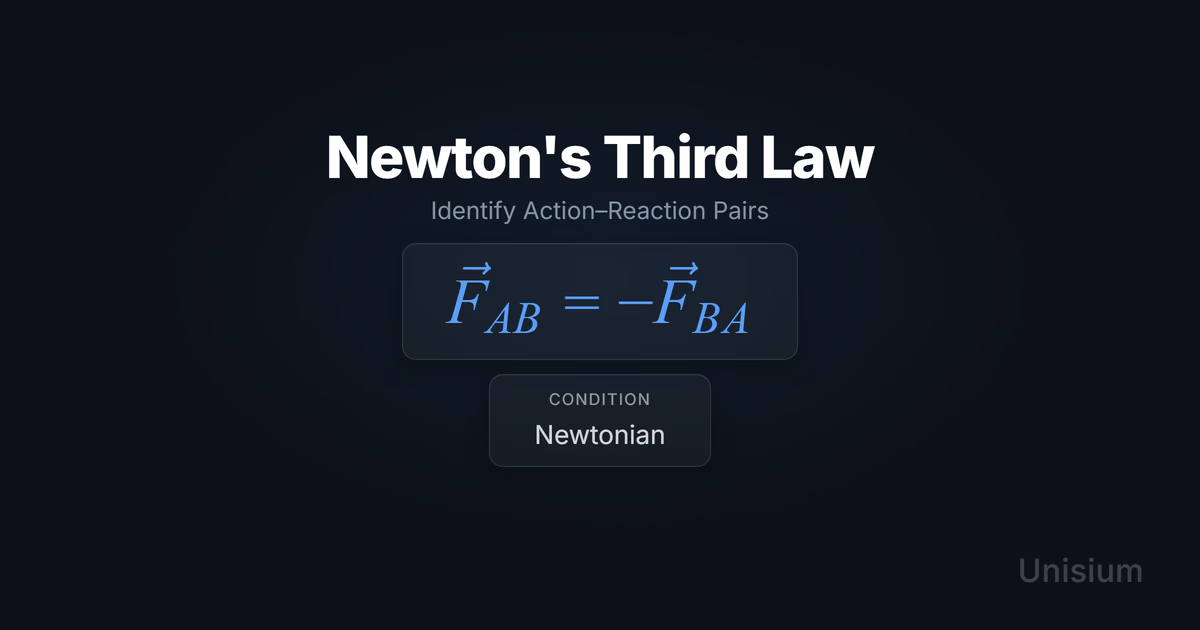
Newton’s Third Law (the Action-Reaction Principle) states that forces always exist in pairs: if object A exerts a force on object B, then object B simultaneously exerts an equal and opposite force back on object A. These forces never act on the same object, meaning they cannot “cancel out” to prevent motion. The key skill is mastering the “swap check”: identifying that every “A on B” force comes with a matching “B on A” partner, equal in magnitude and opposite in direction.
On this page: The Principle · Conditions · Misconceptions · EE Questions · Retrieval Practice · Worked Example · Solve a Problem · FAQ
The Principle
Statement
Whenever one object exerts a force on a second object, the second object simultaneously exerts a force of equal magnitude and opposite direction on the first object. In common phrasing, “for every action, there is an equal and opposite reaction.” Think interaction pair, not “action then reaction”—the two forces are two sides of the same single interaction.
Mathematical Form
Where:
- = force exerted by object A on object B (Newtons, )
- = force exerted by object B on object A (Newtons, )
- The negative sign indicates the vectors point in opposite directions.
Alternative Forms
In different contexts, this appears as:
- Scalar Magnitude:
- Component Form:
The contact diagram separates the interaction pair from the two free-body diagrams. The force on A belongs in A’s free-body diagram; the force on B belongs in B’s free-body diagram. The arrows have the same length because the force magnitudes are equal, even if the objects have different sizes.
The gravity diagram shows the same ownership rule without contact. Each body gets the gravitational force acting on it in its own free-body diagram; the equal-and-opposite partner belongs in the other body’s diagram.
Conditions of Applicability
Condition: Newtonian
Practical modeling notes (optional)
- Pair test: If one force is “A on B”, the matching force must be “B on A” and of the same interaction type (e.g., both are gravitational).
- Simultaneity: In introductory mechanics, we treat the pair as simultaneous. The forces appear and disappear at exactly the same time.
- Single Interaction: Both forces are part of the same physical interaction (e.g., both are gravitational, or both are contact forces).
- Different Objects: The most critical rule for modeling is that the interaction forces act on two different objects. They never act on the same object. This is why internal forces don’t change system momentum → Conservation of Linear Momentum.
Want the complete framework behind this guide? Read Masterful Learning.
Common Misconceptions
Misconception 1: “Action-Reaction forces cancel out”
The truth: Because action and reaction forces act on different objects, they never appear in the same free-body diagram and therefore cannot cancel each other out.
Why this matters: They don’t cancel on a single object because they act on different objects. Acceleration happens because the net force on a single object is non-zero.
Misconception 2: “The reaction force happens slightly after the action”
The truth: In introductory mechanics we treat the interaction pair as simultaneous—neither force happens after the other.
Why this matters: Students often look for a “response” from an object, but the force is present the instant the contact or field interaction begins.
Misconception 3: “A stronger or faster object exerts more force”
The truth: When a massive truck hits a small bug, the truck exerts exactly the same amount of force on the bug as the bug exerts on the truck. Same force, different acceleration → Newton’s Second Law.
Why this matters: The effect (acceleration) is different because of Newton’s Second Law (), but the forces are identical in magnitude.
Elaborative Encoding
Use these questions to build deep understanding. (See Elaborative Encoding for the full method.)
Within the Principle
- What is the physical meaning of the negative sign in ?
- If the magnitude of is , what must be the magnitude of ?
For the Principle
- If you are drawing a free-body diagram for a single block, should you include both forces of an action-reaction pair? Why or why not?
- How can you verify if two forces are a “pair”? (Hint: Swap the “giver” and “receiver” labels).
Between Principles
- How does Newton’s Third Law explain why a propeller can push a plane forward through the air? (Contrast with Newton’s Second Law).
Generate an Example
- Describe a situation involving a magnet and a piece of iron where the forces are equal and opposite, even though the iron moves much more than the magnet.
Retrieval Practice
Answer from memory, then click to reveal and check. (See Retrieval Practice for the full method.)
State the principle in words: _____If object A exerts a force on object B, then object B exerts a force of equal magnitude and opposite direction on object A.
Write the canonical equation: _____
State the canonical condition: _____Newtonian
Worked Example
Use this worked example to practice Self-Explanation.
Problem
A ice skater pushes off a crate on frictionless ice. If the skater exerts a constant horizontal force of on the crate, what is the magnitude of the skater’s acceleration?
Step 1: Verbal Decoding
Target:
Given:
Constraints: frictionless, horizontal, simultaneous interaction
Step 2: Visual Decoding
Try drawing the skater and the crate. Draw a 1D axis. Choose to the right (the direction the skater pushes the crate). Label the force on the crate along and the force on the skater along .
(So is positive and is negative.)
Step 3: Physics Modeling
Step 4: Mathematical Procedures
Step 5: Reflection
- Units: , which matches acceleration.
- Magnitude: is a reasonable acceleration for a skater.
- Limiting case: If the skater’s mass were much larger, the acceleration would approach zero for the same push.
Before moving on: self-explain the model
Try explaining Step 3 out loud (or in writing): why the chosen principle applies, what the diagram implies, and how the equations encode the situation.
Physics model with explanation (what “good” sounds like)
Principle: Newton’s Third Law and Newton’s Second Law.
Conditions: The interaction is being modeled in the Newtonian mechanics regime, so Newton’s Third Law applies. The net-force step then applies Newton’s Second Law to the horizontal forces on the skater.
Relevance: To find the skater’s acceleration, we need the force acting on the skater. The problem only gives the force the skater exerts on the crate. The Third Law provides the bridge to find the reciprocal force.
Description: The skater and crate interact. By the Third Law, the crate pushes back on the skater with in the opposite direction.
Goal: We find the reaction force magnitude, then use the Second Law to calculate the resulting acceleration of the skater’s mass.
Solve a Problem
Apply what you’ve learned with Problem Solving.
Problem
A apple is falling toward Earth. The Earth exerts a gravitational force of on the apple. What is the magnitude of the force that the apple exerts on the Earth?
Hint (if needed): Remember that Newton’s Third Law applies to all interactions, including those involving gravity and massive planets.
Show Solution
Step 1: Verbal Decoding
Target: (force of apple on Earth)
Given: (force of Earth on apple)
Constraints: gravitational interaction, falling
Step 2: Visual Decoding
Try drawing the Earth and the apple. Choose as upward. Label the force on the apple pointing down (negative) and the force on the Earth pointing up (positive).
(So is negative and is positive.)
Step 3: Physics Modeling
Step 4: Mathematical Procedures
Step 5: Reflection
- Units: Force is correctly given in Newtons ().
- Magnitude: The force is identical to the weight of the apple, as required by the law.
- Limiting case: The Earth’s acceleration resulting from this force is effectively zero due to its massive mass, but the force itself is not zero.
Related Principles
- Classical Mechanics: The Complete Principle Map — see where this principle fits in the full subdomain.
| Principle | Relationship to Newton’s Third Law |
|---|---|
| Newton’s First Law | To kill the “they cancel so nothing moves” misconception. |
| Newton’s Second Law | Connects the forces found via the Third Law to the acceleration of individual objects. |
| Impulse-Momentum Theorem | Collision forces are big but short; use impulse reasoning. |
| Conservation of Momentum | The Third Law ensures that internal impulses cancel within a system. |
See Principle Structures for how to organize these relationships visually.
Next Step in Mechanics Core
- Next: Impulse–Momentum Theorem — force over time → momentum change
FAQ
What is Newton’s Third Law?
Newton’s Third Law states that forces always exist in pairs. If object A exerts a force on object B, object B must exert a force of equal magnitude and opposite direction back on object A.
When does Newton’s Third Law apply?
It applies to every interaction in classical mechanics, without exception. Whether objects are touching (contact forces) or separated by a distance (field forces like gravity), the symmetry holds.
Why don’t action and reaction forces cancel out?
They don’t cancel because they act on different objects. To cancel out, two forces would need to act on the same object in opposite directions, resulting in a net force of zero for that object.
Is the Third Law true for gravity?
Yes. The Earth pulls on you with a force equal to your weight, and you simultaneously pull on the Earth with a force exactly equal to your weight.
How do I identify a Third Law pair?
A simple test is to identify the two objects involved. If Force 1 is “Object A on Object B,” then its pair must be “Object B on Object A.” If the objects are not swapped, it is not a Third Law pair.
Related Guides
- Principle Structures — Organize this principle in a hierarchical framework
- Self-Explanation — Learn to explain worked examples step by step
- Retrieval Practice — Make this principle instantly accessible
- Problem Solving — Apply principles systematically to new problems
How This Fits in Unisium
Mastering Newton’s Third Law requires more than just memorizing the “equal and opposite” phrase; it requires the ability to correctly identify interacting systems. The Unisium Study System helps you internalize this through elaborative encoding and retrieval practice, ensuring you never mistakenly cancel out interaction forces in your free-body diagrams.
Ready to master Newton’s Third Law? Check access and join the Unisium waitlist or explore the full learning framework in Masterful Learning.
Masterful Learning
The book behind these guides: a study system for physics, math, & programming built on retrieval, connection, explanation, and problem solving.
Ready to apply this strategy?
Unisium turns these evidence-based techniques into guided study sessions for math and physics. Places are limited during early access. Check current availability to start a trial; joining the mailing list is optional.
See plans and availability Read More GuidesAlready have access? Sign in