Acceleration - Derivative Definition: Instantaneous Rate of Change
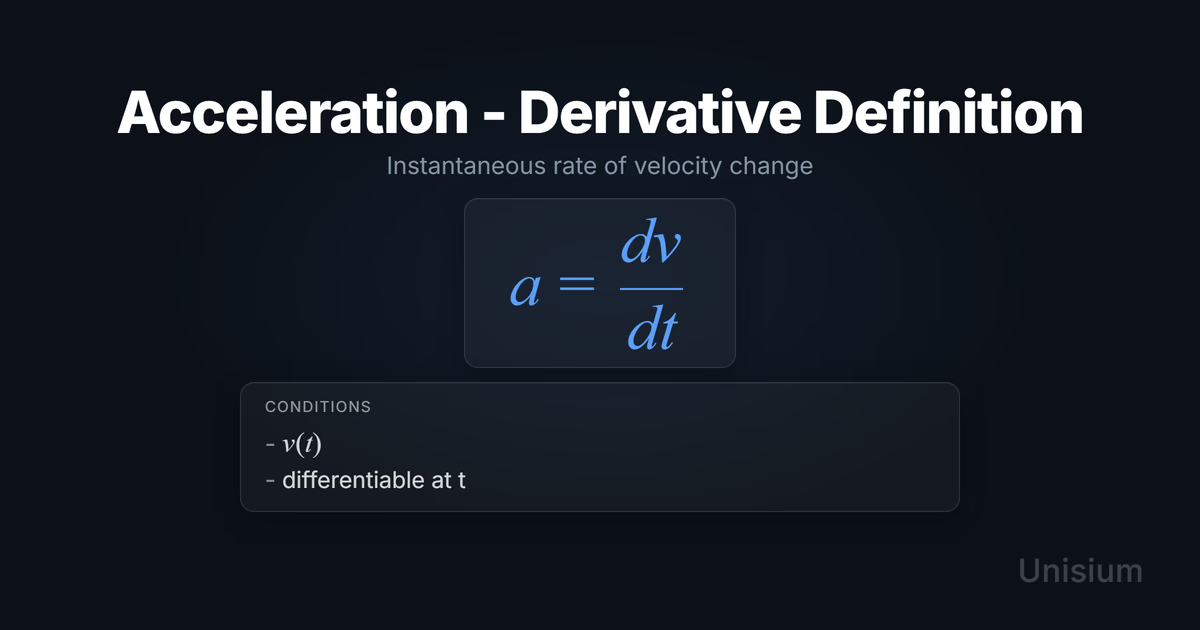
Acceleration - Derivative Definition states that instantaneous acceleration is the derivative of velocity with respect to time: , so you can compute acceleration at an instant without averaging over a time interval. It applies when the velocity function is differentiable at the time of interest.
This definition is fundamental in kinematics because it provides the precise mathematical tool for finding acceleration at any instant when velocity varies with time. Unlike average acceleration (which requires two time points), the derivative gives you the instantaneous rate of change, enabling analysis of motion with continuously varying velocity.
On this page: The Principle | Conditions | Misconceptions | EE Questions | Retrieval Practice | Worked Example | Solve a Problem | FAQ
The Principle
Statement
Acceleration is the instantaneous rate of change of velocity with respect to time. When velocity is expressed as a function of time , acceleration at any instant is found by taking the derivative of that function.
Mathematical Form
Where:
- = instantaneous acceleration ( in SI units)
- = velocity as a function of time (m/s)
- = time (s)
- = the derivative operator, giving the instantaneous rate of change
Alternative Forms
In different contexts, this appears as:
- Vector form: for motion in two or three dimensions
- Second derivative form: by combining with
Conditions of Applicability
Condition: ; differentiable at t
This means velocity must be expressed as a function of time, and that function must be differentiable at the time of interest.
Practical modeling notes
- To compute at a specific instant, must be differentiable at that point. At sharp corners or discontinuities, acceleration is undefined or infinite.
- If you only have discrete velocity measurements at specific times, you cannot use this definition directly—you would need to fit a function or use numerical differentiation.
- For motion data given as (position vs. time), you must first find before applying this principle.
When It Doesn’t Apply
- Discrete data points: If you only have velocities at and , use average acceleration instead.
- Non-differentiable velocity: At instantaneous collisions or impacts where velocity jumps discontinuously, this definition breaks down. Use impulse-momentum instead.
- Unknown velocity function: If you don’t have an explicit function, you cannot differentiate. You’ll need to use other kinematic relations or Newton’s laws to find acceleration.
Want the complete framework behind this guide? Read Masterful Learning.
Common Misconceptions
Misconception 1: “Zero velocity means zero acceleration”
The truth: Acceleration measures how velocity changes, not the velocity itself. An object can have at an instant while still having non-zero if velocity is changing through zero.
Why this matters: At the peak of a thrown ball’s trajectory, but . Confusing these leads to incorrect predictions about motion direction changes.
Misconception 2: “The derivative always makes things smaller”
The truth: The derivative can be larger than, smaller than, or equal to in magnitude. It measures the rate of change, which has different units ( vs. m/s).
Why this matters: Students sometimes expect acceleration to be numerically less than velocity. This can lead to incorrect magnitude checks when solving problems.
Misconception 3: “You can always find acceleration by plugging in a time”
The truth: You can only evaluate at time if the velocity function is differentiable at that point. At discontinuities, cusps, or corners, the derivative doesn’t exist.
Why this matters: Real motion sometimes has discontinuous velocity (collisions, cable snapping). Recognizing when calculus-based definitions fail prevents invalid calculations and points you toward impulse-based methods.
Elaborative Encoding
Use these questions to build deep understanding. (See Elaborative Encoding for the full method.)
Within the Principle
- What does the derivative operator tell you about how acceleration relates to velocity? What does it mean that we’re taking the limit as ?
- Why does acceleration have units of m/s² when velocity has units of m/s? How does the derivative operator change the dimensions?
For the Principle
- How would you decide whether to use the derivative definition versus the average acceleration formula when analyzing a motion problem?
- If you’re given position as a function of time , what steps do you need to take before you can apply this principle? In what order do the operations occur?
Between Principles
- How does the acceleration derivative definition relate to the velocity derivative definition ? What happens when you combine them by substitution?
Generate an Example
- Describe a realistic motion scenario where velocity is a known function of time and you would use this definition to find acceleration. What would the velocity function look like?
Retrieval Practice
Answer from memory, then click to reveal and check. (See Retrieval Practice for the full method.)
State the principle in words: _____Acceleration is the instantaneous rate of change of velocity with respect to time.
Write the canonical equation: _____
State the canonical condition: _____
Worked Example
Use this worked example to practice Self-Explanation.
Problem
A rocket’s velocity is given by (in m/s, where is in seconds). Find the rocket’s acceleration at s.
Step 1: Verbal Decoding
Target:
Given: ,
Constraints: Velocity is a polynomial function of time, differentiable everywhere
Step 2: Visual Decoding
Draw a 2D plot with on the horizontal axis (positive to the right) and on the vertical axis (positive up). Mark s and sketch the tangent line to the curve at that point; the slope of the tangent is . (At this time, is positive.)
Step 3: Physics Modeling
Step 4: Mathematical Procedures
Step 5: Reflection
- Units: Differentiating m/s with respect to s gives , which is correct for acceleration.
- Magnitude: is large (about 11g) but plausible for a rocket during rapid acceleration.
- Limiting case: At , , so acceleration starts negative and increases linearly with time.
Before moving on: self-explain the model
Try explaining Step 3 out loud (or in writing): why the derivative definition applies, what the graph of reveals about acceleration, and how the power rule produces the acceleration function.
Physics model with explanation (what “good” sounds like)
Principle: We use the acceleration derivative definition because we have velocity as an explicit function of time.
Conditions: The velocity function is a polynomial, which is differentiable everywhere. The condition “v(t); differentiable at t” is satisfied.
Relevance: This is the right tool because we want instantaneous acceleration at a specific moment ( s), not an average over an interval. The derivative gives the exact rate of change at that instant.
Description: The velocity is a quadratic function of time, opening upward. This means velocity starts with a relatively small value, then increases at an accelerating rate. The acceleration is itself a linear function of time: it starts negative and increases as increases, eventually becoming positive and growing large.
Goal: We’re finding the instantaneous acceleration at s. By differentiating the velocity function using the power rule, we get an acceleration function , then evaluate it at the specific time to get .
Solve a Problem
Apply what you’ve learned with Problem Solving.
Problem
A particle moves along a straight line with velocity (in m/s, where is in seconds). Find the particle’s acceleration at s.
Hint: Remember the chain rule when differentiating .
Show Solution
Step 1: Verbal Decoding
Target:
Given: ,
Constraints: Velocity is a trigonometric function of time, differentiable everywhere
Step 2: Visual Decoding
Draw a 2D plot with on the horizontal axis (positive to the right) and on the vertical axis (positive up). Mark s and sketch the tangent line to the oscillating curve at that point; the slope of the tangent is . (At this time, is positive and decreasing.)
Step 3: Physics Modeling
Step 4: Mathematical Procedures
Step 5: Reflection
- Units: Differentiating m/s with respect to s gives , which is correct for acceleration.
- Magnitude: About is comparable to Earth’s gravitational acceleration, reasonable for oscillatory motion.
- Limiting case: At , because is at a maximum, where the rate of change is momentarily zero.
Related Principles
- Classical Mechanics: The Complete Principle Map — see where this principle fits in the full subdomain.
| Principle | Relationship to Acceleration - Derivative Definition |
|---|---|
| Velocity - Derivative Definition | The velocity definition is the direct predecessor; combining them gives |
| Average Acceleration | Average acceleration is the discrete version; the derivative is the limit as |
| Newton’s Second Law | Once you find from , you can use to relate acceleration to forces |
See Principle Structures for how to organize these relationships visually.
FAQ
What is the acceleration derivative definition?
The acceleration derivative definition states that acceleration is the instantaneous rate of change of velocity with respect to time: . It applies when velocity is given as a differentiable function of time.
When does the derivative definition of acceleration apply?
It applies when you have velocity expressed as a function of time and that function is differentiable at the point where you want to find acceleration. You cannot use it for discrete data points or at discontinuities in velocity.
What’s the difference between and average acceleration ?
The derivative definition gives instantaneous acceleration at a specific moment by taking the limit as the time interval approaches zero. Average acceleration is the change in velocity divided by a finite time interval. The derivative is what average acceleration approaches as the interval shrinks.
What are the most common mistakes with the acceleration derivative definition?
The most common mistakes are: (1) thinking zero velocity means zero acceleration (velocity and its rate of change are independent), (2) trying to apply the derivative to discrete velocity measurements instead of a continuous function, and (3) forgetting the chain rule when velocity depends on a function of time, like .
How do I know whether to use or ?
Use when you’re given velocity as a function of time. Use when you’re given position as a function of time (and need to differentiate twice). They’re equivalent by the chain of definitions: , so .
Related Guides
- Principle Structures — Organize this principle in a hierarchical framework
- Self-Explanation — Learn to explain worked examples step by step
- Retrieval Practice — Make this principle instantly accessible
- Problem Solving — Apply principles systematically to new problems
How This Fits in Unisium
Unisium helps students master fundamental definitions like the derivative definition of acceleration through structured practice combining elaborative encoding (building mental models of what the derivative means physically), retrieval practice (recalling the definition and condition without looking), self-explanation (articulating why the definition applies in worked examples), and problem solving (applying the derivative to new velocity functions). This integrated approach transforms the mechanical act of differentiation into deep conceptual understanding of how acceleration emerges from changing velocity.
Ready to master the acceleration derivative definition? Check access and join the Unisium waitlist or explore the full learning framework in Masterful Learning.
Masterful Learning
The book behind these guides: a study system for physics, math, & programming built on retrieval, connection, explanation, and problem solving.
Ready to apply this strategy?
Unisium turns these evidence-based techniques into guided study sessions for math and physics. Places are limited during early access. Check current availability to start a trial; joining the mailing list is optional.
See plans and availability Read More GuidesAlready have access? Sign in