Momentum Anki Deck (Physics)
Download the deck
Get new deck drops (and deck updates)
One email per new deck release. No spam.
Use this deck to build fast, reliable recall of Momentum concepts so you can model collisions and systems without guessing at the conservation rules.
What this deck is for
This deck is for recall training: quick retrieval of the key definitions (momentum, impulse, center of mass), what the symbols mean, and the exact conditions that make conservation laws valid.
Use it when you want mechanics problems to feel less like “formula roulette” and more like pattern recognition: you identify an isolated system, recall the conservation law, and spend your effort on the setup.
This deck does not replace solving problems. It’s the recall layer that makes problem practice pay off.
Coverage
Core ideas
- Linear momentum as a vector quantity
- Impulse as the product of force and time (and change in momentum)
- Conservation of Momentum (and when it applies)
- Center of mass definitions for position and velocity
- System boundaries and external forces
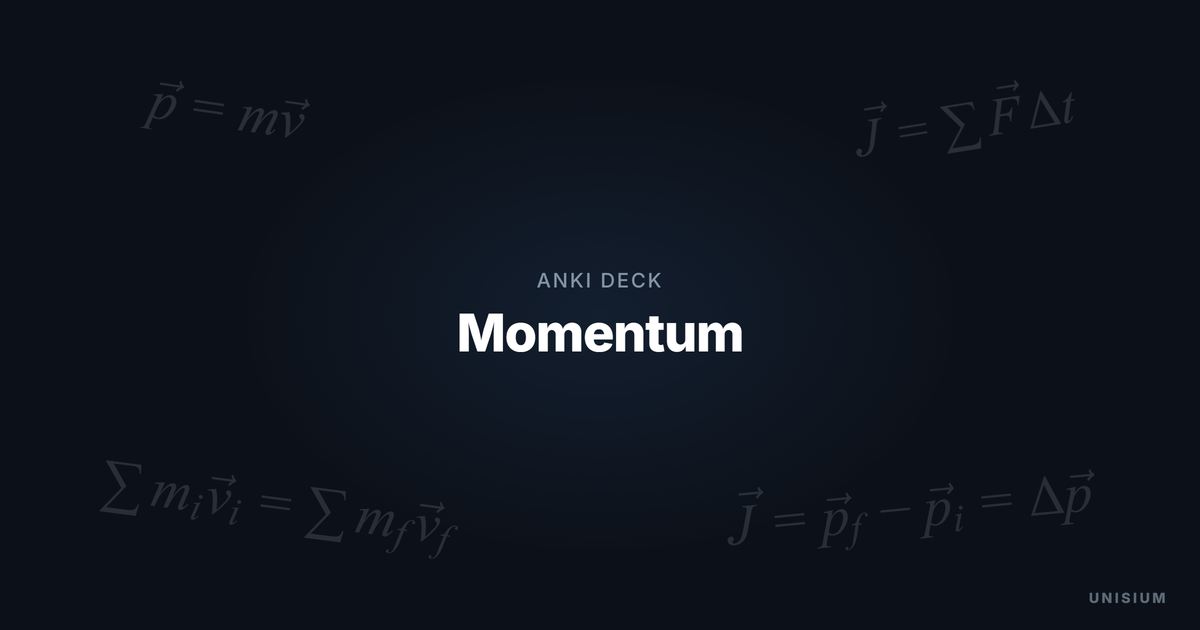
Equations in this deck
Definitions & Theorem:
Conservation & Center of Mass:
Common traps in Momentum
Before you drill cards, know the classic failure modes:
- Confusing Momentum with Energy: Momentum () is a vector; Energy () is a scalar. They are conserved under different conditions—don’t swap them.
- Forgetting signs in 1D: If a ball hits a wall at and bounces back at , the change is , not . Direction matters.
- Applying conservation when external forces act: Momentum is only conserved if net external force is zero. Gravity breaks conservation vertically for a falling ball, even if it’s conserved horizontally.
- Mixing up Elastic vs. Inelastic: In “Elastic” collisions, is conserved. In “Inelastic” collisions, is lost. Momentum is conserved in both (if the system is isolated). (Use the sticky note: “Momentum is robust; Kinetic Energy is fragile.”)
What this deck does not do
- It does not teach full mechanics problem solving by itself.
- It does not cover Rotation or Angular Momentum. If you want that next, move to setups and reasoning practice.
How to use it (so it works)
- Download the deck and import into Anki (Desktop → File → Import).
- Do short daily sessions. Ten minutes beats one long weekly grind.
- Always attempt before reveal. Recognition is not recall.
- When you miss a card, write a one-line rule (condition → action): “External force exists, so momentum is NOT conserved.”
- Pair recall with real setup practice: Problem-Solving Strategies.
If you want the full physics+math Anki workflow (card types, settings, traps), use: How to Study Physics & Math with Anki
Where this fits in a typical mechanics sequence
- Previous: Work & Energy Anki Deck
- Next up: Rotational Kinematics Anki Deck
If you’re using Unisium
Anki is strong at recall. Unisium is built to train the full loop: retrieval practice, elaboration, self-explanation, and problem solving — with structure and progression.
Related guides
Want more than recall?
Use Unisium to practice retrieval, self-explanation, and problem solving with guided sessions.
See plans and availability Read More Guides