Mechanical Energy with Non-Conservative Work: Tracking Energy Transfers
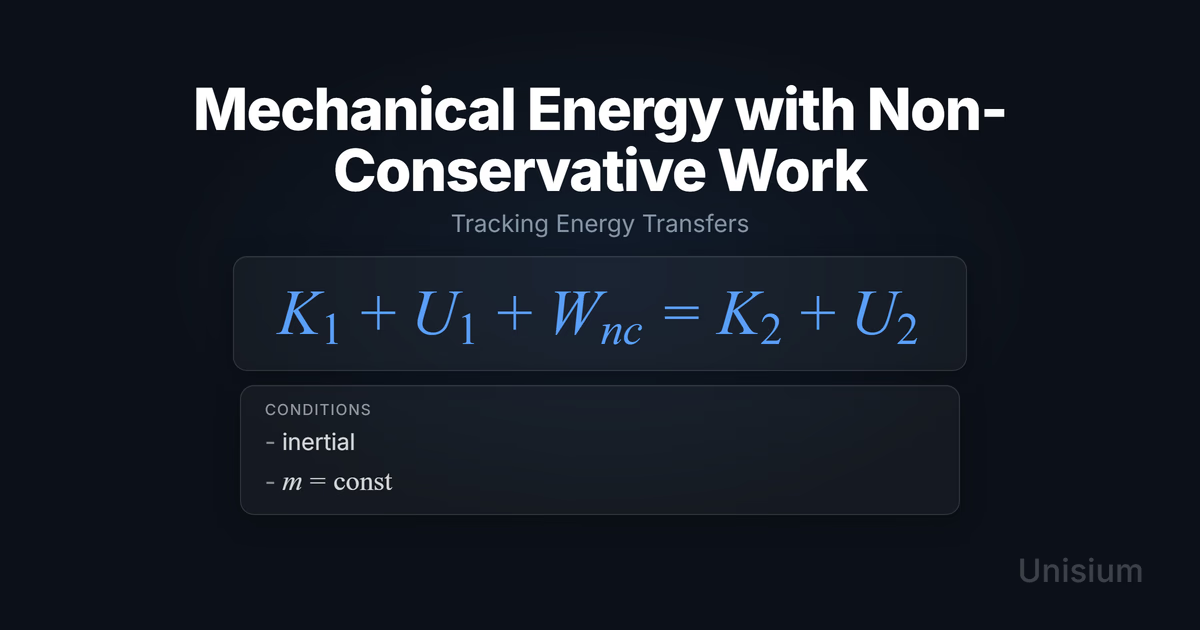
Mechanical Energy with Non-Conservative Work states that the total mechanical energy (kinetic plus potential) of a system changes by the amount of work done by non-conservative forces. It applies in non-relativistic mechanics in an inertial frame when forces like friction, drag, or applied pushes transfer energy into or out of the mechanical energy pool.
This principle extends the conservation of mechanical energy to real-world situations where friction, air resistance, or external forces act. Instead of mechanical energy staying constant, it changes by exactly the work done by non-conservative forces—allowing you to track energy transfers between mechanical forms (kinetic and potential) and other forms like thermal energy or energy added by external work.
On this page: The Principle · Conditions · Misconceptions · EE Questions · Retrieval Practice · Worked Example · Solve a Problem · FAQ
The Principle
Statement
The total mechanical energy of a system at state 1 (kinetic energy plus potential energy ) plus the work done by non-conservative forces equals the total mechanical energy at state 2 (kinetic energy plus potential energy ). Non-conservative forces—such as friction, air resistance, braking forces, applied pushes/pulls, or external work done by a person/motor—transfer energy into or out of the mechanical energy budget. This principle accounts for energy changes that pure conservation cannot explain.
Mathematical Form
Where:
- = initial kinetic energy (J, joules)
- = initial potential energy (J)
- = work done by non-conservative forces (J)
- = final kinetic energy (J)
- = final potential energy (J)
Alternative Forms
In different contexts, this appears as:
- Rearranged for non-conservative work:
- Change in mechanical energy: where
Conditions of Applicability
Condition: inertial; This means the principle applies when speeds are much less than the speed of light and you’re working in an inertial (non-accelerating) reference frame, with the mass of the object remaining constant. Under these conditions, you can use the classical expressions for kinetic and potential energy.
Practical modeling notes
- Identify conservative vs. non-conservative forces: Conservative forces (gravity, ideal springs) are already accounted for in . Only non-conservative forces contribute to .
- Sign of : If a non-conservative force opposes motion (like friction), and mechanical energy decreases. If it aids motion (like an external push in the direction of motion), and mechanical energy increases.
- Potential energy choice: You must define a reference point for (e.g., ground level for gravitational potential). The equation structure remains valid for any consistent choice.
When It Doesn’t Apply
- Relativistic speeds: At speeds approaching the speed of light, classical kinetic energy fails. Use relativistic energy-momentum relations instead.
- Non-inertial frames: In accelerating reference frames, fictitious forces appear and complicate the energy accounting. Switch to an inertial frame or account for fictitious force work explicitly.
Want the complete framework behind this guide? Read Masterful Learning.
Common Misconceptions
Misconception 1: All forces should be included in
The truth: Only non-conservative forces go into . Conservative forces (gravity, ideal springs) are already accounted for through the potential energy terms and . Including them twice leads to incorrect energy balances.
Why this matters: Students often write , double-counting gravity’s effect. Gravity is already accounted for by the potential-energy change (equivalently ), so it must not be added again in .
Misconception 2: Mechanical energy is always conserved
The truth: Mechanical energy is conserved only when (no non-conservative forces). In the presence of friction, air resistance, or applied forces, mechanical energy changes by exactly . When , the equation reduces to .
Why this matters: Real-world problems almost always involve friction or drag. Assuming when friction is present produces wildly incorrect final speeds or heights.
Misconception 3: Negative means energy is lost from the universe
The truth: Negative means mechanical energy decreases, but total energy is still conserved. The “lost” mechanical energy is converted to other forms—typically thermal energy (heat) from friction. The first law of thermodynamics (total energy conservation) remains intact.
Why this matters: Understanding where energy goes (thermal, sound, deformation) helps explain why objects don’t bounce back to their original height or why sliding objects slow down and warm up.
Elaborative Encoding
Use these questions to build deep understanding. (See Elaborative Encoding for the full method.)
Within the Principle
- Why do conservative forces not appear in , and what role do they play in the equation?
- What does the sign of tell you about whether energy is entering or leaving the mechanical energy pool?
For the Principle
- How do you decide which forces are conservative and which are non-conservative in a given problem?
- When would you use this principle instead of the work-energy theorem or Newton’s second law?
Between Principles
- How does this principle relate to the work-energy theorem, and what insight does separating work into conservative and non-conservative components provide?
Generate an Example
- Describe a situation where friction does negative work on a sliding block, and explain how the mechanical energy equation accounts for the energy that “disappears” from kinetic and potential forms.
Retrieval Practice
Answer from memory, then click to reveal and check. (See Retrieval Practice for the full method.)
State the principle in words: _____The total mechanical energy at state 1 plus the work done by non-conservative forces equals the total mechanical energy at state 2.
Write the canonical equation: _____
State the canonical condition: _____
Worked Example
Use this worked example to practice Self-Explanation.
Problem
A 2.0 kg block slides down a 30° incline from rest. The block starts 4.0 m up the incline (measured along the slope) and experiences a constant kinetic friction force of magnitude 5.0 N. Use . What is the block’s speed when it reaches the bottom of the incline?
Step 1: Verbal Decoding
Target: (speed at bottom)
Given: , , , , ,
Constraints: Slides down incline from rest, kinetic friction opposes motion
Step 2: Visual Decoding
Draw a side view of the incline. Choose down the slope. Label the starting position at the top and the final position at the bottom. Mark the displacement along the slope. The friction force points up the slope (opposes motion).
(So displacement is along (down the slope), while points along .)
Step 3: Physics Modeling
Step 4: Mathematical Procedures
Step 5: Reflection
- Units: m²/s² → m/s after square root ✓
- Magnitude: 4.5 m/s is reasonable for a 2.0 kg block sliding 4.0 m down a shallow incline with friction
- Limiting case: If (frictionless), giving . With friction, the speed is lower, which makes sense.
Before moving on: self-explain the model
Try explaining Step 3 out loud (or in writing): why the mechanical energy principle applies, what the diagram implies, and how the equations encode the situation.
Physics model with explanation (what “good” sounds like)
Principle: The mechanical energy equation accounts for kinetic energy, gravitational potential energy, and work by friction. It’s ideal here because we care about initial and final states (rest at top, moving at bottom) and we have a non-conservative force (friction).
Conditions: We’re non-relativistic and in an inertial frame. Gravity and friction are the only forces doing work over the displacement.
Relevance: Gravity is conservative, so its work is encoded in the change in gravitational potential energy . Friction is non-conservative, so its work appears as (negative because friction opposes the displacement down the slope).
Description: The block starts from rest () at height and ends at ground level () with speed (). Setting up the energy equation: .
Goal: Solve for . Rearrange to isolate , factor out common terms, substitute , and plug in numerical values with units to get the final speed.
Solve a Problem
Apply what you’ve learned with Problem Solving.
Problem
A 1.5 kg ball is thrown straight upward from ground level with an initial speed of 12 m/s. As the ball rises, it experiences an average air resistance force of magnitude 3.0 N. Use . What is the maximum height the ball reaches?
Hint: At maximum height, the ball’s speed is zero. Identify which forces are conservative and which are non-conservative.
Show Solution
Step 1: Verbal Decoding
Target: (maximum height)
Given: , , , ,
Constraints: Thrown straight up from ground, air resistance opposes motion, motion to rest at top
Step 2: Visual Decoding
Draw a vertical axis. Choose upward. Label the initial position at (ground level) with velocity upward. Label the final position at with velocity . The air resistance force points downward (opposes motion upward).
(So displacement is along , while points along .)
Step 3: Physics Modeling
Step 4: Mathematical Procedures
Step 5: Reflection
- Units: J/N = (N·m)/N = m ✓
- Magnitude: 6.0 m is reasonable for a 1.5 kg ball thrown at 12 m/s with air resistance
- Limiting case: If (no air resistance), . With air resistance, the height is lower, which makes sense.
Related Principles
- Classical Mechanics: The Complete Principle Map — see where this principle fits in the full subdomain.
| Principle | Relationship to Mechanical Energy with Non-Conservative Work |
|---|---|
| Work-Energy Theorem | Relates total work to kinetic energy change; this principle separates work into conservative (potential) and non-conservative parts |
| Gravitational Potential Energy | Provides the term used in the potential energy accounting |
| Translational Kinetic Energy | Defines the term used in the kinetic energy accounting |
See Principle Structures for how to organize these relationships visually.
FAQ
What is Mechanical Energy with Non-Conservative Work?
It’s a principle stating that the total mechanical energy (kinetic plus potential) of a system changes by the amount of work done by non-conservative forces. In equation form: .
When does this principle apply?
It applies in non-relativistic mechanics in an inertial frame when you want to track how non-conservative forces like friction, drag, or external pushes change the mechanical energy of a system.
What’s the difference between this principle and conservation of mechanical energy?
Conservation of mechanical energy is the special case when (no non-conservative forces). When friction, air resistance, or applied forces are present, mechanical energy is not conserved—it changes by exactly .
What are the most common mistakes with this principle?
The most common mistakes are: (1) including conservative forces like gravity in when they’re already accounted for in the potential energy terms, (2) assuming mechanical energy is conserved when friction is present, and (3) getting the sign of wrong (negative when force opposes motion).
How do I know which forces are conservative and which are non-conservative?
Conservative forces (gravity, ideal springs) have path-independent work and can be represented by a potential energy function. Non-conservative forces (friction, air resistance, applied pushes) depend on the path taken. If a force dissipates energy as heat or does work that depends on how you move, it’s non-conservative.
Related Guides
- Principle Structures — Organize this principle in a hierarchical framework
- Self-Explanation — Learn to explain worked examples step by step
- Work-Energy Theorem — Relate total work to kinetic energy changes
- Problem Solving — Apply principles systematically to new problems
How This Fits in Unisium
Unisium helps you master mechanical energy principles through systematic elaboration (connecting energy concepts to forces and motion), retrieval practice (recalling when to include and how to compute it), self-explanation (articulating why friction changes mechanical energy), and problem solving (applying the energy equation to blocks on inclines, projectiles with drag, and work by external agents). The system tracks your understanding of each principle component—identifying conservative vs. non-conservative forces, setting up energy equations, and interpreting signs—so you build fluency with energy accounting in realistic scenarios.
Ready to master Mechanical Energy with Non-Conservative Work? Check access and join the Unisium waitlist or explore the full learning framework in Masterful Learning.
Masterful Learning
The book behind these guides: a study system for physics, math, & programming built on retrieval, connection, explanation, and problem solving.
Ready to apply this strategy?
Unisium turns these evidence-based techniques into guided study sessions for math and physics. Places are limited during early access. Check current availability to start a trial; joining the mailing list is optional.
See plans and availability Read More GuidesAlready have access? Sign in