Conservation of Linear Momentum
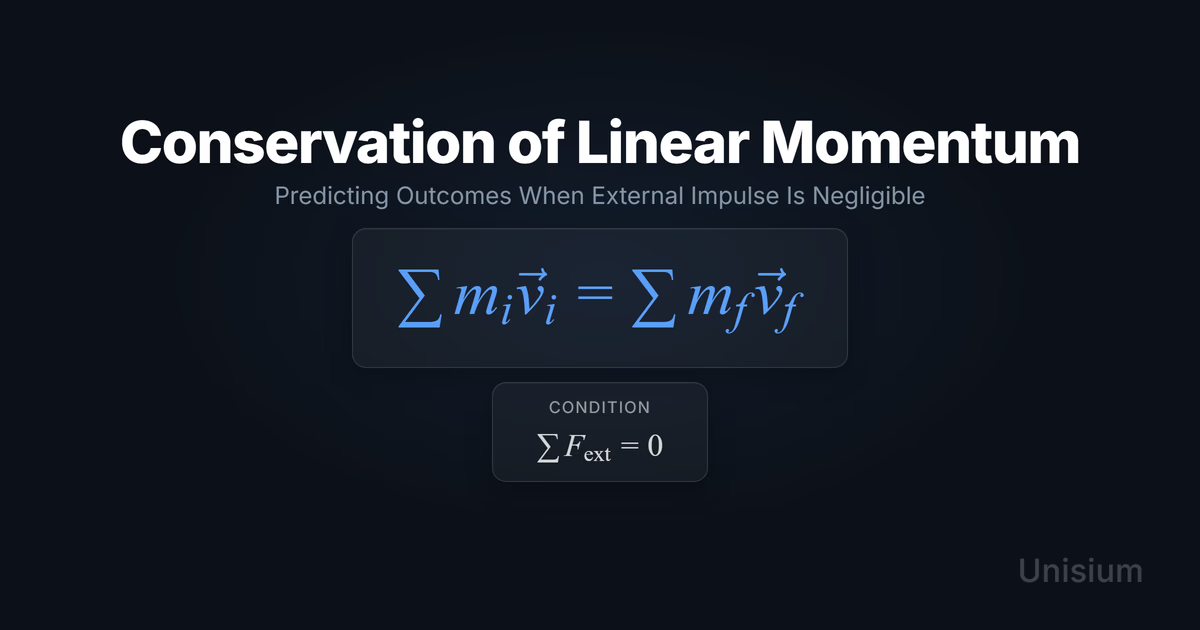
Conservation of Linear Momentum states that the total momentum of a system remains constant if the net external force acting on it is zero. It is a fundamental principle used to predict outcomes in interactions where external impulse is negligible, ranging from subatomic collisions to macroscopic recoil.
On this page: The Principle · Conditions · Misconceptions · EE Questions · Retrieval Practice · Worked Example · Solve a Problem · FAQ
The Principle
Statement
The Conservation of Linear Momentum states that if the net external force acting on a system of objects is zero, the total linear momentum of the system remains constant in time. This means the sum of the momenta of all objects before an interaction equals the sum of their momenta after the interaction.
Mathematical Form
Where:
- = mass of an object (kg)
- = initial velocity vector of an object (m/s)
- = final velocity vector of an object (m/s)
- = summation over all objects in the chosen system
Alternative Forms
In a two-body system (like a standard collision), this often appears as:
- Explicit Form:
- Component Form (x-axis):
Conditions of Applicability
Condition:
Condition (math)
Momentum is conserved when:
Equivalent interval form (impulse form):
Condition (words)
means the net force from outside the system boundary. Internal forces occur in equal-and-opposite pairs (Newton’s Third Law), so they cancel in the system-sum and do not change .
Equivalently over a time interval: momentum is conserved if the net external impulse on the system is negligible.
The Decision Rule
Use momentum conservation when the net external impulse on your chosen system is zero or negligible over the time interval. If external forces matter, use the Impulse–Momentum Theorem instead.
If you’re deciding between those two tools rather than reviewing this principle alone, see When to Use Momentum Conservation vs Impulse.
Use it for (when external impulse 0):
- Collisions (often, not always)
- Recoil (gun + bullet, person + skateboard)
- Explosions / separations (spring-loaded carts, fragments)
- Two people pushing off each other (skaters)
- Any short internal interaction where external forces don’t have time to matter
Don’t use it blindly when:
- Significant external impulse acts (friction over time, tether/rope yank, braking, hitting a wall)
- Your “system” accidentally excludes a big external interaction partner (Earth/ground can matter)
- You’re mixing it up with kinetic energy conservation (elastic vs inelastic)
Practical modeling notes
- System definition: Choose the system boundary so the interaction forces you want to avoid modeling are internal (so they cancel in the system-sum). Then check that the net impulse from outside the boundary is negligible during the interaction.
- The Impulse Approximation: During brief, intense interactions, we assume momentum is conserved because the external impulse is negligible compared to the massive internal forces.
When It Doesn’t Apply
- External Forces: If a significant net external force acts on the system (e.g., a car hitting a wall that is anchored to the Earth), the momentum of the car alone is not conserved.
- System Leakage: If mass enters or leaves the system (e.g., a rocket burning fuel), you must account for the momentum of the exhausted mass to maintain the conservation law.
Want the complete framework behind this guide? Read Masterful Learning.
Common Misconceptions
Misconception 1: Momentum is conserved for every object
The truth: Momentum is only conserved for the total system. Individual objects within the system almost always change their momentum as they exert forces on each other.
Misconception 2: Momentum is conserved in all collisions
The truth: Momentum is conserved in all collisions if the system is isolated. However, kinetic energy is only conserved in elastic collisions. Do not confuse the conservation of momentum with the conservation of kinetic energy.
Misconception 3: “External” means “outside the objects”
The truth: “External” depends entirely on your system boundary. If your system is “Object A,” then Object B is external. If your system is “Object A + Object B,” then the force between them is internal.
Elaborative Encoding
Use these questions to build deep understanding. (See Elaborative Encoding for the full method.)
Within the Principle
- How does the vector nature of velocity affect the summation? Can the total momentum be zero even if objects are moving?
- If the mass of an object in the system increases while the total momentum is constant, what must happen to its velocity?
For the Principle
- How do you decide which objects to include in your system to make the net external force zero?
- Why do we use the conservation of momentum for collisions rather than Newton’s Second Law directly?
Between Principles
- How is the conservation of momentum related to Newton’s Third Law? (Hint: Consider the impulse pairs between objects).
Generate an Example
- Describe a situation where momentum is conserved in the horizontal direction but not in the vertical direction.
Retrieval Practice
Answer from memory, then click to reveal and check. (See Retrieval Practice for the full method.)
State the principle in words: _____The total momentum of a system is constant if the net external force acting on the system is zero.
Write the canonical equation: _____
State the canonical condition: _____
Worked Example
Use this worked example to practice Self-Explanation.
Problem
A cart moving at to the right collides with a cart at rest. After the collision, the two carts stick together. What is their final velocity?
Step 1: Verbal Decoding
Target:
Given:
Constraints: carts stick together (inelastic collision), horizontal, frictionless
Step 2: Visual Decoding
Try drawing the situation. Define the two carts as the system. Draw a 1D axis. Choose to the right. Label as positive and . (So the initial momentum is positive.)
Step 3: Physics Modeling
Step 4: Mathematical Procedures
Step 5: Reflection
- Units: The result is in m/s, which is correct for velocity.
- Magnitude: is less than the initial , which makes sense as the mass increased.
- Limiting case: If the second cart were infinitely massive, the final velocity would approach zero.
Before moving on: self-explain the model
Try explaining Step 3 out loud: why we treated the two carts as a single mass after the collision and why the external forces (gravity and normal force) didn’t affect the horizontal momentum.
Physics model with explanation (what “good” sounds like)
Principle: Conservation of Linear Momentum.
Conditions: The net external force on the two-cart system is zero in the horizontal direction because the track is frictionless and there are no other horizontal external forces.
Relevance: Since the carts collide and interact through internal forces, momentum conservation is the most direct way to relate the initial and final states without needing the details of the impact force.
Description: We modeled the “before” state as two separate momenta and the “after” state as a single combined mass moving at a common velocity.
Goal: We are solving for the shared final velocity by isolating it algebraically from the conservation equation.
Solve a Problem
Apply what you’ve learned with Problem Solving.
Problem
A block sliding at on a frictionless surface hits a block that is initially stationary. If the first block comes to a complete stop after the collision, what is the final velocity of the second block?
Hint (if needed): Use the explicit two-body form of the momentum equation.
Show Solution
Step 1: Verbal Decoding
Target:
Given:
Constraints: frictionless, horizontal, one-dimensional collision
Step 2: Visual Decoding
Try drawing the blocks before and after impact. Draw a 1D axis. Choose in the direction of the first block’s initial motion. Label as positive and . (So the first block’s momentum is entirely transferred.)
Step 3: Physics Modeling
Step 4: Mathematical Procedures
Step 5: Reflection
- Units: Velocity is in m/s.
- Magnitude: Since the masses were equal and one stopped, the other should take all the velocity. is correct.
- Limiting case: If were much larger than , would be much smaller.
Related Principles
- Classical Mechanics: The Complete Principle Map — see where this principle fits in the full subdomain.
| Principle | Relationship to Conservation of Linear Momentum |
|---|---|
| Newton’s First Law | Related to system isolation; equilibrium is a special case of zero net force. |
| Newton’s Second Law | Conservation of momentum is a specific case of . |
| Newton’s Third Law | Explains why internal forces always cancel out in pairs within a system. |
| Impulse-Momentum Theorem | Describes how momentum changes when an external force is applied. |
| Angular Momentum Conservation | Rotational analog: angular momentum conserved when net torque = 0. |
See Principle Structures for how to organize these relationships visually.
Next Step in Mechanics Core
- Back to: Newton’s First Law — equilibrium intuition
FAQ
What is Conservation of Linear Momentum?
It is the principle that the total momentum of a system remains constant unless acted upon by an external force. In collisions, it allows us to calculate final velocities by setting the total initial momentum equal to the total final momentum.
When does Conservation of Momentum apply?
It applies whenever the net external force on the chosen system is zero. In many physics problems, we “choose” the system to include all interacting objects so that their interaction forces are internal.
What’s the difference between elastic and inelastic collisions?
In both types, momentum is conserved. However, in an elastic collision, kinetic energy is also conserved. In an inelastic collision, some kinetic energy is converted into other forms (like heat or sound), though momentum remains constant.
Do I have to use vectors for momentum?
Yes. Momentum is , so direction matters. If two objects are moving toward each other, one must have a positive velocity and the other a negative velocity in your calculations.
Is momentum conserved if there is friction?
Technically no, because friction is an external force. However, if the collision happens quickly, the “impulse” from friction is often so small that we can ignore it during the impact itself (the Impulse Approximation).
Related Guides
- Principle Structures — Organize this principle in a hierarchical framework
- Momentum Anki Deck — Drill momentum, impulse, center-of-mass, and conservation relationships
- Self-Explanation — Learn to explain worked examples step by step
- Retrieval Practice — Make this principle instantly accessible
- Problem Solving — Apply principles systematically to new problems
How This Fits in Unisium
The Unisium Study System helps you master principles like the Conservation of Linear Momentum by moving beyond plug-and-chug math. By using Elaborative Encoding to understand system boundaries and Self-Explanation to deconstruct collision models, you build a mental framework that works for any problem, not just the ones you’ve seen before.
Ready to master Conservation of Linear Momentum? Check access and join the Unisium waitlist or explore the full learning framework in Masterful Learning.

Masterful Learning
The book behind these guides: a study system for physics, math, & programming built on retrieval, connection, explanation, and problem solving.
Ready to apply this strategy?
Unisium turns these evidence-based techniques into guided study sessions for math and physics. Places are limited during early access. Check current availability to start a trial; joining the mailing list is optional.
See plans and availability Read More GuidesAlready have access? Sign in