Kinematics 2 - Algebraic: Velocity as a Function of Time
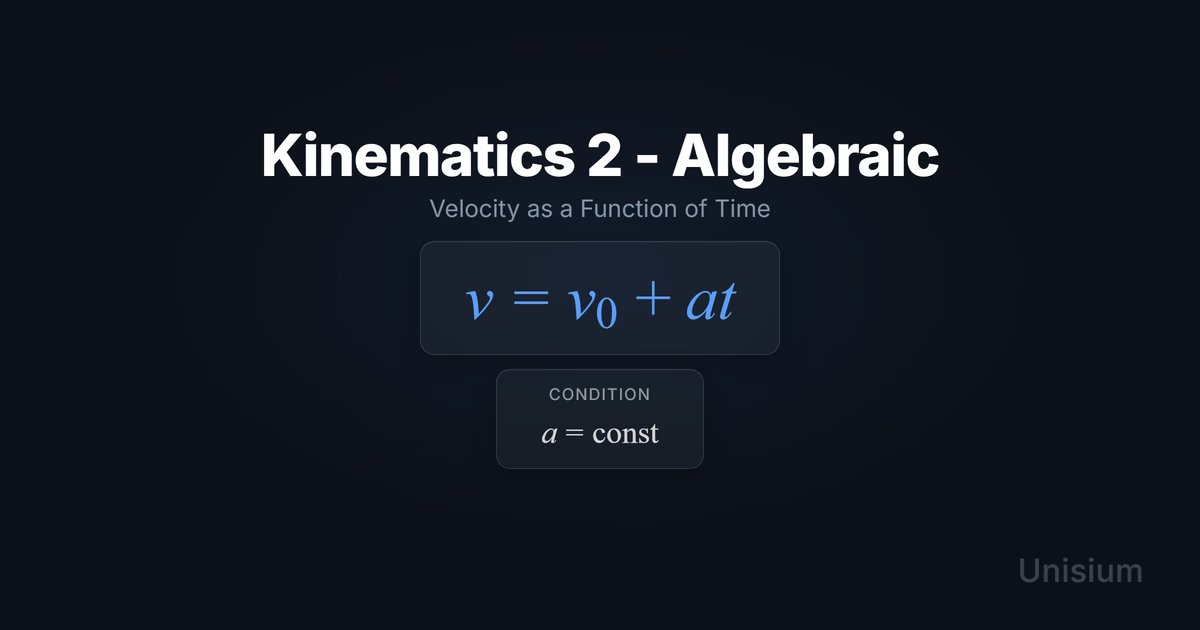
Kinematics 2 - Algebraic gives velocity as a function of time under constant acceleration: . It applies over any interval where acceleration stays constant, and it lets you solve for , , or when the other two are known. Choose it when acceleration is constant and time is known or sought.
On this page: The Principle · Conditions · Misconceptions · EE Questions · Retrieval Practice · Worked Example · Solve a Problem · FAQ
This equation is one of the four kinematic equations for uniformly accelerated motion. It directly links the final velocity to the initial velocity, acceleration, and elapsed time—making it the go-to relation when time is known or sought.
The Principle
Statement
The velocity of an object at any time equals its initial velocity plus the product of its constant acceleration and the elapsed time. This relationship is linear: velocity changes at a steady rate determined by the acceleration.
Mathematical Form
Where:
- = final velocity (m/s)
- = initial velocity (m/s)
- = constant acceleration (m/s²)
- = elapsed time (s)
Alternative Forms
In different contexts, this appears as:
- Vector form:
- Component form (1D):
Conditions of Applicability
Condition: The acceleration must remain constant throughout the time interval of interest. This includes the special case where (uniform motion), but excludes any situation where acceleration varies with time, position, or velocity.
Practical modeling notes (optional)
- Choose a coordinate system and sign convention before applying the equation
- All quantities (, , ) must be measured along the same axis with consistent signs
- The equation works for any constant acceleration, including negative values (deceleration)
When It Doesn’t Apply
- Variable acceleration: If depends on time, position, or velocity, use calculus-based kinematics:
- Circular or curved motion: This equation addresses motion along a single axis; for curved paths, apply it separately to each component or use tangential/radial decomposition
Want the complete framework behind this guide? Read Masterful Learning.
Common Misconceptions
Misconception 1: Negative acceleration means slowing down
The truth: Negative acceleration means the acceleration vector points in the negative direction. Whether the object speeds up or slows down depends on the relationship between velocity and acceleration signs.
Why this matters: Students often confuse sign conventions with physical meaning. An object moving in the negative direction with negative acceleration is speeding up, not slowing down.
Misconception 2: The equation works for any motion problem
The truth: The equation requires constant acceleration. For projectile motion with air resistance, oscillatory motion, or any situation where changes, this equation yields incorrect results.
Why this matters: Applying to variable-acceleration problems is a common error that produces wrong answers without warning signs.
Misconception 3: Initial velocity must be zero
The truth: The equation works for any initial velocity. The term can be positive, negative, or zero—it simply represents the velocity at the start of the time interval.
Why this matters: Many textbook examples start from rest, leading students to implicitly assume even when the problem specifies otherwise.
Elaborative Encoding
Use these questions to build deep understanding. (See Elaborative Encoding for the full method.)
Within the Principle
- What does the slope of a velocity-time graph represent, and how does that connect to the structure of ?
- If you double the time, does the velocity double? Under what conditions?
For the Principle
- How do you decide whether to use versus a position equation like ?
- What physical clues in a problem statement indicate that acceleration is constant?
Between Principles
- How is related to the definition of acceleration ? Is one more general than the other?
Generate an Example
- Describe a situation where using would give the wrong answer because the condition is violated.
Retrieval Practice
Answer from memory, then click to reveal and check. (See Retrieval Practice for the full method.)
State the principle in words: _____The final velocity equals the initial velocity plus the product of constant acceleration and time.
Write the canonical equation: _____
State the canonical condition: _____
Worked Example
Use this worked example to practice Self-Explanation.
Problem
A car traveling at 15 m/s accelerates uniformly at 2.0 m/s² for 6.0 s. What is its final velocity?
Step 1: Verbal Decoding
Target:
Given: , ,
Constraints: constant acceleration, straight-line motion
Step 2: Visual Decoding
Draw a 1D axis. Choose in the direction of motion. Label the initial velocity along and the final velocity along (since the car is speeding up in the positive direction). Label in the direction of acceleration. (So is positive and is positive.)
Step 3: Physics Modeling
Step 4: Mathematical Procedures
Step 5: Reflection
- Units: m/s + (m/s²)(s) = m/s + m/s = m/s ✓
- Magnitude: Starting at 15 m/s and gaining 2 m/s every second for 6 s gives 12 m/s increase—27 m/s is reasonable for highway speeds.
- Limiting case: If , then m/s, which matches the initial condition.
Before moving on: self-explain the model
Try explaining Step 3 out loud (or in writing): why the chosen principle applies, what the diagram implies, and how the equations encode the situation.
Physics model with explanation (what “good” sounds like)
Principle: We use because the problem states uniform (constant) acceleration, and we need to find the final velocity given time.
Conditions: The acceleration is constant at 2.0 m/s²—the condition is satisfied.
Relevance: This is the right tool because we know , , and , and we want . No other kinematic equation is simpler for this combination of knowns and unknowns.
Description: The car starts at 15 m/s and gains speed at a steady rate. Each second adds 2.0 m/s to its velocity.
Goal: We compute the final velocity by adding the velocity change () to the initial velocity.
Solve a Problem
Apply what you’ve learned with Problem Solving.
Problem
A cyclist moving at 8.0 m/s applies the brakes, producing a constant deceleration of 1.5 m/s². How long does it take to come to rest?
Hint (if needed): “Coming to rest” means .
Show Solution
Step 1: Verbal Decoding
Target:
Given: , ,
Constraints: constant deceleration, straight-line motion, starts at 8.0 m/s and ends at rest
Step 2: Visual Decoding
Draw a 1D axis. Choose in the direction of initial motion (the cyclist’s travel direction). Label along . The final velocity is zero. Since the cyclist decelerates (slows while moving in the positive direction), the acceleration points opposite to velocity: is negative. Label opposite to the direction of motion. (So )
Step 3: Physics Modeling
Step 4: Mathematical Procedures
Step 5: Reflection
- Units: (m/s) / (m/s²) = s ✓
- Magnitude: Losing 1.5 m/s each second from 8.0 m/s takes about 5–6 s—5.3 s is plausible for a braking cyclist.
- Limiting case: If , then , meaning without deceleration the cyclist never stops—correct.
Related Principles
- Classical Mechanics: The Complete Principle Map — see where this principle fits in the full subdomain.
| Principle | Relationship to Kinematics 2 |
|---|---|
| Kinematics 1 - Position-Time | Position-time equation; shares the same constant-acceleration condition |
| Kinematics 3 - Velocity-Position | Eliminates time; useful when is unknown |
| Newton’s Second Law | Determines the acceleration used in kinematic equations |
| Rotational Kinematics 2 | Rotational analog: angular velocity vs time. |
See Principle Structures for how to organize these relationships visually.
FAQ
What is Kinematics 2 - Algebraic?
Kinematics 2 - Algebraic is the velocity-time equation . It describes how an object’s velocity changes over time when acceleration is constant.
When does apply?
It applies whenever acceleration is constant throughout the motion. This includes uniform motion (), free fall near Earth’s surface (if air resistance is negligible), and any idealized situation with steady acceleration.
What’s the difference between and ?
The velocity equation gives you final velocity; the position equation gives you final position. Use the velocity equation when you need and know . Use the position equation when you need and know .
What are the most common mistakes with this equation?
The top errors are: (1) using it when acceleration varies, (2) confusing sign conventions (especially with deceleration), and (3) forgetting that can be nonzero.
How do I know which kinematic equation to use?
List your knowns and unknowns. Choose the equation that contains only one unknown. If you know , , and , and need , then is the direct choice.
How This Fits in Unisium
Unisium helps you master specific principles like Kinematics 2 through structured practice. You encode the equation and condition through elaboration, strengthen recall through retrieval practice, deepen understanding through self-explanation of worked examples, and build fluency through problem solving. Each interaction reinforces not just what the equation is, but when and how to apply it.
Related guides: Principle Structures · Self-Explanation · Retrieval Practice · Problem Solving
Ready to master Kinematics 2? Check access and join the Unisium waitlist or explore the full learning framework in Masterful Learning.
Masterful Learning
The book behind these guides: a study system for physics, math, & programming built on retrieval, connection, explanation, and problem solving.
Ready to apply this strategy?
Unisium turns these evidence-based techniques into guided study sessions for math and physics. Places are limited during early access. Check current availability to start a trial; joining the mailing list is optional.
See plans and availability Read More GuidesAlready have access? Sign in