Newton's First Law (Rotation): Rotational Equilibrium
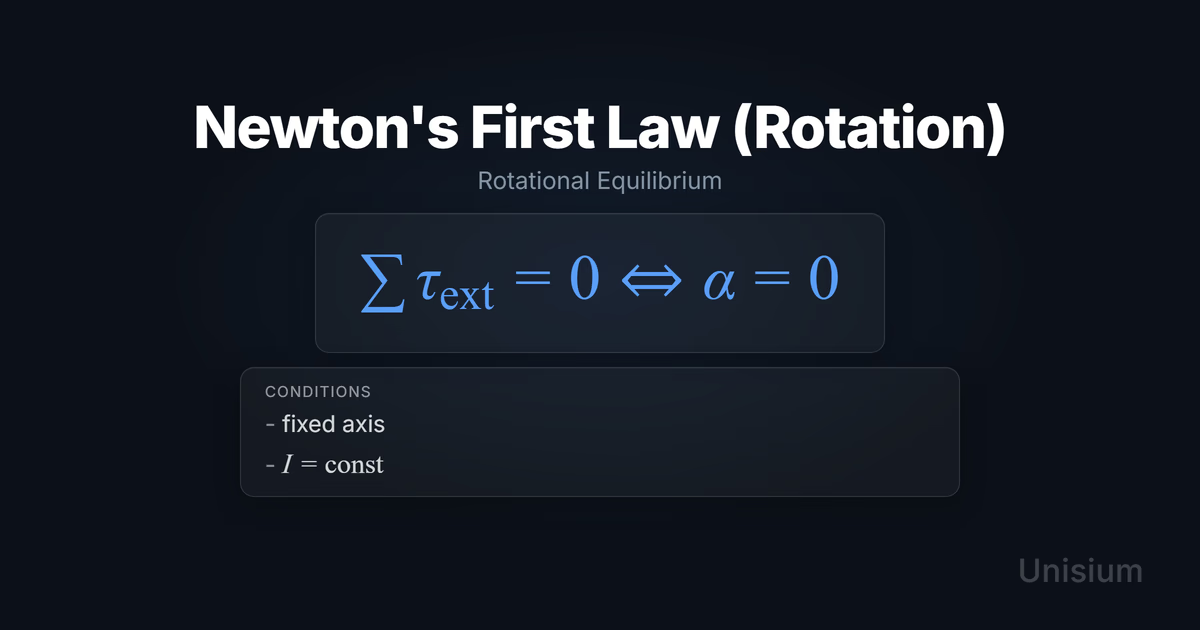
Newton’s First Law (Rotation) states that a rigid body rotating about a fixed axis maintains constant angular velocity (zero angular acceleration) if and only if the net external torque acting on it is zero. It applies when the axis is fixed in an inertial frame and the moment of inertia remains constant.
This principle is the rotational analog of Newton’s First Law for translational motion. Just as a body maintains constant linear velocity when net force is zero, a rotating body maintains constant angular velocity when net torque is zero. It’s essential for analyzing rotating systems in equilibrium, from flywheels to spinning satellites.
On this page: The Principle · Conditions · Misconceptions · EE Questions · Retrieval Practice · Worked Example · Solve a Problem · FAQ
The Principle
Statement
For a rigid body rotating about a fixed axis in an inertial reference frame, the net external torque is zero if and only if the angular acceleration is zero. In other words, a body continues to rotate at constant angular velocity (including , i.e., remaining at rest) when no net torque acts on it. This state of constant is called rotational equilibrium.
Mathematical Form
Where:
- = net external torque about the rotation axis (N·m)
- = angular acceleration (rad/s²)
- The double arrow means “if and only if”
Alternative Forms
In different contexts, this appears as:
- Component form (fixed axis):
- Rotational equilibrium condition: (when the body is in equilibrium)
Conditions of Applicability
Condition: fixed axis; This principle applies when the axis of rotation is fixed in an inertial reference frame and the moment of inertia about that axis remains constant. The fixed-axis constraint means the axis direction and position don’t change during the motion.
Practical modeling notes
- The axis must be fixed in an inertial frame (non-accelerating, non-rotating reference frame)
- Fixed axis means we can treat rotation as one-dimensional motion about that axis
- Constant requires the mass distribution relative to the axis stays fixed (rigid body)
- Internal torques (forces between parts of the body) cancel by Newton’s Third Law and don’t appear in
When It Doesn’t Apply
- Freely rotating body (no fixed axis): This guide assumes a single fixed axis. For freely rotating rigid bodies (like a tumbling satellite), use the angular momentum form where is computed about the center of mass. The full treatment requires tensor methods beyond this guide’s scope.
- Non-rigid body (changing ): When mass distribution changes (ice skater pulling arms in), you must account for changing with time. Use .
- Non-inertial reference frame: In an accelerating or rotating frame, fictitious torques appear and must be included in .
Want the complete framework behind this guide? Read Masterful Learning.
Common Misconceptions
Misconception 1: “If something is rotating, there must be a net torque”
The truth: A body rotating at constant angular velocity experiences zero net torque. Once spinning, it continues without additional torque (like a freely spinning wheel in space).
Why this matters: Students often confuse the torque needed to start rotation with the torque needed to maintain constant rotation. Only changing requires net torque.
Misconception 2: ” means the body isn’t rotating”
The truth: Zero net torque means zero angular acceleration, not zero angular velocity. A flywheel spinning at 1000 rpm with has .
Why this matters: This confuses state () with rate of change (). It’s the rotational version of thinking “no net force means no motion.”
Misconception 3: “Torques about different points are interchangeable”
The truth: For fixed-axis rotation, you must calculate torques about the rotation axis (or pivot). That’s the axis that connects directly to the angular acceleration. While other reference points can be valid in statics, for rotational dynamics about a fixed axis, the axis choice is not optional.
Why this matters: Using a different reference point changes which torques contribute and requires a more complex analysis. In fixed-axis problems, always use the rotation axis as your torque reference point.
Elaborative Encoding
Use these questions to build deep understanding. (See Elaborative Encoding for the full method.)
Within the Principle
- What does the double arrow mean physically? How does it differ from a single arrow like ?
- Why does the equation refer to external torques specifically? What happens to internal torques?
For the Principle
- How do you determine if a rotation axis is “fixed” in a real problem? What physical constraints create a fixed axis?
- If but the body is speeding up, what does that tell you about your choice of axis or system?
Between Principles
- How does this relate to Newton’s Second Law for rotation ()? Is the First Law redundant?
Generate an Example
- Describe a rotating system where but multiple non-zero torques act. What must be true about those torques?
Retrieval Practice
Answer from memory, then click to reveal and check. (See Retrieval Practice for the full method.)
State the principle in words: _____A rigid body rotating about a fixed axis maintains constant angular velocity (zero angular acceleration) if and only if the net external torque is zero.
Write the canonical equation: _____
State the canonical condition: _____
Worked Example
Use this worked example to practice Self-Explanation.
Problem
A uniform rod of mass and length is pivoted at one end and held horizontal. A downward force is applied perpendicular to the rod at a distance from the pivot. What must be the magnitude of an upward force applied perpendicular to the rod at the free end to keep the rod in equilibrium (maintain )?
Step 1: Verbal Decoding
Target:
Given: , , , , (implicitly)
Constraints: uniform rod, pivot at one end, rod held horizontal, both forces perpendicular to rod
Step 2: Visual Decoding
Draw a horizontal rod with pivot at the left end. Label the axis out of the page (positive for counterclockwise torques). The weight acts downward at the rod’s center (distance from pivot). Force acts downward at distance . Force acts upward at the free end (distance from pivot). Weight and create clockwise (negative) torques; creates a counterclockwise (positive) torque.
Step 3: Physics Modeling
Step 4: Mathematical Procedures
Step 5: Reflection
- Units: N·m divided by m gives N, correct for force.
- Magnitude: The result is physically reasonable— must balance both the weight’s torque and ‘s torque, so it’s larger than either individual contribution.
- Limiting case: If , then (balancing weight’s torque alone), which is less than our answer—makes sense since adds more clockwise torque.
Before moving on: self-explain the model
Try explaining Step 3 out loud (or in writing): why Newton’s First Law for rotation applies, what the torque diagram implies, and how the equilibrium condition encodes the situation.
Physics model with explanation (what “good” sounds like)
Principle: Newton’s First Law (Rotation) applies because the rod rotates about a fixed axis (the pivot) and we want it to remain in equilibrium ().
Conditions: The axis is fixed at the pivot point in an inertial frame (the room), and the rod is rigid so is constant. These conditions are satisfied.
Relevance: When , the principle tells us . All external torques (from , , and weight) about the pivot must sum to zero.
Description: Three forces create torques about the pivot: the weight acts downward at the center ( from pivot), force acts downward at distance , and force acts upward at the end (distance ). Weight and create clockwise torques (negative), while creates a counterclockwise torque (positive). The lever arm for each is the horizontal distance from the pivot since the rod is horizontal.
Goal: We sum all torques with proper signs, set the sum to zero, and solve for . The positive result shows the upward force needed to balance both the weight’s torque and ‘s torque.
Solve a Problem
Apply what you’ve learned with Problem Solving.
Problem
A thin uniform disk of radius and mass rotates about an axis through its center, perpendicular to its plane. The disk is initially spinning at constant angular velocity . A tangential friction force of magnitude is applied at the rim. If the disk continues to rotate at constant , what must be the magnitude of a second tangential force applied at distance from the center to maintain equilibrium?
Hint: For a disk rotating at constant , what must be true about ? What does Newton’s First Law for rotation tell you?
Show Solution
Step 1: Verbal Decoding
Target:
Given: , , ,
Constraints: uniform disk, rotation about center axis perpendicular to disk, friction force tangential at rim, second force tangential at distance , constant angular velocity maintained
Step 2: Visual Decoding
Draw a circular disk (top view) rotating about its center. Label the axis perpendicular to the page. The friction force acts tangentially at the rim (opposing the direction of rotation, creating negative torque). Force acts tangentially at radius (direction to be determined). Since we want constant , we need .
Step 3: Physics Modeling
Step 4: Mathematical Procedures
Step 5: Reflection
- Units: (N)(m)/(m) = N, correct.
- Magnitude: must be twice as large as because it acts at half the distance (smaller lever arm means larger force needed for same torque).
- Limiting case: If (both forces at rim), then , which makes sense—equal lever arms require equal forces.
Related Principles
- Classical Mechanics: The Complete Principle Map — see where this principle fits in the full subdomain.
| Principle | Relationship to Newton’s First Law (Rotation) |
|---|---|
| Newton’s Second Law (Rotation) | The First Law is a special case: when and , then |
| Newton’s First Law (Translation) | Direct analog: constant when parallels constant when |
| Angular Momentum Conservation | When , angular momentum is conserved (the First Law implies this for constant ) |
| Newton’s First Law (Translation) | Translation analog: net force = 0 means constant velocity. |
See Principle Structures for how to organize these relationships visually.
FAQ
What is Newton’s First Law (Rotation)?
Newton’s First Law (Rotation) states that a rigid body rotating about a fixed axis has zero angular acceleration if and only if the net external torque is zero. A rotating body continues spinning at constant angular velocity when no net torque acts on it.
When does Newton’s First Law (Rotation) apply?
It applies when the axis of rotation is fixed in an inertial reference frame and the moment of inertia about that axis remains constant. These conditions are met for rigid bodies rotating about a physically fixed axis (like a wheel on an axle) or constrained to rotate about one axis.
What’s the difference between Newton’s First Law (Rotation) and Newton’s Second Law (Rotation)?
Newton’s Second Law for rotation () is the general relationship between net torque and angular acceleration. The First Law is the special case when : it tells us that constant angular velocity (including zero) occurs if and only if net torque is zero. The First Law emphasizes the equivalence: .
What are the most common mistakes with Newton’s First Law (Rotation)?
The top mistakes are: (1) thinking rotation requires net torque (constant rotation needs zero net torque), (2) confusing with (equilibrium means constant , not necessarily zero), and (3) calculating torques about different points instead of consistently using the fixed axis.
How do I know when to use the rotational vs translational form of Newton’s First Law?
Use the rotational form when analyzing systems that rotate about a fixed axis—anything involving angular velocity, torques, and angular acceleration. Use the translational form for motion of the center of mass or when forces act on a non-rotating body. Many problems require both: the center of mass obeys while rotation about the center of mass obeys .
Related Guides
- Principle Structures — Organize this principle in a hierarchical framework
- Self-Explanation — Learn to explain worked examples step by step
- Problem Solving — Apply principles systematically to new problems
- Elaborative Encoding — Build deep conceptual understanding of physics principles
How This Fits in Unisium
The Unisium Study System helps you master specific principles like Newton’s First Law (Rotation) through a four-stage learning cycle. First, you build deep understanding through elaborative encoding questions that connect the principle to its conditions and related concepts. Then retrieval practice makes the principle instantly accessible when you need it. Self-explanation of worked examples solidifies your ability to recognize when and how the principle applies. Finally, problem solving builds your skill in using the principle to analyze new situations.
Ready to master Newton’s First Law (Rotation)? Check access and join the Unisium waitlist or explore the full learning framework in Masterful Learning.
Masterful Learning
The book behind these guides: a study system for physics, math, & programming built on retrieval, connection, explanation, and problem solving.
Ready to apply this strategy?
Unisium turns these evidence-based techniques into guided study sessions for math and physics. Places are limited during early access. Check current availability to start a trial; joining the mailing list is optional.
See plans and availability Read More GuidesAlready have access? Sign in