Mechanical Energy Conservation: Master Energy Transformations
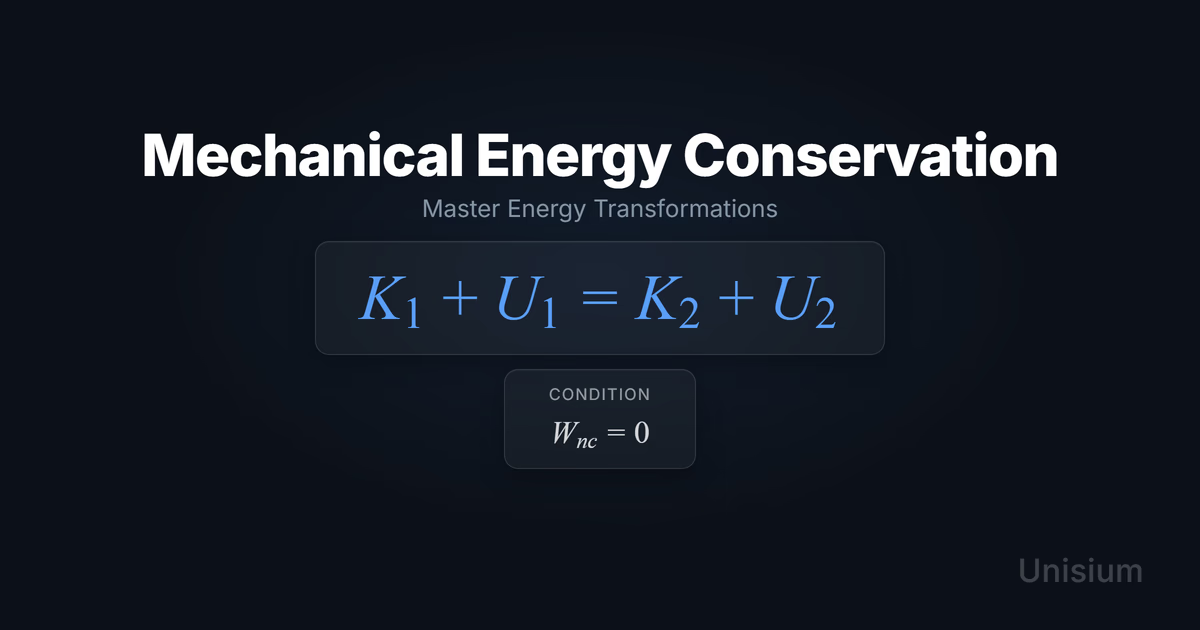
Conservation of Mechanical Energy states that if the net work done by non-conservative forces is zero, the system’s mechanical energy stays constant: kinetic energy and potential energy trade off, but the total does not change. It applies when over the motion you’re comparing.
This principle lets you solve dynamics problems by comparing initial and final states. Rather than tracking forces and accelerations at every instant, you work with energy transformations between two moments in time.
On this page: The Principle · Conditions · Misconceptions · EE Questions · Retrieval Practice · Worked Example · Solve a Problem · FAQ
The Principle
Statement
When a system experiences only conservative forces (or when non-conservative forces do zero net work), the total mechanical energy—the sum of kinetic energy and potential energy—remains constant. Energy transforms between kinetic and potential forms, but the total never changes.
Mathematical Form
Where:
- = kinetic energy (J)
- = potential energy (J, includes gravitational, elastic, or any conservative potential)
- subscript 1 = initial state
- subscript 2 = final state
Alternative Forms
In different contexts, this appears as:
- Change form:
- Expanded (gravity only):
Conditions of Applicability
Condition: This means the work done by non-conservative forces must be zero. This occurs when:
- Only conservative forces act (gravity, elastic spring force, electrostatic force)
- Non-conservative forces are present but perpendicular to motion (normal force on a frictionless surface)
- Non-conservative forces are present but the object doesn’t move along their direction
Practical modeling notes
Conservative forces are path-independent—the work they do depends only on initial and final positions. Typical conservative forces: gravity, ideal springs, electrostatic interactions. Non-conservative forces include friction, air resistance, and applied forces from motors. Constraint forces (like tension or normal force) may or may not do work—check whether displacement occurs along the force direction.
When It Doesn’t Apply
When non-conservative forces do work, mechanical energy changes. Use the Work-Energy Theorem with Non-Conservative Work instead.
- Friction is present: Friction converts mechanical energy to thermal energy. Use where (negative because friction opposes motion).
- Air resistance matters: Drag dissipates energy. Again, use the work-energy theorem with non-conservative work.
- External force does work: If you push an object or a motor does work, that energy input must be accounted for: .
Want the complete framework behind this guide? Read Masterful Learning.
Common Misconceptions
Misconception 1: “Energy is always conserved, so I can always use this principle”
The truth: Mechanical energy is conserved only when . Total energy (including thermal, chemical, etc.) is always conserved, but mechanical energy can transform into other forms.
Why this matters: Applying conservation of mechanical energy to a problem with friction yields incorrect results because you ignore the energy lost to heat. Always check for non-conservative forces first.
Misconception 2: “I can pick any two points and apply conservation”
The truth: You can compare any two states as long as the net non-conservative work between them is zero. Path doesn’t matter for conservative forces.
Why this matters: If friction acts between your chosen states, energy is not conserved. You might accidentally compare states before and after a collision (where internal forces do work) or across a frictional region.
Misconception 3: “More potential energy always means higher position”
The truth: Potential energy depends on the choice of reference (zero point). Also, elastic potential energy () increases with compression or extension, not height.
Why this matters: Forgetting the reference point leads to sign errors. Mixing gravitational and elastic potential without care causes algebraic mistakes. Always define your zero-potential reference explicitly.
Elaborative Encoding
Use these questions to build deep understanding. (See Elaborative Encoding for the full method.)
Within the Principle
- Why does the equation have sums on each side () rather than just one energy term?
- What does it mean physically for —what is the relationship between the changes and ?
For the Principle
- How do you verify that in a given problem? What forces must you check?
- When both gravitational and elastic potential energies are present, how do you construct the term?
Between Principles
- How is conservation of mechanical energy a special case of the work-energy theorem with non-conservative forces ()?
Generate an Example
- Describe a situation where an object speeds up but mechanical energy is conserved. (Hint: think about motion on a ramp or swing.)
Retrieval Practice
Answer from memory, then click to reveal and check. (See Retrieval Practice for the full method.)
State the principle in words: _____When only conservative forces act on a system (or when non-conservative forces do zero net work), the sum of kinetic and potential energy remains constant.
Write the canonical equation: _____
State the canonical condition: _____
Worked Example
Use this worked example to practice Self-Explanation.
Problem
A 2.0 kg pendulum bob is released from rest at a height of 1.5 m above its lowest point. Assuming negligible air resistance, what is the speed of the bob as it passes through the lowest point?
Step 1: Verbal Decoding
Target:
Given: , ,
Constraints: released from rest, negligible air resistance, pendulum motion
Step 2: Visual Decoding
Draw the pendulum at state 1 (release) and state 2 (lowest point). Draw a 1D height axis with upward and set at the lowest point. Mark above it. Draw a 1D speed axis and label and . (So , , , and is positive.)
Step 3: Physics Modeling
Step 4: Mathematical Procedures
Step 5: Reflection
- Units: ✓
- Magnitude: Dropping 1.5 m freely under gravity gives about 5.4 m/s, which matches our result.
- Limiting case: If , then , which makes sense—no height, no speed gained.
Before moving on: self-explain the model
Try explaining Step 3 out loud (or in writing): why conservation of mechanical energy applies, what the diagram implies, and how the equation encodes the situation.
Physics model with explanation (what “good” sounds like)
Principle: Conservation of mechanical energy applies here.
Conditions: The only force doing work is gravity (a conservative force). The tension in the string is always perpendicular to the velocity, so it does zero work. Air resistance is negligible. Thus .
Relevance: Because mechanical energy is conserved, we can equate the total energy at the release point to the total energy at the lowest point. This avoids having to track the changing tension force or the path of the bob.
Description: At state 1 (release), the bob has maximum potential energy (relative to the lowest point) and zero kinetic energy. At state 2 (lowest point), all that potential energy has converted to kinetic energy. The equation captures this transformation.
Goal: We solve for by substituting and , then isolating . Notice that mass cancels—the final speed depends only on the drop height and gravity.
Solve a Problem
Apply what you’ve learned with Problem Solving.
Problem
A 0.50 kg ball is thrown upward from ground level with an initial speed of 15 m/s. Ignoring air resistance, what is the maximum height the ball reaches?
Hint: At maximum height, the ball’s velocity is zero. Choose the ground as your potential energy reference.
Show Solution
Step 1: Verbal Decoding
Target:
Given: , ,
Constraints: thrown upward, ignoring air resistance, ground level start
Step 2: Visual Decoding
Draw a vertical 1D axis with upward and set at the ground. Mark state 2 at height above it. Draw a 1D speed axis and label (upward) and . (So , , is positive, and .)
Step 3: Physics Modeling
Step 4: Mathematical Procedures
Step 5: Reflection
- Units: ✓
- Magnitude: An initial speed of 15 m/s is reasonable for a throw, and reaching about 11.5 m (roughly three stories) makes physical sense.
- Limiting case: If , then —no initial kinetic energy means no height gained.
Related Principles
- Classical Mechanics: The Complete Principle Map — see where this principle fits in the full subdomain.
| Principle | Relationship to Conservation of Mechanical Energy |
|---|---|
| Work-Energy Theorem with Non-Conservative Work | The general case; conservation of mechanical energy is the special case when |
See Principle Structures for how to organize these relationships visually.
FAQ
What is Conservation of Mechanical Energy?
Conservation of Mechanical Energy is the principle that when only conservative forces act on a system (or when non-conservative forces do zero net work), the total mechanical energy—kinetic plus potential—remains constant. Energy can transform between kinetic and potential forms, but the sum does not change.
When does Conservation of Mechanical Energy apply?
It applies when , meaning the work done by non-conservative forces is zero. This occurs when only conservative forces (gravity, ideal springs, electrostatic forces) act, or when non-conservative forces are perpendicular to the motion.
What’s the difference between Conservation of Mechanical Energy and the Work-Energy Theorem?
Conservation of mechanical energy is a special case of the work-energy theorem. The work-energy theorem states , which can be expanded to . Rearranging gives (since for conservative forces). When , we have , or equivalently, .
What are the most common mistakes with Conservation of Mechanical Energy?
- Ignoring friction or air resistance: If non-conservative forces are present and do work, mechanical energy is not conserved.
- Forgetting to define a potential energy reference: You must choose a zero point for gravitational (or elastic) potential energy and use it consistently.
- Mixing conservative and non-conservative systems: Don’t apply conservation when a motor, hand, or friction is doing work.
How do I know which form of Conservation of Mechanical Energy to use?
Use the standard form for most problems. Expand and into the appropriate potential(s) (gravitational , elastic , or both). If the problem asks about changes rather than absolute values, use , but the standard form is usually clearer.
Related Guides
- Principle Structures — Organize this principle in a hierarchical framework
- Self-Explanation — Learn to explain worked examples step by step
- Retrieval Practice — Make this principle instantly accessible
- Problem Solving — Apply principles systematically to new problems
How This Fits in Unisium
Conservation of mechanical energy is a cornerstone of classical mechanics, and Unisium helps you master it through elaborative encoding (connecting the equation to physical meaning), retrieval practice (building instant recall), self-explanation (articulating why it applies), and structured problem solving (applying it correctly every time). These strategies—part of the Masterful Learning framework—transform abstract equations into usable tools.
Ready to master Conservation of Mechanical Energy? Check access and join the Unisium waitlist or explore the full learning framework in Masterful Learning.
Masterful Learning
The book behind these guides: a study system for physics, math, & programming built on retrieval, connection, explanation, and problem solving.
Ready to apply this strategy?
Unisium turns these evidence-based techniques into guided study sessions for math and physics. Places are limited during early access. Check current availability to start a trial; joining the mailing list is optional.
See plans and availability Read More GuidesAlready have access? Sign in