Power - Derivative Form: Instantaneous Rate of Energy Transfer
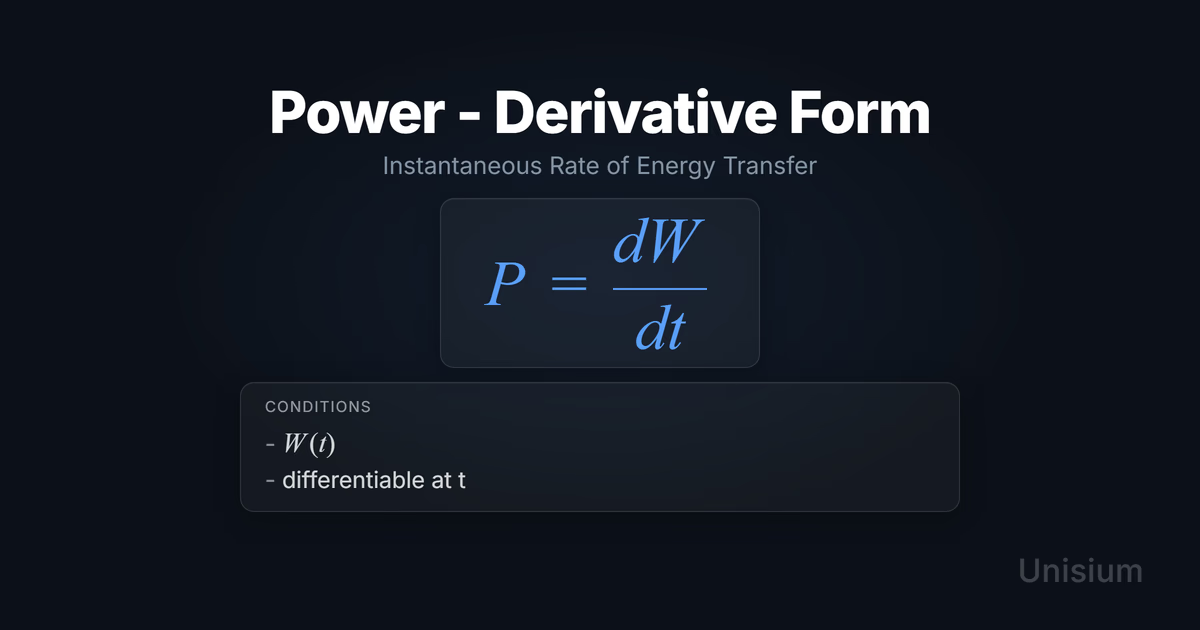
Power in its derivative form defines instantaneous power as the rate of change of work with respect to time: . It applies when work is a differentiable function of time, allowing us to calculate power at any specific instant rather than averaging over an interval.
While the algebraic definition of power () gives average power over a time interval, many real-world scenarios involve power that changes from moment to moment. An accelerating car’s engine, a variable-force collision, or a rocket’s thrust all produce power that varies continuously. The derivative form captures this instantaneous behavior, connecting power directly to the calculus of energy transfer.
On this page: The Principle | Conditions | Misconceptions | EE Questions | Retrieval Practice | Worked Example | Solve a Problem | FAQ
The Principle
Statement
Instantaneous power is the derivative of work with respect to time. When work is a differentiable function of time , the power at any instant equals the rate at which work is being done at that moment: .
Mathematical Form
Where:
- = instantaneous power (watts, W)
- = work done as a function of time (joules, J)
- = time (seconds, s)
- = time derivative of work (joules per second)
Alternative Forms
In different contexts, this appears as:
- Using force and velocity: (when is the net force or a specific force of interest)
- Rotational analog: For general 3D rotation, the power is ; for rotation about a fixed axis this reduces to (torque times angular velocity).
These forms follow from the chain rule: since , differentiating gives .
Conditions of Applicability
Condition: ; differentiable at t
Practical modeling notes
- Work must be a well-defined function of time, which requires tracking the energy transfer process continuously.
- Differentiability at means the derivative exists at that instant.
- In practice, most smooth force applications satisfy this condition. Brief, intense collisions are typically modeled with impulse rather than instantaneous power.
- For piecewise-smooth processes (e.g., a rocket with stages), evaluate the derivative separately on each smooth interval.
When It Doesn’t Apply
This form becomes problematic or requires modification in several scenarios:
- Impulsive collisions: When forces are so large and brief that work changes nearly instantaneously, the derivative becomes ill-defined. Use impulse-momentum methods instead.
- Discontinuous forces: If force (and hence work) has a jump discontinuity at time , may not exist there. Use average power over an interval.
- Non-time-parameterized work: If work is expressed as a function of position or another variable without an explicit time dependence, you must first express before differentiating.
Want the complete framework behind this guide? Read Masterful Learning.
Common Misconceptions
Misconception 1: “Power is always force times velocity”
The truth: The equation is valid only when you’re calculating the power delivered by that specific force. If multiple forces act, each contributes its own power term. The net power (rate of change of kinetic energy) equals the sum of all power contributions.
Why this matters: Students often write without specifying which force, leading to sign errors or missing contributions. Always identify: whose power? Which force’s power?
Misconception 2: “If velocity is constant, power must be zero”
The truth: Constant velocity means net force is zero (by Newton’s first law), so net power is zero. But individual forces can still do positive or negative work at nonzero rates. A car cruising at constant speed has engine thrust doing positive power and drag doing negative power; they cancel.
Why this matters: Confusing net power with individual force contributions leads to errors in energy analysis. Track each force’s power separately, then sum them.
Misconception 3: “Derivative form is just a calculus technique for the algebraic definition”
The truth: The derivative form is the fundamental definition of instantaneous power. The algebraic form is a consequence, valid only as an average over a time interval. You cannot compute instantaneous power from the algebraic form unless power is constant over the interval.
Why this matters: Treating as primary leads to errors when power varies. Always start with for instantaneous analysis, then integrate if you need total work.
Elaborative Encoding
Use these questions to build deep understanding. (See Elaborative Encoding for the full method.)
Within the Principle
- What does the derivative measure physically, and why must we use a derivative rather than a simple ratio when power changes over time?
- The units of are watts (W), which equal J/s. How does the derivative structure of guarantee that the units work out correctly?
For the Principle
- How do you decide whether to use versus in a given problem? What features of the physical situation indicate which form is appropriate?
- When work is given as , what additional information do you need before you can compute ?
Between Principles
- How does the derivative form relate to the algebraic definition ? Under what condition does the algebraic form give the same result as the derivative form?
Generate an Example
- Describe a physical scenario where the algebraic power formula would give a misleading answer, but the derivative form correctly captures the instantaneous behavior.
Retrieval Practice
Answer from memory, then click to reveal and check. (See Retrieval Practice for the full method.)
State the principle in words: _____Instantaneous power is the derivative of work with respect to time.
Write the canonical equation: _____
State the canonical condition: _____
Worked Example
Use this worked example to practice Self-Explanation.
Problem
A 1200 kg car accelerates from rest. The net horizontal force on the car varies with time according to (in newtons, with in seconds). Find the instantaneous power delivered by this net force at s.
Step 1: Verbal Decoding
Target: at
Given: , , ,
Constraints: 1D horizontal motion; net force along ; starts from rest.
Step 2: Visual Decoding
Draw a 1D axis. Choose forward. Draw along . Label along . (So and are positive.)
Step 3: Physics Modeling
Step 4: Mathematical Procedures
Step 5: Reflection
- Units: N·m/s = W.
- Magnitude: 41 kW is plausible for moderate acceleration.
- Limiting case: At , so .
Before moving on: self-explain the model
Try explaining Step 3 out loud (or in writing): why the chosen principle applies, what the diagram implies, and how the equations encode the situation.
Physics model with explanation (what “good” sounds like)
Principle: Instantaneous power is defined by . For a force doing work along the direction of motion, the chain rule gives , which is the form we use here. We also use Newton’s second law to connect force to velocity.
Conditions: The power derivative form applies because work is a differentiable function of time (the force is continuous). We’re calculating the power delivered by the net force.
Relevance: Since force varies with time, power also varies. We cannot use an average power formula; we must evaluate at the specific instant s.
Description: The car experiences a time-varying net force that decreases linearly. Starting from rest, the car accelerates. The acceleration decreases over time as the force weakens. Velocity increases but at a decreasing rate.
Goal: We need velocity at s to compute power. We find acceleration from , integrate to get , then multiply force and velocity at the target time.
Solve a Problem
Apply what you’ve learned with Problem Solving.
Problem
A 50 kg crate is pulled up a frictionless incline (angle ) by a rope parallel to the incline. The tension in the rope is constant at N. Find the instantaneous power delivered by the tension force when the crate’s speed is m/s.
Hint: Instantaneous power depends on the force and the velocity at that moment. You don’t need to know the crate’s position or how long it’s been moving—just the current speed.
Show Solution
Step 1: Verbal Decoding
Target:
Given: , , ,
Constraints: Frictionless incline; rope parallel to incline; constant tension; motion along incline.
Step 2: Visual Decoding
Draw the incline with angle . Choose up the incline. Label tension pointing up the incline, velocity pointing up the incline. (So and are parallel and positive.)
Step 3: Physics Modeling
Step 4: Mathematical Procedures
Step 5: Reflection
- Units: N·m/s = W.
- Magnitude: 750 W is about 1 horsepower, reasonable for pulling a crate up a slope.
- Limiting case: If , then even though tension is nonzero.
Related Principles
- Classical Mechanics: The Complete Principle Map — see where this principle fits in the full subdomain.
| Principle | Relationship to Power - Derivative Form |
|---|---|
| Power (Algebraic) | The algebraic form gives average power over an interval; the derivative form gives instantaneous power. When power is constant, the two are equal. |
| Work-Energy Theorem | Work equals change in kinetic energy. Differentiating with respect to time gives , connecting power to the rate of kinetic energy change. |
| Work (Integral Definition) | Power is the time derivative of work. Knowing allows us to derive using the chain rule. |
See Principle Structures for how to organize these relationships visually.
FAQ
What is the power derivative form?
The power derivative form defines instantaneous power as the rate of change of work with respect to time: . It tells you how fast energy is being transferred at a specific moment, rather than averaged over an interval.
When does the power derivative form apply?
It applies whenever work is a differentiable function of time . In practice, this means forces and motion must vary smoothly (no instantaneous collisions or discontinuous jumps at the moment you’re analyzing).
What’s the difference between the derivative form and the algebraic form of power?
The derivative form gives instantaneous power at a specific time. The algebraic form gives average power over a time interval. If power is constant during the interval, the two give the same result. If power varies, only the derivative form captures the instantaneous behavior.
What are the most common mistakes with the derivative form of power?
The top mistakes are: (1) Using without checking that force and velocity are parallel (must use dot product in general); (2) Forgetting to specify which force’s power you’re calculating when multiple forces act; (3) Trying to use for instantaneous power when power is changing.
How do I know when to use versus ?
They’re the same principle, just different forms. Use when work is given explicitly as a function of time. Use when you know the force and velocity at a specific instant. The force-velocity form is usually more practical for problem solving.
Related Guides
- Principle Structures — Organize this principle in a hierarchical framework
- Self-Explanation — Learn to explain worked examples step by step
- Retrieval Practice — Make this principle instantly accessible
- Problem Solving — Apply principles systematically to new problems
How This Fits in Unisium
Unisium helps you master the derivative form of power by combining elaborative encoding (to understand why power is a derivative and what that means physically), retrieval practice (to make the equation and its conditions instantly accessible), self-explanation (to reason through worked examples and see how the derivative connects to force and velocity), and problem solving (to apply the principle in varied contexts). Each study session reinforces the connections between power, work, force, and energy—building the mechanistic understanding that makes physics intuitive.
Ready to master the derivative form of power? Check access and join the Unisium waitlist or explore the full learning framework in Masterful Learning.

Masterful Learning
The book behind these guides: a study system for physics, math, & programming built on retrieval, connection, explanation, and problem solving.
Ready to apply this strategy?
Unisium turns these evidence-based techniques into guided study sessions for math and physics. Places are limited during early access. Check current availability to start a trial; joining the mailing list is optional.
See plans and availability Read More GuidesAlready have access? Sign in