Rotational Kinematics 4: Angular Displacement via Average Angular Velocity
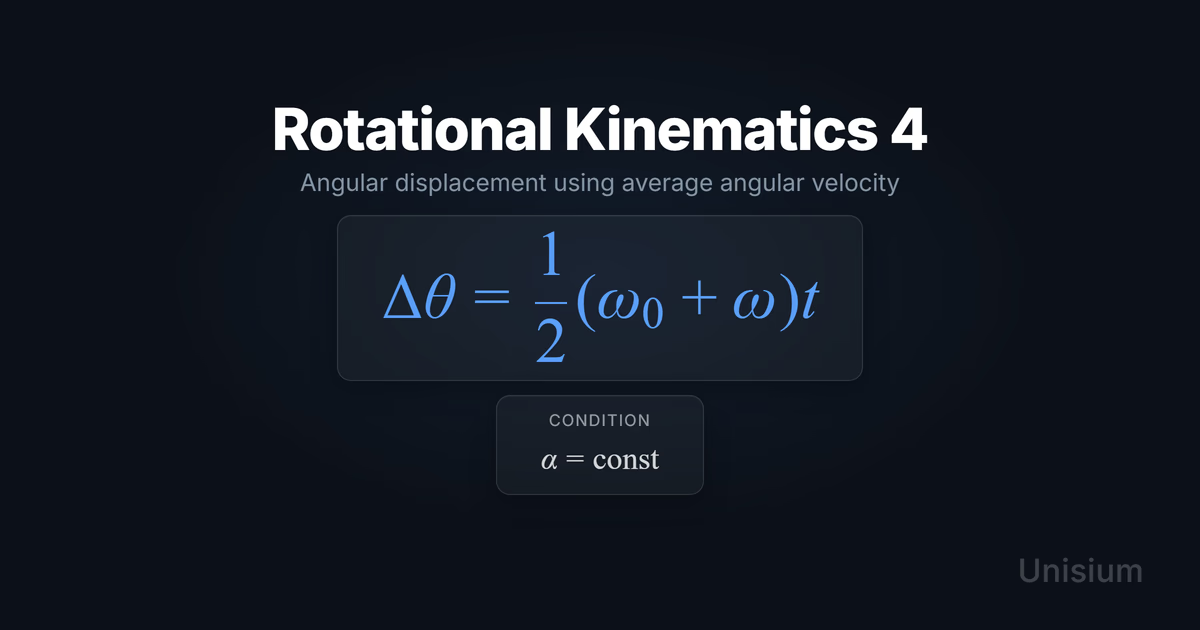
Rotational Kinematics 4 states that, when angular acceleration is constant, the angular displacement over a time interval equals the average of the initial and final angular velocities multiplied by time: . It’s the most direct way to compute when you know , , and but don’t want to solve for . Use it when the initial and final angular velocities are known and the angular acceleration is constant.
This equation is the rotational analog of the linear kinematics relation . It’s particularly useful when you know initial and final angular velocities but don’t know the angular acceleration directly. The equation expresses a fundamental fact about constant-acceleration motion: the average of the initial and final velocities gives you the true average velocity over the interval.
On this page: The Principle · Conditions · Misconceptions · EE Questions · Retrieval Practice · Worked Example · Solve a Problem · FAQ
The Principle
Statement
When an object rotates with constant angular acceleration, its angular displacement equals the average of its initial and final angular velocities multiplied by the elapsed time. This is one of four rotational kinematics equations that describe motion under constant angular acceleration.
Mathematical Form
Where:
- = angular displacement (rad)
- = initial angular velocity (rad/s)
- = final angular velocity (rad/s)
- = elapsed time (s)
Alternative Forms
In different contexts, this appears as:
- Explicit final angle:
- Using average angular velocity: where
Conditions of Applicability
Condition: This equation applies only when the angular acceleration is constant throughout the motion. If angular acceleration varies with time, this equation cannot be used.
Practical modeling notes
- “Constant angular acceleration” means is the same value at every instant during the time interval. Spinning up a rigid wheel with approximately steady net torque (and roughly constant resistive torque) is often close to constant .
- Choose a sign convention for your axis of rotation. Typically, counterclockwise is positive in the overhead view, but you must label your choice clearly.
- It’s derived assuming is constant over the interval.
When It Doesn’t Apply
This equation fails when angular acceleration changes during the motion:
- Variable torque: If the torque on a rotating object changes (e.g., a fan with a time-varying driving voltage), is not constant.
- Variable moment of inertia: If the object’s moment of inertia changes during rotation (e.g., a figure skater pulling in their arms), the relationship between torque and angular acceleration changes, making non-constant unless torque also adjusts perfectly.
- Non-constant friction: If angular friction increases with angular speed (e.g., air resistance on a spinning disk), changes over time.
What to use instead: For non-constant angular acceleration, you must integrate to find and then integrate again to find . Analytic solutions exist only for specific functional forms of .
Want the complete framework behind this guide? Read Masterful Learning.
Common Misconceptions
Misconception 1: The average angular velocity is always halfway between and
The truth: The arithmetic average equals the true average angular velocity only when angular acceleration is constant. If varies, the time-averaged angular velocity is not simply the midpoint of the initial and final values.
Why this matters: Students sometimes apply this equation to situations where angular acceleration changes (e.g., a motor that gradually increases torque), leading to incorrect angular displacement predictions.
Misconception 2: You can use this equation even if you don’t know the angular acceleration
The truth: While the equation doesn’t explicitly contain , it’s still derived under the assumption that . If is not constant, the equation is invalid regardless of whether you know ‘s value.
Why this matters: The absence of in the formula makes students think the condition "" doesn’t matter. This leads to misapplication in variable-acceleration problems.
Misconception 3: Angular displacement must be positive
The truth: Angular displacement can be negative if the object rotates opposite to your chosen positive direction. Similarly, and can be negative. The equation handles signs correctly as long as you use a consistent sign convention.
Why this matters: Failing to track signs causes errors when an object reverses direction or when comparing rotations in opposite directions.
Elaborative Encoding
Use these questions to build deep understanding. (See Elaborative Encoding for the full method.)
Within the Principle
- Why does the equation contain the factor ? What would happen to the calculated displacement if you used without the ?
- What are the units of each term, and why must have units of rad/s?
For the Principle
- How would you decide whether to use this equation versus Rotational Kinematics 1 () when solving a problem?
- If you measure a wheel starting from rest and reaching a final angular velocity in a known time, which kinematic equation would be most efficient for finding the total angle rotated?
Between Principles
- How does Rotational Kinematics 2 () explain why the average angular velocity becomes when is constant?
Generate an Example
- Describe a rotating system where you could easily measure , , and , making this equation the natural choice for finding (for example, a turntable with a tachometer and timer).
Retrieval Practice
Answer from memory, then click to reveal and check. (See Retrieval Practice for the full method.)
State the principle in words: _____Angular displacement equals the average of initial and final angular velocities multiplied by time, when angular acceleration is constant.
Write the canonical equation: _____
State the canonical condition: _____
Worked Example
Use this worked example to practice Self-Explanation.
Problem
A grinding wheel starts from rest and reaches an angular velocity of after spinning for . Assuming constant angular acceleration, how many radians does the wheel rotate during this time?
Step 1: Verbal Decoding
Target:
Given: , ,
Constraints: Constant angular acceleration, starts from rest
Step 2: Visual Decoding
Draw a top view. Choose counterclockwise as positive. Mark at the start and at the end using that sign convention.
(So and is positive.)
Step 3: Physics Modeling
Step 4: Mathematical Procedures
Step 5: Reflection
- Units: (rad/s)(s) = rad, correct for angular displacement.
- Magnitude: 375 radians is about 60 revolutions (), plausible for a wheel accelerating steadily over 5 seconds.
- Limiting case: If the wheel reached rad/s instantly (zero time), would be zero—consistent with the formula when .
Before moving on: self-explain the model
Try explaining Step 3 out loud (or in writing): why this equation applies, what the average angular velocity represents physically, and why multiplying by time gives the total angular displacement.
Physics model with explanation (what “good” sounds like)
Principle: Rotational Kinematics 4, which relates angular displacement to the average angular velocity when angular acceleration is constant.
Conditions: The problem states “constant angular acceleration,” satisfying .
Relevance: We know initial and final angular velocities plus the time interval, but not the angular acceleration explicitly. This equation directly connects those three quantities to .
Description: The average angular velocity is rad/s. Multiplying by the time interval gives the total angle swept out.
Goal: Substitute , rad/s, and s to compute rad. This tells us the wheel completes about 60 full rotations during its acceleration phase.
Solve a Problem
Apply what you’ve learned with Problem Solving.
Problem
A carousel decelerates uniformly from an angular velocity of to over a period of . Through what angle (in radians) does the carousel rotate during this deceleration?
Hint: The initial angular velocity is rad/s and the final is rad/s. Both are positive (same direction), so the carousel is slowing down but not reversing.
Show Solution
Step 1: Verbal Decoding
Target:
Given: , ,
Constraints: Uniform (constant) angular acceleration, deceleration (slowing down)
Step 2: Visual Decoding
Draw a top view. Choose counterclockwise as positive. Mark at the start and at the end using that sign convention.
(Both angular velocities are positive; the object is slowing but not reversing direction.)
Step 3: Physics Modeling
Step 4: Mathematical Procedures
Step 5: Reflection
- Units: (rad/s)(s) = rad, correct for angular displacement.
- Magnitude: 6.0 radians is slightly less than one full revolution ( rad), plausible for a carousel decelerating over 12 seconds from a modest initial speed.
- Limiting case: If the carousel decelerated to zero instead of rad/s, the average angular velocity would be rad/s and rad—our result of rad is larger, as expected when the final velocity is higher.
Related Principles
- Classical Mechanics: The Complete Principle Map — see where this principle fits in the full subdomain.
| Principle | Relationship to Rotational Kinematics 4 |
|---|---|
| Rotational Kinematics 1 | Gives using , , ; use RK4 when you know and instead of |
| Rotational Kinematics 2 | Relates , , , ; combine with RK4 to eliminate or |
| Rotational Kinematics 3 | Gives ; use when time is unknown |
See Principle Structures for how to organize these relationships visually.
FAQ
What is Rotational Kinematics 4?
Rotational Kinematics 4 is the equation , which calculates angular displacement from initial and final angular velocities when angular acceleration is constant.
When does Rotational Kinematics 4 apply?
It applies when angular acceleration is constant () and you know the initial angular velocity, final angular velocity, and time interval.
What’s the difference between Rotational Kinematics 4 and Rotational Kinematics 1?
Rotational Kinematics 1 () requires knowing explicitly, while RK4 uses and instead. Choose RK4 when you can measure final angular velocity but not angular acceleration directly.
What are the most common mistakes with Rotational Kinematics 4?
The most common mistakes are: (1) applying it when angular acceleration is not constant, (2) forgetting the factor, and (3) mixing up sign conventions when angular velocities are in opposite directions.
How do I know which rotational kinematics equation to use?
Identify which of the variables you know and which one you need. Each rotational kinematics equation omits one variable, so pick the one that excludes the variable you don’t have (and don’t want).
Related Guides
- Principle Structures — Organize this principle in a hierarchical framework
- Self-Explanation — Learn to explain worked examples step by step
- Retrieval Practice — Make this principle instantly accessible
- Problem Solving — Apply principles systematically to new problems
How This Fits in Unisium
Unisium helps you master rotational kinematics through targeted retrieval practice, elaborative encoding prompts that build conceptual understanding, and self-explanation exercises on worked examples. The system tracks your progress on each principle and adapts practice to ensure you can apply this equation fluently in diverse problem contexts.
Ready to master Rotational Kinematics 4? Check access and join the Unisium waitlist or explore the full learning framework in Masterful Learning.
Masterful Learning
The book behind these guides: a study system for physics, math, & programming built on retrieval, connection, explanation, and problem solving.
Ready to apply this strategy?
Unisium turns these evidence-based techniques into guided study sessions for math and physics. Places are limited during early access. Check current availability to start a trial; joining the mailing list is optional.
See plans and availability Read More GuidesAlready have access? Sign in