Displacement-Integral Relation: Finding Position from Velocity
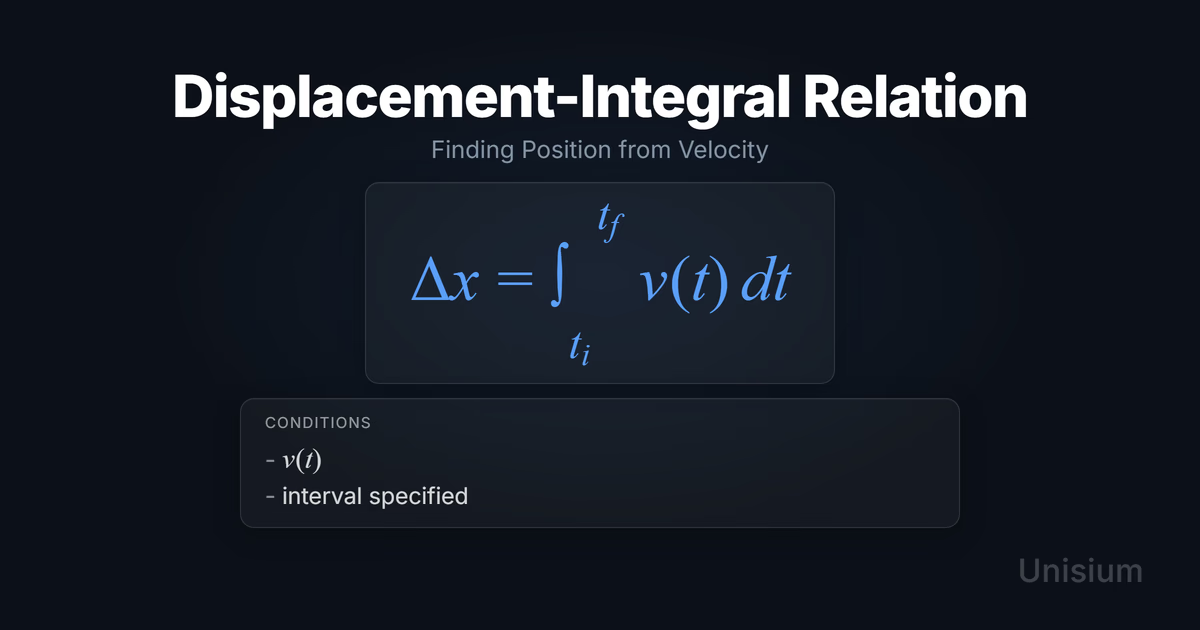
The Displacement-Integral Relation states that displacement over a time interval equals the definite integral of velocity: . It applies when is known and the interval is specified. Use it to compute signed displacement from a velocity-time function, especially when velocity varies with time and a velocity-time integral is clearer than a kinematic shortcut.
This principle is fundamental to kinematics with calculus. When you know how velocity changes with time but need to find the total displacement, integration provides the exact answer. It’s the inverse operation to finding velocity from position via differentiation.
On this page: The Principle | Conditions | Misconceptions | EE Questions | Retrieval Practice | Worked Example | Solve a Problem | FAQ
The Principle
Statement
The Displacement-Integral Relation states that the displacement of an object over a time interval equals the definite integral of its velocity function over that interval. Mathematically, if velocity is a known function of time, then the change in position is exactly the area under the velocity-time curve.
Mathematical Form
Where:
- = displacement (change in position) in meters (m)
- = velocity as a function of time in meters per second (m/s)
- = initial time in seconds (s)
- = final time in seconds (s)
- = infinitesimal time element in seconds (s)
The diagram is a -time graph. Its signed shaded area gives displacement : area above the time axis contributes positive displacement, while area below the axis contributes negative displacement.
Alternative Forms
In different contexts, this appears as:
- Position function (with initial condition):
- Vector form:
Conditions of Applicability
Condition: ; interval specified
This principle applies when:
- Velocity is a known function of time: You must have an explicit expression for , or enough information to construct one.
- The time interval is specified: You need definite limits of integration ( and ) to compute a numerical displacement.
Practical modeling notes
- If velocity is constant, the integral simplifies to (the kinematic equation for constant velocity).
- If velocity changes in a piecewise manner, break the interval into segments and integrate each separately.
- The velocity function must be integrable over the interval (continuous or with at most a finite number of discontinuities).
When It Doesn’t Apply
This principle requires knowledge of how velocity varies with time. It does not directly apply when:
- You only know position as a function of time: Use differentiation instead ().
- Velocity depends on position, not time: You may need to use and the chain rule, or work with energy methods.
- The velocity function is unknown or cannot be integrated analytically: You may need numerical integration methods.
Want the complete framework behind this guide? Read Masterful Learning.
Common Misconceptions
Misconception 1: The integral of velocity is the final position
The truth: The integral gives the displacement (), which is the change in position. To find the final position, you must add the initial position: .
Why this matters: Reporting the integral result as the final position without accounting for the starting point leads to incorrect answers when the motion doesn’t start at the origin.
Misconception 2: Integration “undoes” velocity, so you can always recover the entire motion history
The truth: Integration of velocity recovers displacement, but the constant of integration reflects the unknown initial position. Without boundary conditions (e.g., ), you cannot determine the absolute position function—only the displacement.
Why this matters: When solving problems, you must specify or solve for the initial conditions to get a complete description of the motion.
Misconception 3: If velocity is negative, displacement is negative
The truth: Displacement is the signed net area under the velocity curve. If velocity is negative over the entire interval, then displacement is negative. But if velocity changes sign, the displacement is the algebraic sum of positive and negative areas. Distance traveled (always positive) requires integrating the absolute value of velocity.
Why this matters: For distance traveled, you must integrate the absolute value of velocity: . Confusing distance and displacement leads to sign errors when velocity changes direction.
Elaborative Encoding
Use these questions to build deep understanding. (See Elaborative Encoding for the full method.)
Within the Principle
- What does the integral symbol represent physically in the context of velocity and displacement?
- Why does integrating velocity with respect to time give a quantity with units of length?
For the Principle
- How do you decide whether to use the displacement-integral relation versus a kinematic equation like ?
- What information must you have to apply this principle, and what information does it produce?
Between Principles
- How does the displacement-integral relation relate to the velocity-derivative relation ()? Why are they called inverse operations?
Generate an Example
- Describe a motion scenario where you would need to integrate velocity to find displacement, rather than using constant-acceleration kinematics.
Retrieval Practice
Answer from memory, then click to reveal and check. (See Retrieval Practice for the full method.)
State the displacement-integral relation in words: _____Displacement over a time interval equals the definite integral of velocity with respect to time.
Write the canonical equation: _____
State the canonical condition: _____
Worked Example
Use this worked example to practice Self-Explanation.
Problem
A car’s velocity increases according to (m/s), where is in seconds. What is the car’s displacement between and ?
Step 1: Verbal Decoding
Target:
Given: , ,
Constraints: one-dimensional motion
Step 2: Visual Decoding
Draw a velocity-time graph with time on the horizontal axis and velocity on the vertical axis. Sketch from to and shade the region between the curve and the time axis. (So .)
Step 3: Physics Modeling
Step 4: Mathematical Procedures
Step 5: Reflection
- Units: The integral of (m/s)(s) gives m, which is correct for displacement.
- Magnitude: 26 m is plausible for a car accelerating from 3 m/s to 27 m/s over 2 seconds.
- Limiting case: If , then , which is correct (no elapsed time means no displacement).
Before moving on: self-explain the model
Try explaining Step 3 out loud (or in writing): why the displacement-integral relation applies, what the definite integral represents, and how the limits encode the time interval.
Physics model with explanation (what “good” sounds like)
Principle: The displacement-integral relation applies because we are given velocity as an explicit function of time and asked for the displacement over a specified time interval.
Conditions: We have (velocity as a function of time) and the interval from to is specified. Both conditions are met.
Relevance: This principle is the right tool because displacement is the accumulation of all the infinitesimal “chunks” of motion () over the interval. The definite integral performs this summation exactly.
Description: The car’s velocity increases quadratically with time. By integrating from to , we compute the total displacement. The antiderivative of is , and evaluating this at the bounds gives the net change in position.
Goal: Find the total displacement between two specified times when the velocity function is known. The integral provides the exact answer without needing to know the position function explicitly.
Solve a Problem
Apply what you’ve learned with Problem Solving.
Problem
An object moves along a straight line with velocity (m/s), where is in seconds. Find the displacement of the object between and .
Hint: Notice that the velocity becomes negative partway through the interval. The integral will still give the correct signed displacement.
Show Solution
Step 1: Verbal Decoding
Target:
Given: , ,
Constraints: one-dimensional motion, velocity changes sign during interval
Step 2: Visual Decoding
Draw a velocity-time graph with time on the horizontal axis and velocity on the vertical axis. Sketch from to . Mark where at . Shade the region above the time axis from to (positive area) and below the axis from to (negative area). (So is the signed net area.)
Step 3: Physics Modeling
Step 4: Mathematical Procedures
Step 5: Reflection
- Units: The integral of (m/s)(s) gives m, which is correct for displacement.
- Magnitude: 24 m is plausible for an object that moves forward for 5 seconds (reaching maximum displacement of 25 m) then moves backward for 1 second (losing 1 m).
- Limiting case: If the velocity were constant at 10 m/s, displacement would be . Our answer is much less because the object slowed down and reversed direction, which makes sense.
Related Principles
- Classical Mechanics: The Complete Principle Map — see where this principle fits in the full subdomain.
| Principle | Relationship to Displacement-Integral Relation |
|---|---|
| Velocity-Derivative Relation () | Inverse operation: differentiation gives velocity from position; integration gives displacement from velocity |
| Velocity-Integral Relation () | Parallel structure: integrating acceleration with respect to time gives velocity change |
| Constant-Velocity Equation () | Special case when (constant), the integral simplifies to this algebraic form |
See Principle Structures for how to organize these relationships visually.
FAQ
What is the Displacement-Integral Relation?
The Displacement-Integral Relation is the principle that displacement over a time interval equals the definite integral of velocity with respect to time: . It allows you to compute how far an object moves when you know how its velocity changes with time.
When does the Displacement-Integral Relation apply?
It applies when velocity is known as a function of time and the time interval over which you want to find displacement is specified. You need an explicit expression for and the integration limits and .
What’s the difference between the Displacement-Integral Relation and the Velocity-Derivative Relation?
The Velocity-Derivative Relation () uses differentiation to find velocity from position. The Displacement-Integral Relation uses integration to find displacement from velocity. They are inverse operations in calculus.
What are the most common mistakes with the Displacement-Integral Relation?
The most common mistakes are: (1) reporting the integral as the final position instead of displacement (forgetting to add the initial position); (2) ignoring the sign of velocity in signed displacement problems; and (3) confusing displacement (signed) with distance traveled (always positive).
How do I know when to use integration versus constant-acceleration kinematics?
Use the displacement-integral relation when velocity is a known function of time but is not constant or uniformly changing. Use constant-acceleration kinematic equations () when acceleration is constant. Integration is the more general approach and reduces to the kinematic equations in special cases.
Related Guides
- Principle Structures — Organize this principle in a hierarchical framework
- Self-Explanation — Learn to explain worked examples step by step
- Retrieval Practice — Make this principle instantly accessible
- Problem Solving — Apply principles systematically to new problems
How This Fits in Unisium
Unisium helps you master the displacement-integral relation through spaced retrieval practice, elaborative encoding prompts, self-explanation of worked examples, and problem-solving drills. The system tracks your fluency with calculus-based kinematics and schedules targeted practice so you can confidently integrate velocity to find displacement in any physics problem.
Ready to master the Displacement-Integral Relation? Check access and join the Unisium waitlist or explore the full learning framework in Masterful Learning.

Masterful Learning
The book behind these guides: a study system for physics, math, & programming built on retrieval, connection, explanation, and problem solving.
Ready to apply this strategy?
Unisium turns these evidence-based techniques into guided study sessions for math and physics. Places are limited during early access. Check current availability to start a trial; joining the mailing list is optional.
See plans and availability Read More GuidesAlready have access? Sign in