Angular Velocity Change: Integral Form for Rotational Kinematics
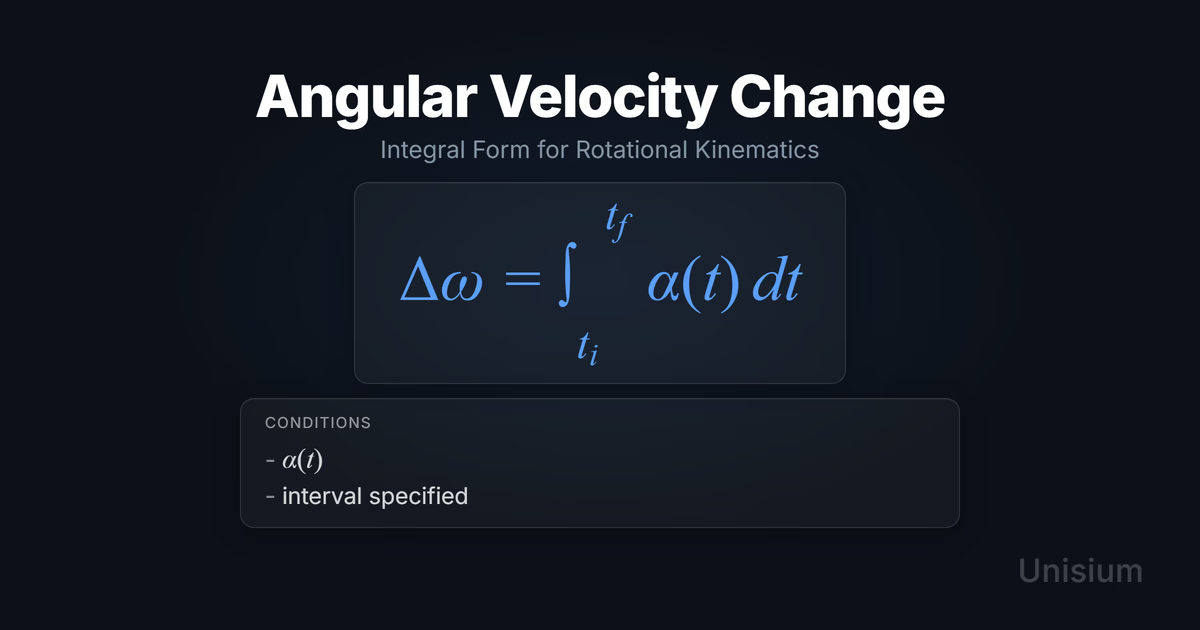
Angular Velocity Change - Integral Relation states that the change in angular velocity equals the integral of angular acceleration over time: . It applies when angular acceleration is known as a function of time and the time interval is specified.
This principle is the rotational analog of the velocity-change integral () for linear motion. When angular acceleration varies with time—due to changing torques or time-dependent forces—this integral form lets you calculate the cumulative change in angular velocity (provided is known explicitly). It’s essential for analyzing motors with time-varying torque, spinning discs with applied friction, and any rotating system where cannot be treated as constant.
On this page: The Principle | Conditions | Misconceptions | EE Questions | Retrieval Practice | Worked Example | Solve a Problem | FAQ
The Principle
Statement
The Angular Velocity Change - Integral Relation states that the change in angular velocity of a rotating object equals the time integral of its angular acceleration. If angular acceleration is known as a function of time, integrating over the interval gives the total change in angular velocity.
Mathematical Form
Where:
- = change in angular velocity (rad/s)
- = angular acceleration as a function of time (rad/s²)
- = initial time (s)
- = final time (s)
Equivalently, .
The diagram is an -time graph, not an -time graph. Its signed shaded area gives ; an -time area would give angular displacement instead.
Alternative Forms
In different contexts, this appears as:
- Vector form: (for 3D rotations about changing axes)
- Differential form: (infinitesimal change)
Conditions of Applicability
Condition: ; interval specified
This relation requires:
- Angular acceleration as a function of time: You must know explicitly or be able to express it in terms of time
- Specified time interval: The integration bounds and must be defined
Practical modeling notes
- If angular acceleration is constant, the integral simplifies to the algebraic form: . Use the simpler constant angular acceleration kinematic equation instead.
- For problems where torque (rather than ) is given as a function of time, first convert using (assuming constant moment of inertia). If changes with time, you can’t treat as a simple substitution without modeling .
- The axis of rotation must remain fixed in direction for the scalar form to apply. For tumbling or precessing bodies, use the vector form.
When It Doesn’t Apply
- Unknown : If angular acceleration depends on position or velocity (not time), you cannot integrate directly over time. Use energy methods or separate the variables.
- Undefined interval: If the time limits are not specified or you’re asked for instantaneous rate of change, use the derivative relation instead.
- Changing axis direction: If the rotation axis itself is rotating (e.g., gyroscope precession), the scalar form fails. Use the vector form or Euler’s equations for rigid-body motion.
Want the complete framework behind this guide? Read Masterful Learning.
Common Misconceptions
Misconception 1: “Integration always gives angular displacement”
The truth: Integrating angular velocity over time gives angular displacement: . Integrating angular acceleration gives angular velocity change: . These are distinct principles.
Why this matters: Mixing up what you’re integrating leads to dimensional errors and wrong answers. Check your units: has units rad/s², so integrating over time (s) yields rad/s, not rad.
Misconception 2: “This is the same as ”
The truth: The algebraic form assumes constant . The integral form handles time-varying .
Why this matters: If you use the constant-acceleration formula when is changing, your answer will be wrong. Always check whether is constant before choosing a kinematic equation.
Misconception 3: “I can integrate if I know as a function of angle”
The truth: To integrate over time, you need . If you have , you must change variables: , which gives the work-energy form, not this integral.
Why this matters: The integral form is specifically for time-dependent acceleration. If depends on position or velocity, use the appropriate alternative principle (e.g., rotational work-energy theorem).
Elaborative Encoding
Use these questions to build deep understanding. (See Elaborative Encoding for the full method.)
Within the Principle
- What is the physical meaning of the integral ? Why is it a sum of infinitesimal velocity changes?
- What are the units of each term in , and how do you verify that the equation is dimensionally consistent?
For the Principle
- How do you decide whether to use the integral form versus the algebraic form ?
- If a problem gives you torque as a function of time (not angular acceleration), what additional step do you need before applying this principle?
Between Principles
- How does this integral relation relate to the angular impulse-momentum theorem? What plays the role of “angular impulse” here?
Generate an Example
- Describe a physical situation where angular acceleration is time-varying (so the integral form is required), and explain why the simple algebraic form would fail.
Retrieval Practice
Answer from memory, then click to reveal and check. (See Retrieval Practice for the full method.)
State the principle in words: _____The change in angular velocity equals the time integral of angular acceleration.
Write the canonical equation: _____
State the canonical condition: _____
Worked Example
Use this worked example to practice Self-Explanation.
Problem
A flywheel initially spinning at experiences a braking torque that causes angular acceleration (where is in seconds). What is the angular velocity after ?
Step 1: Verbal Decoding
Target:
Given: , , ,
Constraints: Time-varying angular acceleration (linearly decreasing magnitude)
Step 2: Visual Decoding
Draw a 1D rotation axis. Choose (and ) counterclockwise. Label at as positive, and label at as unknown. Label as negative for . (So is positive and is negative.)
Step 3: Physics Modeling
Step 4: Mathematical Procedures
Step 5: Reflection
- Units: gives , matching angular velocity.
- Magnitude: A net change of in is plausible for braking that strengthens over time.
- Limiting case: If , the integral is zero and .
Before moving on: self-explain the model
Try explaining Step 3 out loud (or in writing): why the integral form applies here, why constant-acceleration formulas would fail, and what the integral physically represents.
Physics model with explanation (what “good” sounds like)
Principle: The angular velocity change integral relation applies because angular acceleration is given as a function of time.
Conditions: We know explicitly, and the interval is specified. Both conditions are satisfied.
Relevance: Since is not constant (it grows linearly in magnitude), we cannot use the constant-acceleration formula . The integral form is required.
Description: The integral sums up infinitesimal changes in angular velocity over the 2-second interval. Each moment , the angular velocity changes by . The total change is the area under the curve from to .
Goal: We integrate to find , then add it to to get the final angular velocity.
Solve a Problem
Apply what you’ve learned with Problem Solving.
Problem
A motor starts from rest and applies a time-varying angular acceleration (where is in seconds). What is the angular velocity at ?
Hint: Integrate over the interval from to .
Show Solution
Step 1: Verbal Decoding
Target:
Given: , , ,
Constraints: Starts from rest; time-varying angular acceleration
Step 2: Visual Decoding
Draw a 1D rotation axis. Choose (and ) in the motor’s spin-up direction. Label at as zero, and label at as positive. Label as positive for . (So and .)
Step 3: Physics Modeling
Step 4: Mathematical Procedures
Step 5: Reflection
- Units: Integrating over seconds yields .
- Magnitude: Reaching in is reasonable for sustained positive acceleration.
- Limiting case: At , the integral is zero and the motor remains at rest.
Related Principles
| Principle | Relationship to Angular Velocity Integral |
|---|---|
| Angular Acceleration (Derivative) | The inverse operation: differentiating gives ; integrating gives . |
| Angular Displacement Integral | Same structure, one level higher: integrating gives , just as integrating gives . |
| Angular Impulse-Momentum Theorem | Integrates torque (not ) over time to find angular momentum change. Related through . |
See Principle Structures for how to organize these relationships visually.
FAQ
What is the Angular Velocity Change - Integral Relation?
It is the calculus principle that connects time-varying angular acceleration to the change in angular velocity: . It is the rotational analog of the velocity-change integral () for linear motion.
When does this integral form apply?
When angular acceleration is known as a function of time () and the time interval is specified. If is constant, the simpler algebraic form is sufficient.
What’s the difference between this and the angular displacement integral?
This principle integrates angular acceleration to get angular velocity change. The angular displacement integral integrates angular velocity to get angular displacement. They are distinct kinematic relations.
What are the most common mistakes with this principle?
The most common mistakes are: (1) using the constant-acceleration formula when varies with time, (2) confusing angular velocity integration with angular acceleration integration, and (3) trying to integrate when is given as a function of angle or angular velocity (not time).
How do I know when to use the integral form versus the algebraic form?
If angular acceleration is constant over the interval, use the algebraic form . If varies with time, use the integral form .
Related Guides
- Principle Structures — Organize rotational kinematics principles in a hierarchical framework
- Self-Explanation — Learn to explain calculus-based worked examples step by step
- Problem Solving — Apply integral principles systematically to new problems
- Retrieval Practice — Make calculus principles instantly accessible under time pressure
How This Fits in Unisium
Unisium helps you master calculus-based rotational kinematics like the angular velocity integral through elaborative encoding (connecting derivative and integral forms), retrieval practice (recalling when to integrate vs. differentiate), self-explanation (verbalizing what the integral physically represents), and problem solving (applying the integral to time-varying acceleration functions).
Ready to master angular velocity integrals? Check access and join the Unisium waitlist or explore the full learning framework in Masterful Learning.
Masterful Learning
The book behind these guides: a study system for physics, math, & programming built on retrieval, connection, explanation, and problem solving.
Ready to apply this strategy?
Unisium turns these evidence-based techniques into guided study sessions for math and physics. Places are limited during early access. Check current availability to start a trial; joining the mailing list is optional.
See plans and availability Read More GuidesAlready have access? Sign in