Power (Rotation): Instantaneous Rate of Rotational Energy Transfer
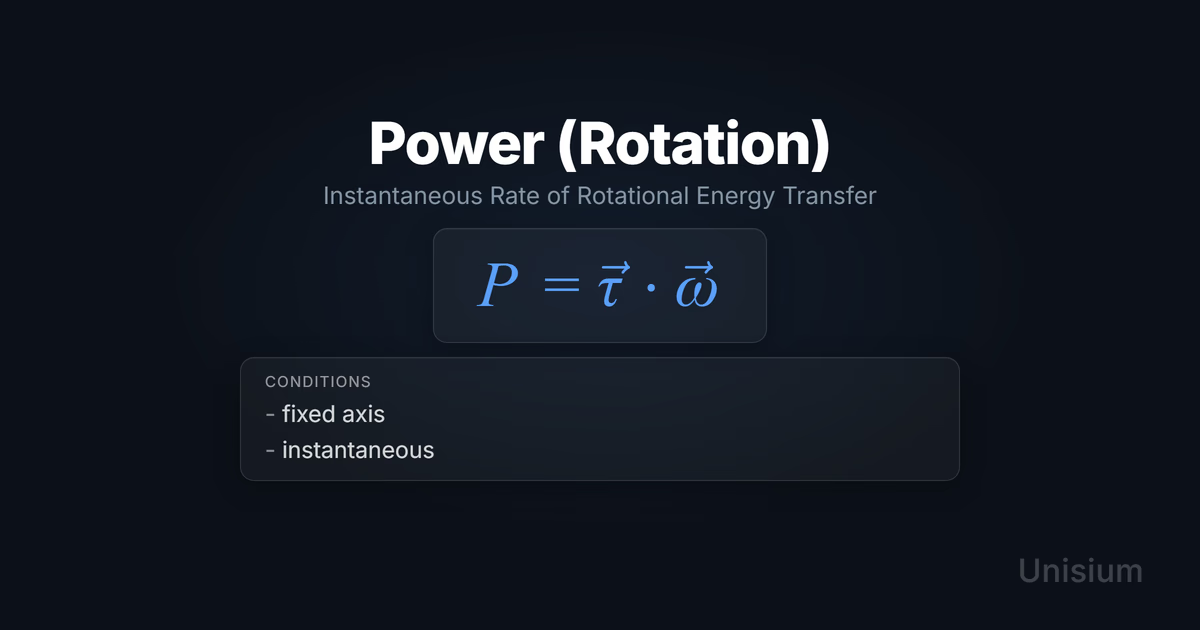
Power (Rotation) measures the instantaneous rate at which torque transfers energy to or from a rotating object, defined as . It applies when the object rotates about a fixed axis and you want instantaneous (not time-averaged) power.
Rotational power connects the kinematic description of rotation (angular velocity) to the energetic consequences of applied torques. Just as translational power tells us how quickly a force does work on a moving object, rotational power tells us how quickly a torque does work on a rotating object. This principle is essential for analyzing motors, turbines, engines, and any system where rotational motion transfers energy.
On this page: The Principle · Conditions · Misconceptions · EE Questions · Retrieval Practice · Worked Example · Solve a Problem · FAQ
The Principle
Statement
Power (Rotation) states that the instantaneous mechanical power delivered to (or extracted from) a rotating rigid body equals the product of the torque component along the rotation axis and the angular speed. Positive power means energy is being added to the system (the torque does positive work); negative power means energy is being extracted (the torque does negative work).
Mathematical Form
Where:
- = instantaneous power (watts, W = J/s)
- = torque along the rotation axis (newton-meters, N·m, signed scalar)
- = angular velocity along the rotation axis (radians per second, rad/s, signed scalar)
Both and are signed scalars: positive when they point along the chosen positive direction of the rotation axis, negative when opposite.
Alternative Forms
In different contexts, this appears as:
- Vector form: — when working with 3D vectors, the dot product gives the same result as when both are measured along the fixed axis
- Multiple torques: — the total power is the sum of power contributions from each torque component along the rotation axis
Conditions of Applicability
Condition: fixed axis; instantaneous
Practical modeling notes
- Fixed axis means the body rotates about an axis that doesn’t change direction or location over the time interval of interest. When both and are parallel to this axis, the dot product reduces to the scalar product of their magnitudes: .
- Instantaneous means this relation gives the power at a particular instant, not averaged over a finite time interval. If torque or angular velocity vary with time, you must evaluate at the moment of interest.
When It Doesn’t Apply
This form assumes rigid-body rotation about a fixed axis. It doesn’t apply when:
- Moving or reorienting axis: If the axis of rotation changes position or direction during the motion (e.g., a wobbling top before it settles), you need more general 3D rigid-body dynamics with angular momentum vectors.
- Deformable bodies: If the object deforms significantly during rotation (e.g., a wobbling spring or a fluid), rotational kinetic energy isn’t the only form of energy transfer; internal forces and heat dissipation matter.
- Time-averaged power: If you want the average power over a finite interval (e.g., ), you need to integrate or use the work-rotation relation (when torque is constant).
Want the complete framework behind this guide? Read Masterful Learning.
Common Misconceptions
Misconception 1: “Any torque on a rotating object delivers power”
The truth: Only the torque component along the rotation axis contributes to power. A torque perpendicular to the axis tries to tip or reorient the axis (resulting in precession or wobble) but delivers zero power at that instant—it doesn’t change the rotational kinetic energy.
Why this matters: In problems with angled forces (e.g., a motor shaft slightly misaligned, or a torque applied off-axis), students sometimes use the full torque magnitude in and get the wrong answer. You must project the torque onto the rotation axis first.
Misconception 2: “High power means high torque or high angular velocity”
The truth: Power is the product of torque and angular velocity. You can have high power with modest torque and high angular velocity (racing engines), or with high torque and low angular velocity (heavy machinery). Neither factor alone determines power.
Why this matters: When designing or analyzing rotational systems (motors, turbines, drills), students must balance torque and speed. A motor optimized for high torque at low speed (e.g., a car engine in first gear) delivers the same power as one optimized for low torque at high speed (same engine in fifth gear), but the applications are entirely different.
Misconception 3: “Rotational power is unrelated to translational power”
The truth: Both have identical mathematical structure: for rotation is the direct analog of for translation. Torque plays the role of force, and angular velocity plays the role of velocity. The principles are parallel.
Why this matters: Many students compartmentalize “rotation problems” and “translation problems.” Recognizing the analogy helps transfer intuition: just as a car engine delivering 100 kW at 50 m/s requires 2000 N of force, a motor delivering 100 W at 10 rad/s requires 10 N·m of torque.
Elaborative Encoding
Use these questions to build deep understanding. (See Elaborative Encoding for the full method.)
Within the Principle
- What does the product tell you physically? Why does power depend on both torque and angular velocity?
- If you double the angular velocity but halve the torque, what happens to the power? What if you reverse the sign of torque (opposite direction) while keeping angular velocity the same?
For the Principle
- How do you identify the rotation axis in a problem? What sign convention should you use for and ?
- A torque acts on a spinning object, but the power is zero. What does this tell you about the direction of the torque relative to the rotation axis?
Between Principles
- How is rotational power related to the work-rotation relation ? (Hint: consider the derivative form of power, .)
Generate an Example
- Describe a real-world situation where a motor applies a large torque to a rotating object, but the instantaneous power delivered is zero or negligible. What would cause this?
Retrieval Practice
Answer from memory, then click to reveal and check. (See Retrieval Practice for the full method.)
State the principle in words: _____The instantaneous mechanical power delivered to a rotating body about a fixed axis equals the product of torque and angular velocity along that axis.
Write the canonical equation: _____
State the canonical condition: _____fixed axis; instantaneous
Worked Example
Use this worked example to practice Self-Explanation.
Problem
A motor spins a circular saw blade at a constant angular velocity of . The motor applies a torque of to overcome friction and air resistance. What power does the motor deliver to the blade?
Step 1: Verbal Decoding
Target:
Given:
Constraints: constant angular velocity (equilibrium), fixed-axis rotation
Step 2: Visual Decoding
Draw a circular saw blade (viewed edge-on) rotating counterclockwise. Choose the rotation axis perpendicular to the page, pointing out toward you (call this the direction). Both and point along this axis. (So both are positive and parallel.)
Step 3: Physics Modeling
Step 4: Mathematical Procedures
Step 5: Reflection
- Units: N·m × rad/s = W ✓ (since radians are dimensionless, N·m·s⁻¹ = (J/m)·m·s⁻¹ = J/s = W)
- Magnitude: 600 W is reasonable for a small motor (about 0.8 horsepower), consistent with hand-held power tools.
- Limiting case: If (blade nearly stopped), then even if torque is applied—consistent with the idea that no work is done if there’s no angular displacement per unit time.
Before moving on: self-explain the model
Try explaining Step 3 out loud (or in writing): why the rotational power principle applies, what the diagram implies, and how the equation encodes the situation.
Physics model with explanation (what “good” sounds like)
Principle: We use rotational power because we have a rotating object (fixed-axis rotation) and want to find the rate of energy transfer.
Conditions: The blade rotates about a fixed axis (the motor shaft) and we’re asked for instantaneous power, so the “fixed axis; instantaneous” condition is satisfied. The motor torque and angular velocity are both along the rotation axis (parallel), so the dot product simplifies to the scalar product .
Relevance: Constant angular velocity means the net torque is zero (rotational equilibrium). But the motor still does work to overcome friction and air resistance—those resistive torques balance the motor torque. The power we calculate is the rate at which the motor supplies energy; an equal rate of energy is dissipated by friction.
Description: The motor applies 5.0 N·m along the rotation axis, and the blade spins at 120 rad/s. Since both are in the same direction, the dot product gives the product of their magnitudes.
Goal: Multiply torque by angular velocity to find the instantaneous power delivered by the motor.
Solve a Problem
Apply what you’ve learned with Problem Solving.
Problem
A wind turbine blade rotates at an angular velocity of . The wind exerts a torque of in the direction of rotation, and the generator extracts torque (opposite direction). What is the net power delivered to the turbine blade by the wind? What power does the generator extract?
Hint: Calculate the power from each torque separately using . Remember to account for the sign (direction) of each torque.
Show Solution
Step 1: Verbal Decoding
Target:
Given:
Constraints: fixed-axis rotation, wind torque and generator torque in opposite directions
Step 2: Visual Decoding
Draw the turbine blade rotating counterclockwise (viewed from the front). Choose axis pointing out of the page along the rotation axis. Wind torque points in the direction (same as ): . Generator torque opposes rotation: . (So , one torque is positive, one is negative.)
Step 3: Physics Modeling
Step 4: Mathematical Procedures
Step 5: Reflection
- Units: N·m × rad/s = W ✓
- Magnitude: 20 kW delivered by wind, 18.75 kW extracted by generator—reasonable for a small wind turbine. The negative sign on means the generator removes energy from the blade.
- Limiting case: If (blade stopped), both powers go to zero even though torques are applied—consistent with power being a rate of energy transfer per angular displacement.
Related Principles
- Classical Mechanics: The Complete Principle Map — see where this principle fits in the full subdomain.
| Principle | Relationship to Power (Rotation) |
|---|---|
| Power (Algebraic) | Translational analog; has the same mathematical structure, with force and velocity replacing torque and angular velocity. |
| Work (Rotation) | Rotational power is the time derivative of rotational work: . For constant torque, , and follows from . |
| Power (Derivative Form) | General definition applies to both translation and rotation. Rotational power is the rotational case of this principle. |
| Power Definition | Translation analog: force times velocity. |
See Principle Structures for how to organize these relationships visually.
FAQ
What is Power (Rotation)?
Power (Rotation) measures the instantaneous rate at which torque transfers energy to or from a rotating object. It’s defined as the product of torque (along the rotation axis) and angular velocity: . Positive power means energy is being added; negative power means energy is being extracted.
When does Power (Rotation) apply?
It applies when you have rigid-body rotation about a fixed axis and want to find the instantaneous rate of energy transfer. The “fixed axis” condition means the axis doesn’t change direction or location, and “instantaneous” means you’re evaluating power at a specific moment (not averaged over time).
What’s the difference between Power (Rotation) and Power (Algebraic)?
Power (Algebraic) is the translational version: . Power (Rotation) is the rotational analog: . They have identical mathematical structure, with torque and angular velocity playing the roles of force and velocity. Both measure the rate of mechanical energy transfer.
What are the most common mistakes with Power (Rotation)?
The most common mistakes are: (1) ignoring the dot product and using magnitudes when torque and angular velocity aren’t aligned, (2) confusing instantaneous power with average power over a finite time interval, and (3) forgetting that high power can come from either high torque with low speed or low torque with high speed—the product matters, not individual factors.
How do I know which form of Power (Rotation) to use?
For fixed-axis rotation (the standard case in introductory physics), use the scalar form with signed values for torque and angular velocity along the rotation axis. This covers motors, wheels, pulleys, and most rotating machinery. The vector form is equivalent but usually unnecessary unless you’re working in 3D with multiple coordinate directions.
Related Guides
- Principle Structures — Organize this principle in a hierarchical framework
- Self-Explanation — Learn to explain worked examples step by step
- Retrieval Practice — Make this principle instantly accessible
- Problem Solving — Apply principles systematically to new problems
How This Fits in Unisium
Unisium helps you master rotational power (and all core physics principles) through spaced retrieval practice, elaborative encoding prompts, and guided self-explanation. When you study a problem involving rotational power, the system prompts you to identify the conditions (fixed axis? instantaneous?), recall the canonical equation, and explain why each step in the solution follows from the physics model. This deep engagement—not passive rereading—builds durable understanding that transfers to new problems.
Ready to master Power (Rotation)? Check access and join the Unisium waitlist or explore the full learning framework in Masterful Learning.
Masterful Learning
The book behind these guides: a study system for physics, math, & programming built on retrieval, connection, explanation, and problem solving.
Ready to apply this strategy?
Unisium turns these evidence-based techniques into guided study sessions for math and physics. Places are limited during early access. Check current availability to start a trial; joining the mailing list is optional.
See plans and availability Read More GuidesAlready have access? Sign in