Power (Algebraic): Calculating Energy Transfer Rate
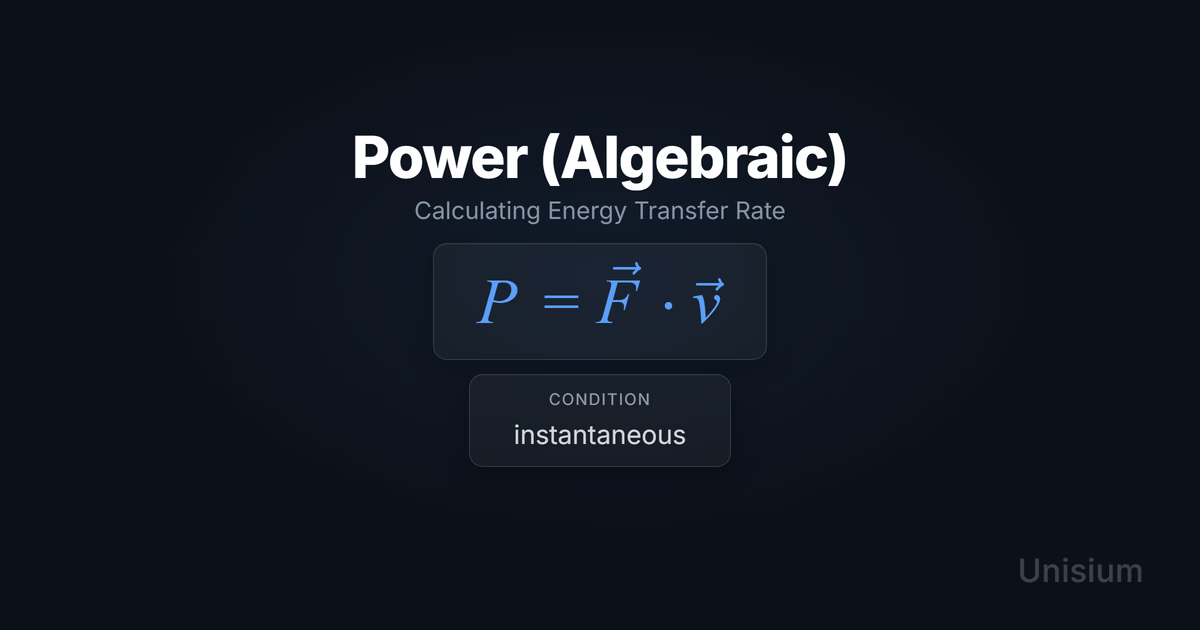
Power (Algebraic) defines the instantaneous rate at which a force does work on an object: . Use it when force and velocity are both defined at an instant and you need the rate of mechanical energy transfer.
Power connects force, velocity, and energy transfer. While work measures total energy transferred over a displacement, power measures how quickly that energy transfer happens. This distinction is crucial in engineering applications where the rate of energy delivery matters as much as the total amount.
On this page: The Principle · Conditions · Misconceptions · EE Questions · Retrieval Practice · Worked Example · Solve a Problem · FAQ
The Principle
Statement
Power is the instantaneous rate at which a force does work on an object. It equals the dot product of the force vector and the velocity vector at any given moment. Positive power means the force delivers energy to the object; negative power means the force removes energy.
Mathematical Form
Where:
- = instantaneous power (watts, W = J/s)
- = force vector acting on the object (newtons, N)
- = velocity vector of the object at the point of application (m/s)
Alternative Forms
In different contexts, this appears as:
- General magnitudes: where is the angle between force and velocity
- Parallel motion: when (force and velocity in same direction)
- Anti-parallel motion: when (force opposes velocity)
Conditions of Applicability
Condition: instantaneous This equation gives the instantaneous power—the rate at which force does work right now—which matters when force or velocity varies with time. If you need average power over an interval, you must integrate or compute instead.
Practical modeling notes
- The dot product means only the component of force parallel to velocity contributes to power
- If , then (e.g., centripetal forces do no work and deliver no power)
- For average power over a time interval, integrate instantaneous power or use
Scope and interpretation
This relation applies universally in classical mechanics—but students often answer the wrong question:
- Instantaneous vs average: This gives power right now. For average power over an interval, use
- Single-force vs net power: This formula gives power from one force. Net power requires summing contributions from all forces
- Point of application: For rigid bodies, evaluate at the contact point or center of mass depending on context
- Unisium boundary: Non-relativistic mechanics only (at speeds )
Want the complete framework behind this guide? Read Masterful Learning.
Common Misconceptions
Misconception 1: Power is just work divided by time
The truth: That’s average power. Instantaneous power tells you the rate right now, which can vary moment to moment.
Why this matters: In problems with changing forces or velocities, instantaneous power changes continuously. Using gives only the average over an interval and misses the variation.
Misconception 2: All forces on an object contribute to its power
The truth: Only the component of force parallel to velocity contributes. Forces perpendicular to motion deliver zero power.
Why this matters: A car turning at constant speed has centripetal force acting on it, but that force does no work and delivers no power. Confusing this leads to incorrect energy accounting.
Misconception 3: Negative power means something is wrong
The truth: Negative power simply means the force opposes motion and removes energy from the object (like friction or drag).
Why this matters: Braking systems, air resistance, and energy dissipation all produce negative power. Recognizing this is essential for modeling real-world energy flows.
Elaborative Encoding
Use these questions to build deep understanding. (See Elaborative Encoding for the full method.)
Within the Principle
- Why does the dot product capture the rate of work? What does each factor contribute?
- What are the units of power in SI? Show how is equivalent to .
For the Principle
- How would you decide whether to use or in a given problem?
- When a force acts perpendicular to velocity, what does tell you about the force’s effect on kinetic energy?
Between Principles
- How does instantaneous power relate to the work-energy theorem? What happens when you integrate over time?
Generate an Example
- Describe a situation where a large force acts on an object but delivers zero power. Explain why.
Retrieval Practice
Answer from memory, then click to reveal and check. (See Retrieval Practice for the full method.)
State the principle in words: _____Power is the instantaneous rate at which a force does work on an object, equal to the dot product of force and velocity.
Write the canonical equation: _____
State the canonical condition: _____instantaneous
Worked Example
Use this worked example to practice Self-Explanation.
Problem
A tow truck pulls a 1200 kg car along a level road with a cable angled above horizontal. The cable tension is 800 N, and the car moves at a constant speed of 2.5 m/s. What is the instantaneous power delivered by the cable?
Step 1: Verbal Decoding
Target: (instantaneous power delivered by cable)
Given: , ,
Constraints: level road, constant speed, cable at angle
Step 2: Visual Decoding
Draw a coordinate system with along the car’s motion (horizontal, to the right). Draw the velocity vector along . Draw the tension vector at above the axis. (So is positive and the angle between and is .)
Step 3: Physics Modeling
Step 4: Mathematical Procedures
Step 5: Reflection
- Units: ✓
- Magnitude: About 1.7 kW, comparable to ~2.3 horsepower—reasonable for towing at moderate speed
- Limiting case: If , then and , which makes sense: a purely vertical force (perpendicular to motion) delivers no power
Before moving on: self-explain the model
Try explaining Step 3 out loud (or in writing): why the chosen principle applies, what the diagram implies, and how the equations encode the situation.
Physics model with explanation (what “good” sounds like)
Principle: Power defines the instantaneous rate of energy transfer.
Conditions: This principle gives instantaneous power—the rate right now—which matters because force or velocity can vary with time.
Relevance: We want the rate at which the cable does work on the car, which is exactly what power measures.
Description: The cable exerts tension at above horizontal. The car moves horizontally at velocity . The angle between and is . Only the horizontal component of tension () contributes to power because the vertical component is perpendicular to motion.
Goal: We substitute the magnitudes and angle into to get the instantaneous power delivered by the cable.
Solve a Problem
Apply what you’ve learned with Problem Solving.
Problem
A helicopter in steady hover exerts a downward force of 18,000 N on the air. The air moves downward at 15 m/s through the rotor disk. What is the instantaneous power delivered by the rotor to the air?
Show Solution
Step 1: Verbal Decoding
Target: (power delivered by rotor to air)
Given: ,
Constraints: steady hover, thrust force on air is downward, air velocity is downward
Step 2: Visual Decoding
Draw a coordinate system with vertical (upward). Draw the rotor as a disk. Draw the force vector pointing downward (the rotor pushes air down). Draw the air velocity vector pointing downward at 15 m/s. (So both and point in the direction.)
Step 3: Physics Modeling
Step 4: Mathematical Procedures
Step 5: Reflection
- Units: ✓
- Magnitude: About 270 kW ≈ 360 horsepower—reasonable for a medium helicopter
- Limiting case: If air velocity were zero (rotor not moving air), power would be zero even with force present—consistent with
Related Principles
- Classical Mechanics: The Complete Principle Map — see where this principle fits in the full subdomain.
| Principle | Relationship to Power (Algebraic) |
|---|---|
| Translational Work | Prerequisite; power measures the rate of work transfer |
| Power – Derivative Form | Equivalent definition via work rate ; use when work as a function of time is the given object |
| Work-Energy Theorem | Integrating net power over time gives the change in kinetic energy: |
| Power (Rotation) | Rotational analog: torque times angular velocity. |
| Power (Derivative Form) | Calculus upgrade: instantaneous power as dW/dt. |
See Principle Structures for how to organize these relationships visually.
FAQ
What is Power (Algebraic)?
Power is the instantaneous rate at which a force does work on an object. It equals the dot product of the force vector and the velocity vector: . Positive power means energy is delivered to the object; negative power means energy is removed.
When does power apply?
Power is a definition, so it applies whenever force and velocity are both defined. It measures the instantaneous rate of energy transfer at any moment in any mechanical system.
What’s the difference between instantaneous power and average power?
Instantaneous power tells you the rate of work at a specific instant. Average power is the total work divided by the time interval. If force or speed varies, instantaneous power changes moment to moment, while average power smooths over the interval.
What are the most common mistakes with power?
The most common mistakes are: (1) using when the problem asks for instantaneous power, (2) forgetting that only the force component parallel to velocity contributes, and (3) treating negative power as an error instead of recognizing it as energy removal.
How do I know which form of power to use?
Use (or ) for instantaneous power when force and velocity are known at a specific moment. Use when you have total work over a time interval and need the average rate.
Related Guides
- Principle Structures — Organize this principle in a hierarchical framework
- Self-Explanation — Learn to explain worked examples step by step
- Retrieval Practice — Make this principle instantly accessible
- Problem Solving — Apply principles systematically to new problems
How This Fits in Unisium
Unisium helps you master power through spaced retrieval, elaborative questions, and tracked problem solving. The platform provides instant feedback on your power calculations and connects this principle to work, energy, and dynamics within a structured learning path. Ready to master Power (Algebraic)? Check access and join the Unisium waitlist or explore the full learning framework in Masterful Learning.
Masterful Learning
The book behind these guides: a study system for physics, math, & programming built on retrieval, connection, explanation, and problem solving.
Ready to apply this strategy?
Unisium turns these evidence-based techniques into guided study sessions for math and physics. Places are limited during early access. Check current availability to start a trial; joining the mailing list is optional.
See plans and availability Read More GuidesAlready have access? Sign in