Hooke's Law: Understanding Spring Force and Elastic Behavior
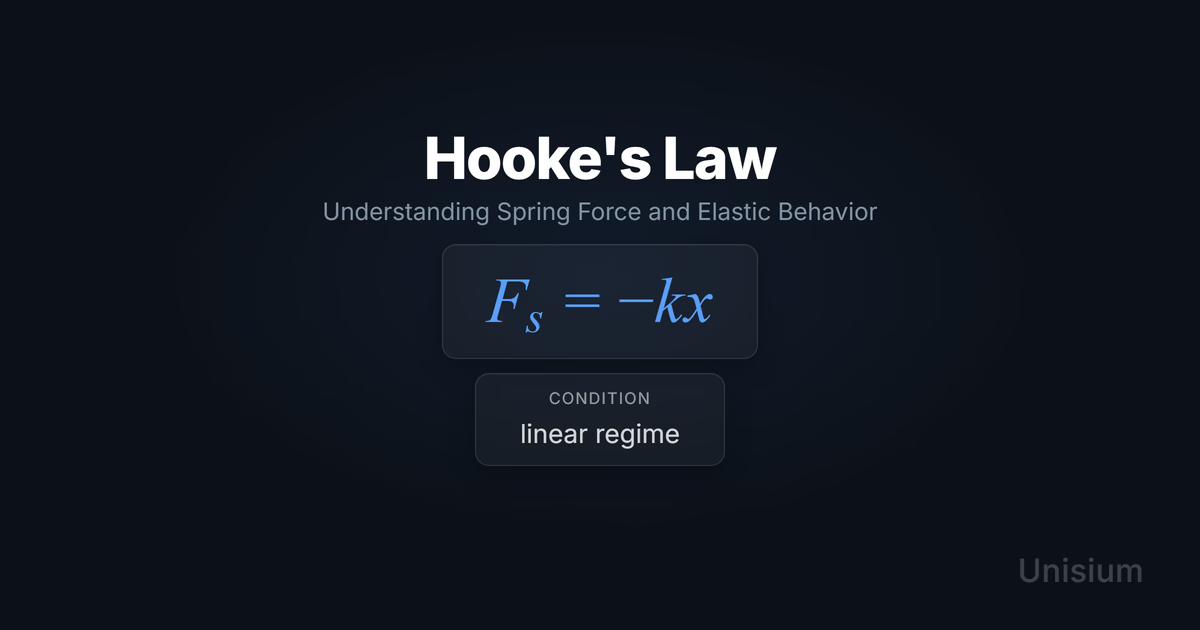
Hooke’s Law states that the restoring force exerted by an ideal spring is proportional to displacement from the spring’s natural length: . The negative sign means the force points back toward the spring’s zero-force length, and the rule applies only while the spring stays in its linear regime.
Use Hooke’s Law when displacement is measured from the spring’s natural length and the spring remains in its linear regime; outside that range, the force is no longer proportional to displacement and stops being the right model.
On this page: The Principle · Conditions · Misconceptions · EE Questions · Retrieval Practice · Worked Example · Solve a Problem · FAQ
The Principle
Statement
Hooke’s Law states that the restoring force exerted by an ideal spring is proportional to its displacement from the spring’s natural length and points back toward that zero-force length. The proportionality constant is the spring constant, which measures the spring’s stiffness.
Mathematical Form
Where:
- = spring force (N)
- = spring constant (N/m)
- = displacement from the spring’s natural length (m)
The negative sign indicates that the spring force always points back toward the spring’s natural length (a restoring force).
Alternative Forms
In different contexts, this appears as:
- Vector form:
- Magnitude only:
Conditions of Applicability
Condition: linear regime The linear regime means the spring obeys Hooke’s Law only for displacements where the force–displacement relationship remains linear. Real springs deviate from this relationship when stretched or compressed too far.
Practical modeling notes (optional)
- Most introductory problems assume ideal springs operating within the linear regime
- The spring constant remains constant (no temperature effects, no plastic deformation)
- Displacement is measured from the spring’s natural length, where the spring exerts zero force
- In shifted-coordinate oscillator problems, you may measure displacement from the system’s static equilibrium instead. Then the equation describes the net restoring force relative to that equilibrium, not the raw spring force from natural length.
When It Doesn’t Apply
Hooke’s Law fails outside the linear regime or when the spring is damaged:
- Large deformations: When stretched or compressed beyond the elastic limit, springs enter the plastic regime where forces are no longer proportional to displacement. Use non-linear elastic models or plasticity theory.
- Permanent deformation: When a spring is overstretched and doesn’t return to its original length, it has exceeded its yield point. The spring constant changes or the spring fails entirely.
Want the complete framework behind this guide? Read Masterful Learning.
Common Misconceptions
Misconception 1: The spring constant depends on displacement
The truth: The spring constant is a property of the spring itself (material, geometry, coil spacing). It does not change with how far the spring is stretched or compressed.
Why this matters: If you treat as variable, you’ll incorrectly model energy storage and force calculations. In problems, is given and remains constant throughout.
Misconception 2: The negative sign means the force is always negative
The truth: The negative sign indicates direction relative to displacement, not that the force value is negative. If the spring is compressed (), then (points back toward natural length). If stretched (), then (also points back toward natural length).
Why this matters: Misunderstanding the sign convention leads to errors in force diagrams and free-body diagrams, especially when combining spring forces with other forces.
Misconception 3: Hooke’s Law applies to all elastic objects
The truth: Hooke’s Law describes ideal springs in the linear regime. Many elastic objects (rubber bands, biological tissues, nonlinear springs) do not follow a linear force–displacement relationship.
Why this matters: Applying Hooke’s Law to non-linear elastic systems produces incorrect predictions. Always check if the linear regime assumption holds.
Elaborative Encoding
Use these questions to build deep understanding. (See Elaborative Encoding for the full method.)
Within the Principle
- What does the negative sign in tell you about the direction of the spring force relative to the displacement?
- How do the units of the spring constant (N/m) reflect the relationship between force and displacement?
For the Principle
- In a vertical spring-mass system, why is the static equilibrium not the same as the spring’s zero-force natural length?
- When analyzing a spring-mass system, how do you decide whether the spring force points left, right, up, or down?
Between Principles
- How does Hooke’s Law imply that a spring can store potential energy? What feature of the force makes that possible?
Generate an Example
- Describe a situation where a spring operates outside the linear regime and Hooke’s Law fails.
Retrieval Practice
Answer from memory, then click to reveal and check. (See Retrieval Practice for the full method.)
State Hooke's Law in words: _____The restoring force exerted by an ideal spring is proportional to displacement from the spring's natural length and points back toward that zero-force length.
Write the canonical equation for Hooke's Law: _____
State the canonical condition: _____linear regime
Worked Example
Use this worked example to practice Self-Explanation.
Problem
A spring with spring constant N/m is compressed by m from its natural length. What is the magnitude of the spring force?
Step 1: Verbal Decoding
Target:
Given: ,
Constraints: spring operates in linear regime, displacement from natural length
Step 2: Visual Decoding
Try drawing the spring in its compressed state. Draw a 1D axis. Choose pointing right (toward the stretched direction). Label the natural length and the compressed position. The spring is compressed, so (to the left of natural length). The spring force will point right (back toward natural length), so .
(So the displacement is m, and we expect the spring force to be positive, pointing right toward natural length.)
Step 3: Physics Modeling
Step 4: Mathematical Procedures
Step 5: Reflection
- Units: N/m × m = N ✓
- Magnitude: A 15 cm compression with a moderately stiff spring ( N/m) produces 30 N, roughly the weight of a 3 kg mass—plausible.
- Limiting case: If , then (no displacement, no force). If (soft spring), then even with displacement.
Before moving on: self-explain the model
Try explaining Step 3 out loud (or in writing): why Hooke’s Law applies, what the sign convention means, and how the equation encodes the restoring force.
Physics model with explanation (what “good” sounds like)
Principle: Hooke’s Law applies because the spring is operating in the linear regime, and we’re measuring displacement from natural length.
Conditions: The problem states the spring has a constant spring constant , implying linear behavior. The displacement is measured from the spring’s natural length.
Relevance: This principle directly relates the spring force to displacement, allowing us to compute the force magnitude given and .
Description: The spring is compressed (displacement negative relative to our chosen direction). The restoring force points toward natural length (positive direction), opposing the compression.
Goal: We want the magnitude of the spring force. We use Hooke’s Law with the correct sign convention to find , then take the absolute value.
Solve a Problem
Apply what you’ve learned with Problem Solving.
Problem
A spring with spring constant N/m is stretched by 8.0 cm. What is the magnitude of the spring force?
Hint: The spring force magnitude is proportional to the stretch.
Show Solution
Step 1: Verbal Decoding
Target:
Given: ,
Constraints: linear regime, displacement from natural length
Step 2: Visual Decoding
Draw a 1D axis. Choose in the stretch direction. Mark at the spring’s natural length and at the stretched position. The spring force points back toward natural length (opposite ).
(So is positive and is negative.)
Step 3: Physics Modeling
Step 4: Mathematical Procedures
Step 5: Reflection
- Units: N/m × m = N ✓
- Magnitude: 40 N is a strong pull, consistent with a stiff spring stretched several cm.
- Limiting case: If , then .
Related Principles
- Classical Mechanics: The Complete Principle Map — see where this principle fits in the full subdomain.
| Principle | Relationship to Hooke’s Law |
|---|---|
| Newton’s Second Law | Spring force from Hooke’s Law is one force component in |
| Work-Energy Theorem | Spring force does work, changing kinetic energy; leads to potential energy concept |
| Potential Spring Energy | The potential energy stored in a spring is , derived by integrating Hooke’s Law |
See Principle Structures for how to organize these relationships visually.
FAQ
What is Hooke’s Law?
Hooke’s Law states that the restoring force exerted by an ideal spring is proportional to displacement from the spring’s natural length, with the force pointing back toward that zero-force length: .
When does Hooke’s Law apply?
Hooke’s Law applies when the spring operates within its linear regime—small enough deformations that the force–displacement relationship remains linear. Real springs deviate at large displacements.
What’s the difference between Hooke’s Law and Newton’s Second Law?
Hooke’s Law describes the specific force exerted by a spring. Newton’s Second Law relates the net force (which may include the spring force) to acceleration: . You use Hooke’s Law to find the spring force, then include it in Newton’s Second Law to analyze motion.
What are the most common mistakes with Hooke’s Law?
The most common mistakes are: (1) forgetting the negative sign and getting the force direction wrong, (2) treating as variable instead of constant, and (3) applying Hooke’s Law outside the linear regime.
How do I know if a spring is in the linear regime?
Introductory problems assume the linear regime unless stated otherwise. In real systems, you test by measuring force versus displacement and checking for linearity. If the graph curves, the spring is outside the linear regime.
Why is the negative sign important in Hooke’s Law?
The negative sign encodes the restoring nature of the force: the spring always pulls (or pushes) back toward natural length. If you stretch the spring (), the force is negative (points left toward natural length). If you compress it (), the force is positive (points right toward natural length).
Related Guides
- Principle Structures — Organize Hooke’s Law in a hierarchical framework
- Self-Explanation — Learn to explain worked examples step by step
- Retrieval Practice — Make Hooke’s Law instantly accessible
- Problem Solving — Apply principles systematically to new problems
How This Fits in Unisium
Unisium helps you master Hooke’s Law through elaborative encoding (connecting force, displacement, and energy concepts), retrieval practice (quickly recalling and its conditions), self-explanation (articulating why the restoring force points back toward natural length), and problem solving (applying the principle to new spring systems). The app tracks your understanding of each principle and schedules practice to build long-term mastery.
Ready to master Hooke’s Law? Check access and join the Unisium waitlist or explore the full learning framework in Masterful Learning.

Masterful Learning
The book behind these guides: a study system for physics, math, & programming built on retrieval, connection, explanation, and problem solving.
Ready to apply this strategy?
Unisium turns these evidence-based techniques into guided study sessions for math and physics. Places are limited during early access. Check current availability to start a trial; joining the mailing list is optional.
See plans and availability Read More GuidesAlready have access? Sign in