Translational Work: Energy from Constant Force
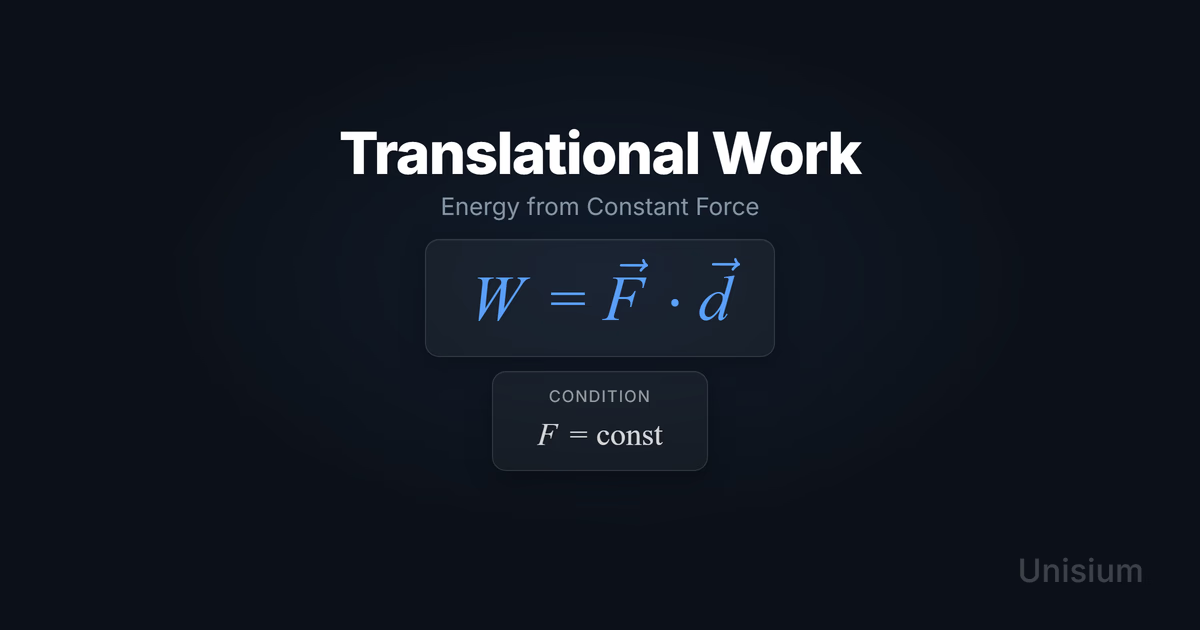
Work done by a constant force quantifies the energy transferred when a steady force acts on an object through a displacement. It is defined as the dot product of the force vector and the displacement vector, , and applies when the force magnitude is constant and the angle between force and displacement is fixed during the motion.
On this page: The Principle · Conditions · Misconceptions · EE Questions · Retrieval Practice · Worked Example · Solve a Problem · FAQ
The Principle
Statement
The work done by a constant force is the energy transferred when a steady force acts on an object as it moves through a displacement. Work depends on both the magnitude of the force, the magnitude of the displacement, and the angle between them. If the force and displacement are in the same direction, the work is positive. If they oppose each other, the work is negative. If they are perpendicular, no work is done.
Mathematical Form
Where:
- = work done by the force (J, or N·m)
- = constant force vector (N)
- = displacement vector (m)
- = dot product (scalar product)
Alternative Forms
When the force and displacement are not aligned, the scalar magnitude form is:
- Scalar Form:
Where:
- = magnitude of the force (N)
- = magnitude of the displacement (m)
- = angle between and
Conditions of Applicability
Condition:
Practical modeling notes
- The force magnitude must remain constant throughout the displacement. The force direction is typically also fixed (resulting in straight-line motion), which simplifies the dot product.
- For varying forces, use the integral definition of work:
- This algebraic form is typically introduced before calculus-based mechanics.
When It Doesn’t Apply
Variable force magnitude or direction: If the force changes in magnitude or direction during the displacement (such as a spring force, gravitational force over large distances, or friction on a curved path), you must use the integral definition of work or break the motion into segments where the force is approximately constant.
No displacement: If the displacement is zero (such as holding a heavy box stationary or pushing against a wall that doesn’t move), no work is done regardless of the force magnitude.
Want the complete framework behind this guide? Read Masterful Learning.
Common Misconceptions
Misconception 1: Work is always positive
The truth: Work can be positive, negative, or zero depending on the angle between the force and displacement. Positive work means energy is transferred to the object. Negative work means energy is transferred from the object (such as friction slowing it down).
Why this matters: Recognizing negative work helps you correctly apply the work-energy theorem and track where energy goes in a system.
Misconception 2: Holding a heavy object means doing work
The truth: Work requires displacement. If you hold a stationary box, you exert an upward force, but the displacement is zero, so . You feel tired because your muscles expend chemical energy maintaining tension, but mechanically no work is done on the box.
Why this matters: Distinguishing mechanical work from biological effort prevents errors when applying energy conservation principles.
Misconception 3: The force that does work must cause the motion
The truth: Work depends only on the component of force along the displacement, not on whether that force caused the motion. For example, gravity does positive work on a ball you throw upward (even though gravity opposes the initial motion) once it starts falling back down.
Why this matters: You can have multiple forces doing work (positive or negative) simultaneously on an object, and the net work determines the change in kinetic energy.
Elaborative Encoding
Use these questions to build deep understanding. (See Elaborative Encoding for the full method.)
Within the Principle
- Why is work a scalar quantity even though both force and displacement are vectors?
- What does the dot product physically represent, and how does the angle affect the result?
For the Principle
- How do you decide whether the work done by a force is positive, negative, or zero in a given situation?
- When can you use the algebraic form instead of the more general integral definition?
Between Principles
- How does the work-constant force relation connect to the work-energy theorem?
Generate an Example
- Describe a situation where a force is applied to an object but no work is done (displacement is zero or perpendicular to force).
Retrieval Practice
Answer from memory, then click to reveal and check. (See Retrieval Practice for the full method.)
State the principle in words: _____The work done by a constant force is the energy transferred when a steady force acts on an object through a displacement. It equals the dot product of the force vector and the displacement vector.
Write the canonical equation: _____
State the canonical condition: _____
Worked Example
Use this worked example to practice Self-Explanation.
Problem
A worker pushes a 25 kg crate across a warehouse floor by applying a constant horizontal force of 85 N. The crate moves 12 m in a straight line. How much work does the worker do on the crate?
Step 1: Verbal Decoding
Target: (work done by the applied force)
Given: , ,
Constraints: Horizontal push, straight-line motion, constant force
Step 2: Visual Decoding
Try drawing the situation. Draw a 1D horizontal axis. Choose in the direction of motion (to the right). The applied force points along , and the displacement points along . Label both vectors pointing to the right. (So the angle between them is .)
Step 3: Physics Modeling
Step 4: Mathematical Procedures
Step 5: Reflection
- Units: Newtons times meters gives joules (N·m = J), which is correct for work.
- Magnitude: Reasonable—pushing a crate 12 meters with significant force requires substantial energy transfer.
- Limiting case: If the displacement were zero, , which makes sense—no motion means no energy transferred.
Before moving on: self-explain the model
Try explaining Step 3 out loud (or in writing): why the chosen principle applies, what the diagram implies, and how the equation encodes the situation.
Physics model with explanation (what “good” sounds like)
Principle: We use the work-constant force relation because the worker applies a steady horizontal force throughout the entire displacement.
Conditions: The force magnitude is constant throughout the 12 m displacement, and the force direction is fixed (horizontal), satisfying the condition.
Relevance: Work quantifies the energy transferred to the crate by the applied force. Since the force and displacement are aligned, the dot product simplifies to .
Description: The worker pushes horizontally, so the applied force and displacement vectors are parallel. This means all of the force contributes to the work done on the crate. The mass of the crate does not appear in the work calculation—it affects the acceleration, but not the work done by this specific force.
Goal: We want to find the energy transferred by the worker’s push, which is the work . The equation directly gives this value when we substitute the force magnitude, displacement, and angle.
Solve a Problem
Apply what you’ve learned with Problem Solving.
Problem
A student pulls a 15 kg suitcase across a horizontal airport floor by applying a force of 60 N at an angle of above the horizontal. The suitcase moves 20 m in a straight line along the floor. How much work does the student do on the suitcase?
Hint: Only the component of the force along the direction of displacement contributes to the work.
Show Solution
Step 1: Verbal Decoding
Target: (work done by the applied force)
Given: , , ,
Constraints: Force at angle above horizontal, horizontal displacement, constant force
Step 2: Visual Decoding
Try drawing the situation. Draw a 1D horizontal axis. Choose in the direction of motion (along the floor). The displacement points along . The applied force points at above the horizontal. The angle between and is . (So the force has a horizontal component along and a vertical component upward.)
Step 3: Physics Modeling
Step 4: Mathematical Procedures
Step 5: Reflection
- Units: Newtons times meters gives joules, which is correct for work.
- Magnitude: The work is slightly less than if the force were fully horizontal (which would give 1200 J), because only the horizontal component contributes to the work.
- Limiting case: If the angle were 90° (pulling straight up), , so no work would be done, which makes sense—no horizontal displacement component means no work along the floor.
Related Principles
- Classical Mechanics: The Complete Principle Map — see where this principle fits in the full subdomain.
| Principle | Relationship to Work - Constant Force |
|---|---|
| Work-Energy Theorem | Uses the net work (sum of work done by all forces) to determine the change in kinetic energy |
| Translational Kinetic Energy | Work changes the kinetic energy of an object; work and kinetic energy are connected through the work-energy theorem |
| Gravitational Potential Energy | Work done by or against gravity relates to changes in gravitational potential energy |
| Work (Rotation) | Rotational analog: torque times angular displacement. |
| Work (Integral Definition) | Calculus upgrade: extends to variable forces and curved paths. |
| Power: Derivative Form | Converts work changing over time into instantaneous power, . |
See Principle Structures for how to organize these relationships visually.
FAQ
What is work done by a constant force?
Work is the energy transferred when a constant force acts on an object through a displacement. It is defined as , where the dot product captures both the magnitude and directional alignment between force and displacement.
When does the constant-force work formula apply?
The formula applies when the force magnitude and direction remain constant throughout the displacement. For varying forces, you must use the integral definition of work.
What’s the difference between work and force?
Force is a vector quantity (N) that describes the push or pull on an object. Work is a scalar quantity (J) that describes the energy transferred by a force acting through a displacement. You can exert a large force but do no work if there is no displacement.
What are the most common mistakes with work calculations?
Using the full force magnitude instead of the component along the displacement (forgetting the factor), assuming work is always positive (it can be negative), and claiming work is done when displacement is zero.
How do I know if work is positive or negative?
Work is positive if the force has a component in the direction of motion (), negative if it opposes motion (), and zero if the force is perpendicular to displacement ().
Related Guides
- Principle Structures — Organize this principle in a hierarchical framework
- Work-Energy Theorem — Connect work to changes in kinetic energy
- Self-Explanation — Learn to explain worked examples step by step
- Problem Solving — Apply principles systematically to new problems
How This Fits in Unisium
Unisium helps you master work and energy principles through deliberate practice with elaborative encoding, retrieval practice, self-explanation, and problem solving. The app structures your learning so you build robust, transferable understanding of when and how to apply the work-constant force relation—not just memorize the formula.
Ready to master work done by constant forces? Check access and join the Unisium waitlist or explore the full learning framework in Masterful Learning.
Masterful Learning
The book behind these guides: a study system for physics, math, & programming built on retrieval, connection, explanation, and problem solving.
Ready to apply this strategy?
Unisium turns these evidence-based techniques into guided study sessions for math and physics. Places are limited during early access. Check current availability to start a trial; joining the mailing list is optional.
See plans and availability Read More GuidesAlready have access? Sign in