Velocity - Derivative Definition: Instantaneous Rate of Position Change
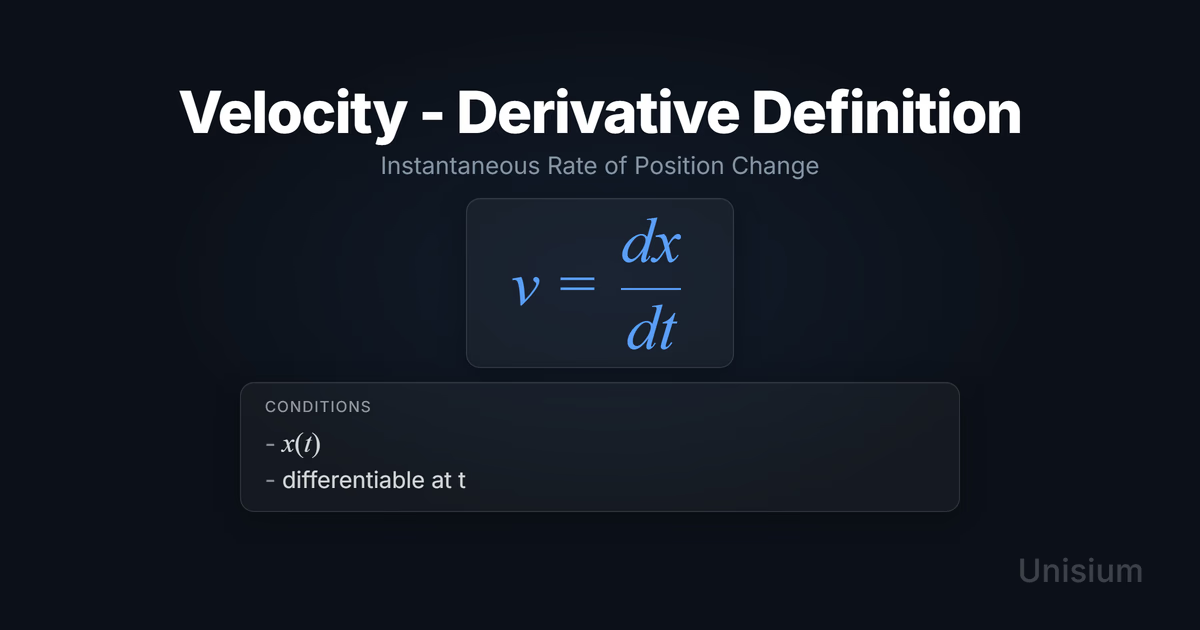
Velocity - Derivative Definition states that instantaneous velocity is the time derivative of position: . It applies when the position function is differentiable at the time of interest. The sign of encodes direction along your chosen axis, so tracking sign conventions is essential.
This definition bridges discrete kinematics (average velocity) to continuous motion through calculus. It forms the foundation for analyzing motion when position changes smoothly and enables precise predictions at any instant—essential for physics, engineering, and applied mathematics.
On this page: The Principle | Conditions | Misconceptions | EE Questions | Retrieval Practice | Worked Example | Solve a Problem | FAQ
The Principle
Statement
The instantaneous velocity of an object is the derivative of its position with respect to time. At any moment , velocity measures how rapidly position changes, capturing both magnitude (speed) and direction. This differs from average velocity (which requires a time interval) by giving the exact rate at the instant.
Mathematical Form
Where:
- = instantaneous velocity (m/s or appropriate units)
- = position as a function of time (m)
- = time (s)
- = derivative of position with respect to time
Alternative Forms
In different contexts, this appears as:
- Vector form: (in two or three dimensions, capturing velocity’s directional nature)
- Component notation: , , (for motion in multiple dimensions)
Conditions of Applicability
Condition: ; differentiable at t
Practical modeling notes
- The position function must be differentiable at the time of interest—the derivative must exist
- For piecewise motion (sudden changes in velocity), use one-sided derivatives at transition points
- When position data is discrete (e.g., experimental measurements), approximate derivatives using finite differences or fit a smooth function first
When It Doesn’t Apply
- Discontinuous position: If has a jump (teleportation-like behavior), the derivative is undefined at that instant
- Only velocity given: If you’re given and asked for position, use the integral relation instead
- Average over finite interval: If the problem asks for average velocity over a time interval , use (no derivatives needed)
Want the complete framework behind this guide? Read Masterful Learning.
Common Misconceptions
Misconception 1: “Velocity is the same as speed”
The truth: Velocity is a vector (has direction); speed is its magnitude. can be negative (indicating direction), while speed is always non-negative. For one-dimensional motion, m/s means moving in the positive direction; m/s means moving in the negative direction, both at 5 m/s speed.
Why this matters: Confusing velocity and speed causes sign errors in kinematics equations. When using , the sign encodes direction—you must track it throughout the solution.
Misconception 2: “I can’t find velocity unless I know the full position function”
The truth: You only need the position function near the time of interest. The derivative is a local property: it depends on how behaves in an infinitesimal neighborhood of time , not the entire trajectory.
Why this matters: In many problems, you’re given only in a specific interval or with boundary conditions. You can still compute instantaneous velocity in that region without knowing the entire motion history.
Misconception 3: ” means ‘divide by ’ like ordinary fractions”
The truth: is a single symbol representing the limit of as . While Leibniz notation suggests a ratio, it’s shorthand for the limit process. You cannot “cancel” arbitrarily across equations unless you’re working in a rigorous differential framework (e.g., separation of variables in calculus).
Why this matters: Treating derivatives as simple fractions leads to errors in more advanced contexts (partial derivatives, chain rule applications). Always ground your reasoning in the limit definition when in doubt.
Elaborative Encoding
Use these questions to build deep understanding. (See Elaborative Encoding for the full method.)
Within the Principle
- What is the physical meaning of the derivative ? Why does taking a limit as give instantaneous velocity?
- Why is velocity a vector in general, and how does the one-dimensional scalar equation capture direction through sign?
For the Principle
- How do you decide whether to use the derivative definition versus the average velocity formula in a given problem?
- When position data comes from a discrete set of measurements (e.g., a position sensor recording every 0.1 s), what must you do before applying ?
Between Principles
- How does relate to ? Why is acceleration the second derivative of position?
Generate an Example
- Describe a physical situation where you’re given explicitly (e.g., ) and would use the derivative definition to find velocity at a specific instant.
Retrieval Practice
Answer from memory, then click to reveal and check. (See Retrieval Practice for the full method.)
State the principle in words: _____Instantaneous velocity is the derivative of position with respect to time.
Write the canonical equation: _____
State the canonical condition: _____
Worked Example
Use this worked example to practice Self-Explanation.
Problem
A particle moves along a straight line with position given by meters, where is in seconds. Find the instantaneous velocity at s.
Step 1: Verbal Decoding
Target: at s
Given: ,
Constraints: One-dimensional motion
Step 2: Visual Decoding
Draw a 1D axis for position. Choose to the right. Mark the particle and label the velocity at as along the axis. (If the computed value is positive, it points right; if negative, it points left.)
Step 3: Physics Modeling
Step 4: Mathematical Procedures
Step 5: Reflection
- Units: Position is in meters, time in seconds; derivative gives m/s (correct for velocity)
- Magnitude: 4 m/s is reasonable for a particle whose position varies on the order of meters over seconds
- Limiting case: If , m/s; as increases, the term dominates and velocity grows quadratically (consistent with a cubic position function)
Before moving on: self-explain the model
Try explaining Step 3 out loud (or in writing): why the chosen principle applies, what the diagram implies, and how the equations encode the situation.
Physics model with explanation (what “good” sounds like)
Principle: The derivative definition of velocity applies because we’re given an explicit position function and asked for velocity at a specific instant.
Conditions: The condition “x(t); differentiable at t” is satisfied—we have , which is differentiable everywhere (polynomial functions are smooth). Instantaneous velocity exists at s.
Relevance: Since we need velocity at one specific time (not averaged over an interval), the derivative definition is the correct tool. Average velocity formulas don’t apply here because we’re not given two distinct times or positions to compare.
Description: The particle’s position follows a cubic function, meaning its velocity changes with time in a quadratic way. At s, we compute the slope of the tangent line to the curve, which physically represents how fast (and in what direction) the particle moves at that exact moment.
Goal: Differentiate the position function to get , then substitute s to find the numerical value. The positive result (4 m/s) indicates motion in the direction at that instant.
Solve a Problem
Apply what you’ve learned with Problem Solving.
Problem
An object’s position along a track is described by meters. Determine the instantaneous velocity at s and interpret the sign of your answer.
Hint: Differentiate the position function, then evaluate at s. Remember that the sign of indicates direction.
Show Solution
Step 1: Verbal Decoding
Target: at s
Given: ,
Constraints: One-dimensional motion
Step 2: Visual Decoding
Draw a 1D axis for position. Choose to the right. Mark the particle and label the velocity at as along the axis. (If the computed value is positive, it points right; if negative, it points left.)
Step 3: Physics Modeling
Step 4: Mathematical Procedures
Step 5: Reflection
- Units: m/s is correct for velocity
- Magnitude: 8 m/s is a reasonable speed; the negative sign indicates motion in the direction (left) at this instant
- Limiting case: At , m/s (positive, moving right); at s, (turning point); beyond that, velocity is negative (moving left), consistent with a parabolic trajectory that peaks and descends
Related Principles
- Classical Mechanics: The Complete Principle Map — see where this principle fits in the full subdomain.
| Principle | Relationship to Velocity - Derivative Definition |
|---|---|
| Acceleration - Derivative Definition | Extends the derivative approach: gives acceleration as the rate of change of velocity, making acceleration the second derivative of position |
| Kinematics 4 - Average Velocity | Simplification: when is finite and you don’t need instantaneous values, approximates the derivative |
See Principle Structures for how to organize these relationships visually.
FAQ
What is the velocity derivative definition?
The velocity derivative definition states that instantaneous velocity is the time derivative of position: . It applies when the position function is known and differentiable, allowing you to compute the exact rate of position change at any instant.
When does the derivative definition of velocity apply?
It applies when you’re given an explicit position function (or can construct one from data) and need instantaneous velocity at a specific time. The function must be differentiable at that time—no jumps or discontinuities.
What’s the difference between instantaneous velocity and average velocity?
Instantaneous velocity () is the rate at a single moment, found by taking the limit as time interval approaches zero. Average velocity () requires a finite time interval and gives the overall rate between two times. As , average velocity converges to instantaneous velocity.
What are the most common mistakes with the velocity derivative definition?
(1) Confusing velocity (vector, can be negative) with speed (scalar, always non-negative). (2) Forgetting that is a limit, not an ordinary fraction—don’t manipulate it algebraically without justification. (3) Applying the derivative definition when only discrete position data is available without first fitting or smoothing the data.
How do I know which form of velocity to use?
Use when you have a continuous, differentiable position function and need velocity at a specific instant. Use when you’re given two positions and times and need an average. Use vector form for multi-dimensional motion. The problem statement’s given information guides your choice.
Related Guides
- Principle Structures — Organize calculus-based kinematics in a hierarchical framework
- Self-Explanation — Learn to explain worked derivative problems step by step
- Retrieval Practice — Make the derivative definition instantly accessible
- Problem Solving — Apply calculus principles systematically to kinematics problems
How This Fits in Unisium
Unisium helps students master specific principles like the velocity derivative definition through deliberate practice in elaborative encoding, retrieval practice, self-explanation, and problem solving. The platform scaffolds the transition from discrete kinematics to calculus-based motion analysis, ensuring you can apply fluently in physics and engineering contexts.
Ready to master the velocity derivative definition? Check access and join the Unisium waitlist or explore the full learning framework in Masterful Learning.

Masterful Learning
The book behind these guides: a study system for physics, math, & programming built on retrieval, connection, explanation, and problem solving.
Ready to apply this strategy?
Unisium turns these evidence-based techniques into guided study sessions for math and physics. Places are limited during early access. Check current availability to start a trial; joining the mailing list is optional.
See plans and availability Read More GuidesAlready have access? Sign in