Static Friction: Understanding the Force that Prevents Sliding
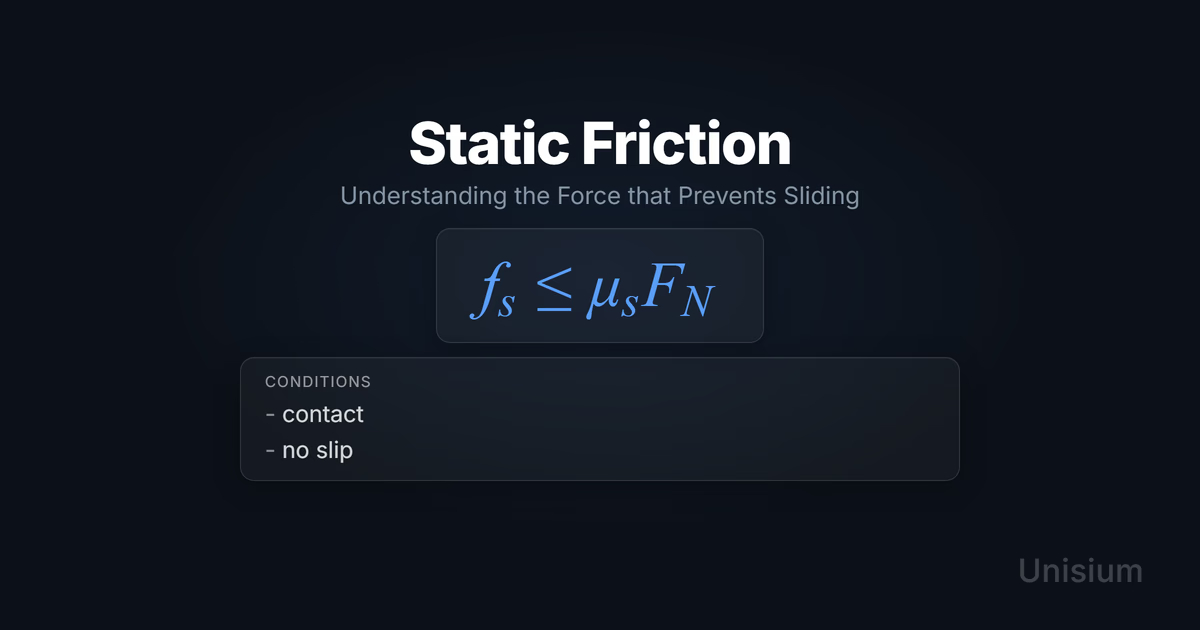
Static friction is the contact force that prevents two surfaces from slipping relative to each other. It is not automatically equal to ; it adjusts to whatever value is needed, up to the maximum . Use static friction in contact problems with no slip, especially equilibrium and onset-of-motion problems where the main question is whether slipping begins.
Static friction is often misunderstood as a single fixed value, but it’s a variable force that responds to applied forces. Understanding when it reaches its maximum and how it relates to the normal force is essential for analyzing equilibrium and the onset of motion in classical mechanics.
On this page: The Principle · Conditions · Misconceptions · EE Questions · Retrieval Practice · Worked Example · Solve a Problem · FAQ
The Principle
Statement
Static friction is the force that acts between two surfaces in contact that are not moving relative to each other. This force opposes any applied force attempting to cause motion, and it adjusts its magnitude to match the applied force up to a maximum value. The maximum static friction force is proportional to the normal force pressing the surfaces together.
Mathematical Form
Where:
- = magnitude of static friction force (N)
- = coefficient of static friction (dimensionless)
- = magnitude of normal force (N)
The inequality indicates that static friction can take any value from zero up to the maximum . The actual value depends on the other forces applied to the object.
Alternative Forms
In different contexts, this appears as:
- At the threshold of motion (impending slip):
- Vector form: opposes the direction of potential motion, with magnitude
Conditions of Applicability
Condition: contact; no slip This means:
- The two surfaces must be in physical contact (“contact”)
- There is no relative motion between the surfaces (“no slip”)
- The object is either at rest or moving with the surface it’s in contact with
Practical modeling notes (optional)
- Static friction applies during equilibrium or when surfaces move together
- The coefficient depends on the material properties and surface conditions
- Once sliding begins, kinetic friction takes over (, where )
When It Doesn’t Apply
Static friction does not apply in these situations:
- Surfaces in relative motion: Once sliding begins, kinetic friction replaces static friction
- Non-contact forces: Static friction requires physical contact between surfaces
- Fluid resistance: For objects moving through fluids, drag forces apply instead of friction
Want the complete framework behind this guide? Read Masterful Learning.
Common Misconceptions
Misconception 1: Static friction always equals
The truth: Static friction is a variable force that can be anything from zero up to . The maximum value is reached only at the threshold of motion (impending slip).
Why this matters: If you always use in equilibrium problems, you’ll overestimate the friction force. In equilibrium, static friction exactly balances the applied force component parallel to the surface, which may be less than the maximum.
Misconception 2: Friction always opposes motion
The truth: Static friction opposes the tendency to slide, not necessarily the object’s motion. An object can be moving (e.g., a box on a truck bed) while static friction acts in the direction of motion to prevent sliding relative to the surface.
Why this matters: This misconception leads to incorrect free-body diagrams where friction is drawn opposite to velocity rather than opposite to the direction of potential slip.
Misconception 3: Friction depends on surface area
The truth: The maximum static friction force depends only on the normal force and the coefficient of friction, not on the contact area.
Why this matters: Students sometimes think a wider tire provides more friction, but the increased area is offset by decreased pressure. The normal force is what matters.
Elaborative Encoding
Use these questions to build deep understanding. (See Elaborative Encoding for the full method.)
Within the Principle
- What does the inequality sign in tell us about static friction that an equals sign wouldn’t?
- Why is the coefficient of static friction dimensionless, and what does this tell us about how friction scales?
For the Principle
- How do you decide whether to use or in a particular problem?
- When an object is at rest on an incline, how does the static friction force “know” how large to be?
Between Principles
- How does static friction relate to Newton’s First Law, and why is it essential for maintaining equilibrium?
Generate an Example
- Describe a real-world situation where static friction is much smaller than its maximum value .
Retrieval Practice
Answer from memory, then click to reveal and check. (See Retrieval Practice for the full method.)
State the principle in words: _____Static friction is the force between surfaces at rest that opposes any applied force attempting to cause motion, with magnitude up to a maximum proportional to the normal force.
Write the canonical equation: _____
State the canonical condition: _____contact; no slip
Worked Example
Use this worked example to practice Self-Explanation.
Problem
A 5.0 kg wooden block rests on a horizontal table. The coefficient of static friction between the block and table is . A horizontal force of 15 N is applied to the block. Does the block move? If not, what is the magnitude of the static friction force?
Step 1: Verbal Decoding
Target: , and whether motion occurs
Given: , ,
Constraints: Horizontal table, horizontal applied force, block initially at rest
Step 2: Visual Decoding
Try drawing a free-body diagram of the block. Choose a coordinate system with to the right (direction of applied force) and upward. Label all forces: weight downward, normal force upward, applied force to the right, and static friction to the left (opposing potential motion).
(So is right, is positive, and points in the negative direction.)
Step 3: Physics Modeling
Step 4: Mathematical Procedures
Step 5: Reflection
- Units: Force in newtons—correct for friction
- Magnitude: 15 N is less than the maximum static friction (19.6 N), so equilibrium is possible
- Limiting case: If , the maximum friction would be zero and any applied force would cause motion—matches physical intuition
Since , the block does not move (), and the static friction force equals the applied force.
Before moving on: self-explain the model
Try explaining Step 3 out loud (or in writing): why Newton’s Second Law applies, what each equation represents, and why we need the inequality to determine whether motion occurs.
Physics model with explanation (what “good” sounds like)
Principle: Newton’s Second Law applies because the block is either in equilibrium or accelerating under applied forces. The static friction inequality provides the constraint on the friction force.
Conditions: The surfaces are in contact with no relative motion initially, so static friction applies. The block is on a horizontal surface, so the normal force equals the weight.
Relevance: To determine whether motion occurs, we must compare the applied force to the maximum static friction force. If the applied force exceeds this maximum, the block will accelerate.
Description: The vertical forces (weight and normal) balance. In the horizontal direction, the applied force is opposed by static friction. Static friction adjusts to exactly balance the applied force (maintaining equilibrium) as long as it doesn’t exceed its maximum value .
Goal: Find the normal force from vertical equilibrium, calculate the maximum possible static friction, compare it to the applied force, and determine the actual static friction force.
Solve a Problem
Apply what you’ve learned with Problem Solving.
Problem
A 2.5 kg book rests on a table tilted at 20° from horizontal. The coefficient of static friction between the book and table is . Will the book slide down the incline?
Hint: Decompose the weight into components parallel and perpendicular to the inclined surface.
Show Solution
Step 1: Verbal Decoding
Target: Whether the book slides (compare to )
Given: , ,
Constraints: Book initially at rest on inclined table
Step 2: Visual Decoding
Try drawing a free-body diagram with axes: down the incline, perpendicular to the surface (outward). Label weight downward (decompose into parallel and perpendicular), normal force perpendicular to surface (outward), and static friction up the incline.
(So is down the incline, the parallel component of weight is positive, and points in the negative direction.)
Step 3: Physics Modeling
Step 4: Mathematical Procedures
Step 5: Reflection
- Units: Forces in newtons—correct
- Magnitude: The component of weight down the incline (8.4 N) is less than maximum static friction (11.5 N), so no motion—physically reasonable
- Limiting case: If (horizontal), and the book won’t slide—matches intuition
Since , the static friction force can balance the parallel component of weight, and the book does not slide.
Related Principles
- Classical Mechanics: The Complete Principle Map — see where this principle fits in the full subdomain.
| Principle | Relationship to Static Friction |
|---|---|
| Newton’s First Law | Static friction is often the force that maintains equilibrium (zero net force) |
| Kinetic Friction | Once static friction is overcome and sliding begins, kinetic friction takes over with |
| Newton’s Second Law | Used with static friction to analyze forces when an object is on the verge of motion or in equilibrium |
See Principle Structures for how to organize these relationships visually.
FAQ
What is static friction?
Static friction is the force between two surfaces in contact that are not moving relative to each other. It opposes any applied force attempting to cause sliding, adjusting its magnitude up to a maximum value determined by the normal force and coefficient of static friction.
When does static friction equal its maximum value?
Static friction equals only at the threshold of motion (impending slip), when the applied force is just about to overcome friction and cause sliding. In equilibrium with smaller applied forces, static friction is less than its maximum.
What’s the difference between static friction and kinetic friction?
Static friction acts between surfaces at rest relative to each other and can vary from zero up to . Kinetic friction acts between surfaces in relative motion and has a constant magnitude , where .
What are the most common mistakes with static friction?
The most common mistakes are: (1) always using instead of recognizing it’s an inequality, (2) drawing friction opposite to velocity instead of opposite to potential slip direction, and (3) thinking friction depends on contact area rather than normal force.
How do I know whether to use the inequality or equality form?
Use the inequality when the object is in equilibrium and you need to find the actual friction force by applying Newton’s Second Law. Use the equality when solving for the threshold of motion or when the problem states the object is about to slip.
Related Guides
- Principle Structures — Organize static friction in a hierarchical framework
- Problem Solving — Apply principles systematically to friction problems
- Self-Explanation — Learn to explain force diagrams step by step
- Retrieval Practice — Make friction principles instantly accessible
How This Fits in Unisium
Unisium helps you master static friction through targeted elaborative encoding questions that build deep understanding of the inequality, retrieval practice to make the relationship between friction and normal force automatic, and structured problem solving using the Five-Step Strategy. The system ensures you can analyze both equilibrium situations and threshold-of-motion problems with confidence.
Ready to master static friction? Check access and join the Unisium waitlist or explore the full learning framework in Masterful Learning.
Masterful Learning
The book behind these guides: a study system for physics, math, & programming built on retrieval, connection, explanation, and problem solving.
Ready to apply this strategy?
Unisium turns these evidence-based techniques into guided study sessions for math and physics. Places are limited during early access. Check current availability to start a trial; joining the mailing list is optional.
See plans and availability Read More GuidesAlready have access? Sign in