Newton's Law of Gravitation: Understanding Universal Attraction
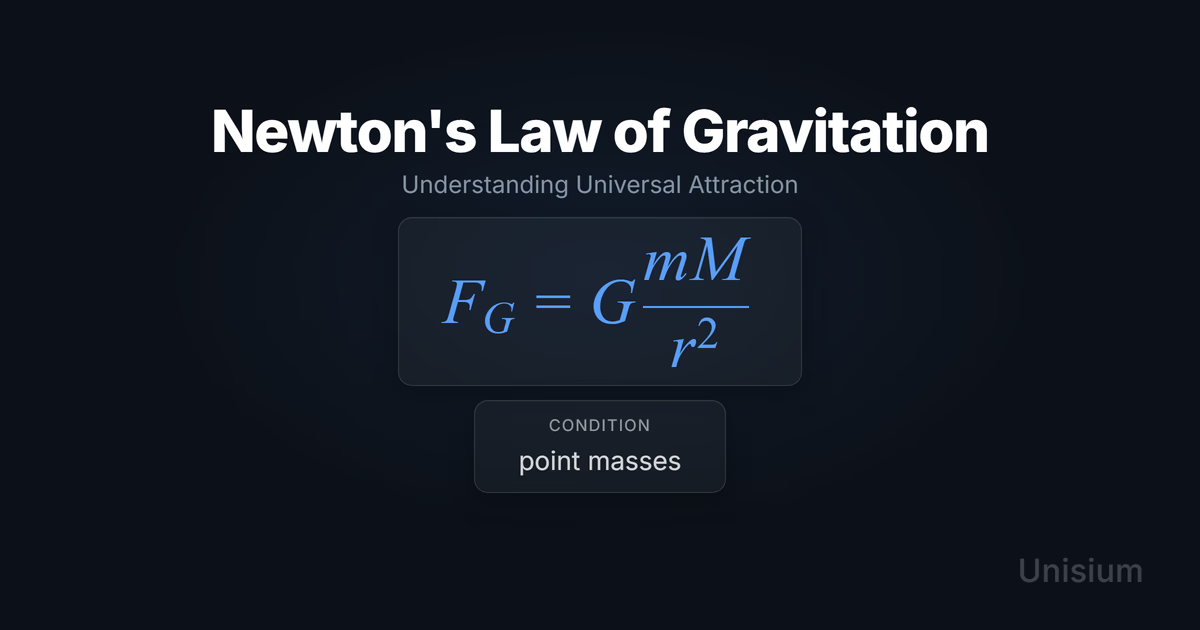
Newton’s Law of Gravitation states that every point mass attracts every other point mass with a force proportional to their masses and inversely proportional to the square of the distance between them: . Use it for point masses or spherically symmetric bodies when inverse-square gravity is the right model.
Newton’s law of gravitation unified terrestrial and celestial mechanics, showing that the same force pulling an apple downward also governs the Moon’s orbit. This insight transformed physics from a collection of separate rules into a coherent framework for predicting motion across all scales.
On this page: The Principle · Conditions · Misconceptions · EE Questions · Retrieval Practice · Worked Example · Solve a Problem · FAQ
The Principle
Statement
Every point mass in the universe attracts every other point mass with a force that is directly proportional to the product of their masses and inversely proportional to the square of the distance between their centers. This force acts along the line connecting the two masses.
Mathematical Form
Where:
- = gravitational force magnitude (N)
- = gravitational constant,
- = mass of the first object (kg)
- = mass of the second object (kg)
- = distance between centers of mass (m)
Alternative Forms
In different contexts, this appears as:
- Vector form: (the minus sign indicates attraction)
- Component along radial direction: (magnitude only)
Conditions of Applicability
Condition: point masses
Practical modeling notes
The “point mass” condition means the objects must be either:
- Actual point masses (negligible size), or
- Spherically symmetric mass distributions (planets, stars) where you measure from center to center, or
- Objects whose separation is much larger than their sizes ( object dimensions)
For non-spherical or extended objects near each other, you must integrate the gravitational force over the mass distribution—Newton’s law still applies locally to each infinitesimal mass element.
When It Doesn’t Apply
Newton’s law of gravitation is non-relativistic and breaks down in these situations:
- Strong gravitational fields: Near black holes or neutron stars, spacetime curvature becomes significant. Use general relativity instead.
- Relativistic speeds: When objects move at speeds comparable to the speed of light (), relativistic corrections are required.
Want the complete framework behind this guide? Read Masterful Learning.
Common Misconceptions
Misconception 1: Use surface-to-surface distance for in the equation
The truth: The distance is always measured center-to-center (between centers of mass), not surface-to-surface. For a satellite 400 km above Earth’s surface, you must use , not just 400 km.
Why this matters: Using surface-to-surface distance produces wildly incorrect forces. For objects in contact, this error makes the denominator zero and the force blow up to infinity. Even for near-Earth orbit, using instead of gives errors of hundreds of times.
Misconception 2: Heavier objects exert more gravitational force but don’t experience more force themselves
The truth: By Newton’s Third Law, if Earth pulls on you with force , you pull on Earth with the same magnitude . The forces are equal—what differs is the acceleration each object experiences (Earth’s acceleration is negligible due to its enormous mass).
Why this matters: Students often think “the Earth pulls on me, but I don’t pull on the Earth.” This misunderstanding obscures Newton’s Third Law and leads to errors when analyzing mutual gravitational interactions.
Misconception 3: The gravitational constant G is large because gravity is a strong force
The truth: is extremely small. Gravity is the weakest of the four fundamental forces. It only dominates at large scales because it’s always attractive and mass accumulates.
Why this matters: Understanding ‘s small value explains why gravitational forces between everyday objects (like two people) are imperceptible, while electromagnetic forces (with larger coupling constants) produce noticeable effects at small scales.
Elaborative Encoding
Use these questions to build deep understanding. (See Elaborative Encoding for the full method.)
Within the Principle
- What does the dependence tell you about how gravitational force changes when you double the distance between two masses?
- Why does the equation multiply the two masses () rather than add them?
For the Principle
- How do you decide whether to treat an object as a “point mass” for a given problem?
- When analyzing the Earth-Moon system, why can you treat both as point masses located at their centers?
Between Principles
- How does Newton’s law of gravitation relate to the weight formula used near Earth’s surface?
Generate an Example
- Describe a situation where you cannot treat the objects as point masses and must integrate the gravitational force over a mass distribution.
Retrieval Practice
Answer from memory, then click to reveal and check. (See Retrieval Practice for the full method.)
State the principle in words: _____Every point mass attracts every other point mass with a force proportional to the product of their masses and inversely proportional to the square of the distance between them.
Write the canonical equation: _____
State the canonical condition: _____point masses
Worked Example
Use this worked example to practice Self-Explanation.
Problem
The International Space Station (ISS) orbits at an altitude of 408 km above Earth’s surface. Earth’s mass is and its radius is . What gravitational force does Earth exert on a 1000 kg module inside the ISS?
Step 1: Verbal Decoding
Target: (gravitational force on module)
Given:
Constraints: Point mass approximation valid (ISS orbit radius much larger than module size), spherically symmetric Earth
Step 2: Visual Decoding
Try drawing Earth as a sphere with the ISS orbiting at altitude above the surface. Draw a radial line from Earth’s center to the module. Label (center-to-center distance). Choose radially outward from Earth’s center.
(So and is reported as a magnitude.)
Step 3: Physics Modeling
Step 4: Mathematical Procedures
Step 5: Reflection
- Units: Newtons check out (force units).
- Magnitude: The force is about 87% of the module’s surface weight (), which makes sense since the ISS is only 6% farther from Earth’s center than the surface.
- Limiting case: As (altitude ), the force approaches surface weight .
Before moving on: self-explain the model
Try explaining Step 3 out loud (or in writing): why Newton’s law of gravitation applies, what the diagram implies, and how the equations encode the situation.
Physics model with explanation (what “good” sounds like)
Principle: Newton’s law of gravitation applies because we’re calculating the gravitational force between two masses (Earth and the ISS module).
Conditions: The point mass condition is satisfied because: (1) Earth is spherically symmetric, so we can treat its mass as concentrated at its center, and (2) the module’s size is negligible compared to the orbital radius.
Relevance: This principle is the correct tool because we need the gravitational force between two separated masses. The weight formula only applies at Earth’s surface where is approximately constant.
Description: Earth pulls on the module with a force directed toward Earth’s center. The distance in the denominator is measured from Earth’s center, not from the surface—this is critical. At higher altitudes, increases, so decreases as .
Goal: We’re solving for the gravitational force at orbital altitude. The steps connect by first finding the center-to-center distance , then substituting into Newton’s law to get .
Solve a Problem
Apply what you’ve learned with Problem Solving.
Problem
Two lead spheres each have mass 10.0 kg. They are placed with their centers 20.0 cm apart. What is the magnitude of the gravitational force between them?
Hint: Lead spheres can be treated as point masses if they’re spherically symmetric. Make sure to convert all units to SI before calculating.
Show Solution
Step 1: Verbal Decoding
Target: (gravitational force between spheres)
Given:
Constraints: Spherically symmetric spheres, point mass approximation valid
Step 2: Visual Decoding
Try drawing two spheres separated by distance measured center-to-center. Draw a line connecting their centers. Label masses and . Choose along the line from sphere 1 to sphere 2.
(So and is reported as a magnitude.)
Step 3: Physics Modeling
Step 4: Mathematical Procedures
Step 5: Reflection
- Units: Newtons check out.
- Magnitude: The force is extremely small (about ), which makes sense because is tiny and everyday masses produce negligible gravitational attraction.
- Limiting case: If we double the distance, becomes as large (inverse square law). If we double both masses, becomes 4 times larger.
Related Principles
- Classical Mechanics: The Complete Principle Map — see where this principle fits in the full subdomain.
| Principle | Relationship to Newton’s Law of Gravitation |
|---|---|
| Weight near surface | Special case: where is derived from Newton’s law evaluated at Earth’s surface |
| Gravitational potential energy (general) | The work done by gravitational force leads to (general form) |
| Kepler’s Laws | Newton’s law of gravitation plus calculus implies Kepler’s empirical laws of planetary motion |
See Principle Structures for how to organize these relationships visually.
FAQ
What is Newton’s Law of Gravitation?
Newton’s law of gravitation states that every point mass attracts every other point mass with a force proportional to the product of their masses and inversely proportional to the square of the distance between them: .
When does Newton’s law of gravitation apply?
Newton’s law applies when the objects can be treated as point masses—either they’re actual point masses, they’re spherically symmetric (planets, stars), or their separation is much larger than their sizes. It breaks down in strong gravitational fields (near black holes) or at relativistic speeds.
What’s the difference between Newton’s law of gravitation and the weight formula?
Newton’s law is the general expression valid for any two point masses separated by distance . The weight formula is a special case used near Earth’s surface where is approximately constant.
What are the most common mistakes with Newton’s law of gravitation?
The top mistakes are: (1) using surface-to-surface distance instead of center-to-center distance for , (2) forgetting that the force is mutual (both objects pull on each other with equal magnitude), and (3) thinking gravity “turns off” at large distances (it only weakens, never reaching zero).
How do I know which form of Newton’s law to use?
Use the scalar form when you only need the magnitude. Use the vector form when direction matters (the minus sign indicates attraction along ). For non-point masses, integrate the force over the mass distribution.
Related Guides
- Principle Structures — Organize this principle in a hierarchical framework
- Self-Explanation — Learn to explain worked examples step by step
- Retrieval Practice — Make this principle instantly accessible
- Problem Solving — Apply principles systematically to new problems
How This Fits in Unisium
Unisium helps you master Newton’s law of gravitation through spaced retrieval practice (equation and condition), elaborative encoding questions (symbol meanings, when to apply), self-explanation prompts for worked examples, and targeted problems. The system tracks your understanding and schedules reviews when you’re most likely to forget—ensuring you can recall and apply this principle instantly during exams.
Ready to master Newton’s Law of Gravitation? Check access and join the Unisium waitlist or explore the full learning framework in Masterful Learning.
Masterful Learning
The book behind these guides: a study system for physics, math, & programming built on retrieval, connection, explanation, and problem solving.
Ready to apply this strategy?
Unisium turns these evidence-based techniques into guided study sessions for math and physics. Places are limited during early access. Check current availability to start a trial; joining the mailing list is optional.
See plans and availability Read More GuidesAlready have access? Sign in