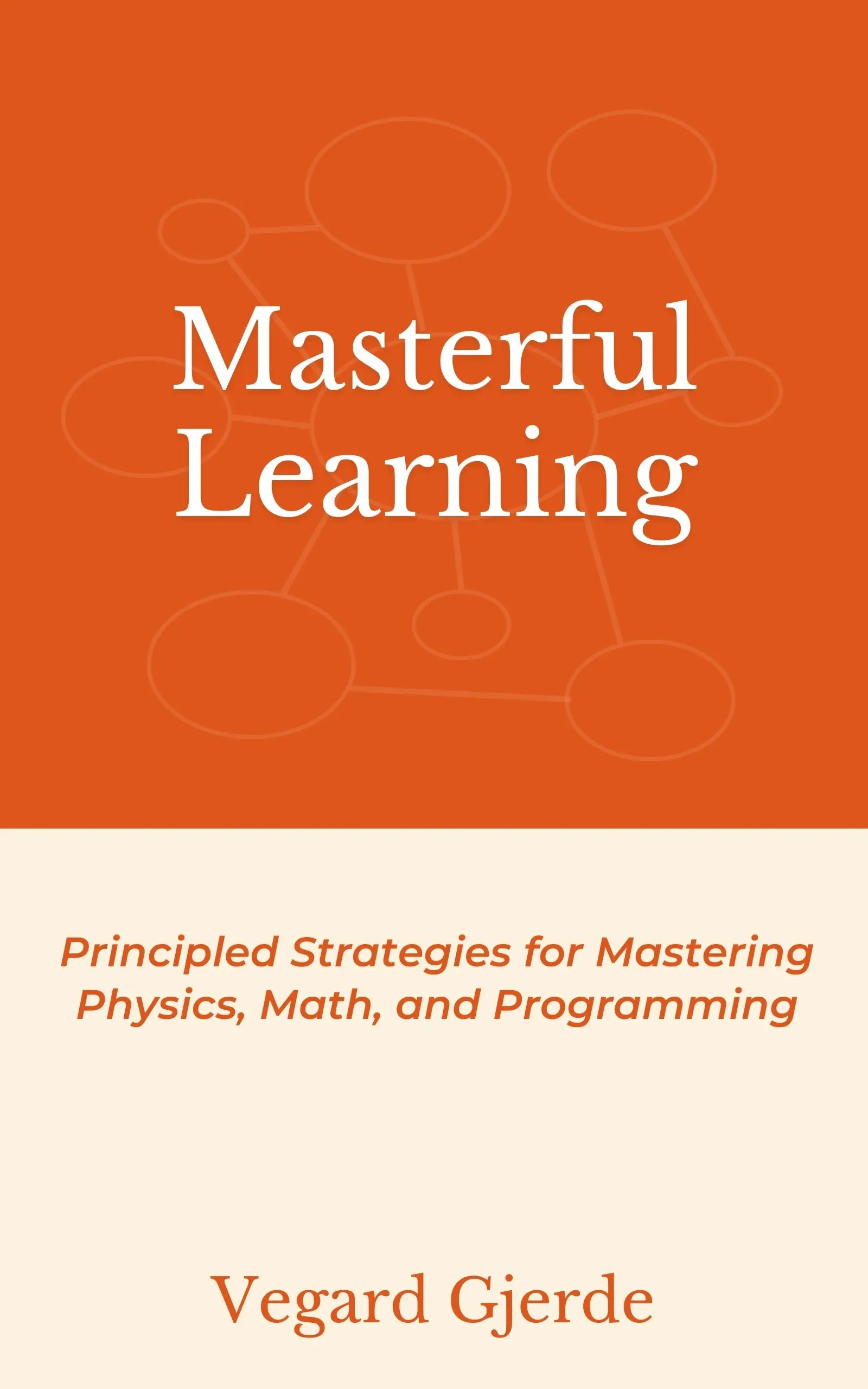
Masterful Learning: Principled Strategies for Mastering Physics, Math, and Programming
You know the formulas. You can follow the solutions when someone explains them. Then a new problem shows up and you don’t know where to start.
Masterful Learning is a study system for closing that gap. If the hours keep growing while your results don’t, the problem is usually the method, not you.
- Clear routines for what to do next when you’re stuck, instead of rereading and hoping.
- Knowledge you can recall months later, not just recognize the night before an exam.
- Problem solving that holds up on questions you’ve never seen, under time pressure.
Over time you become the kind of student who can take on demanding subjects, finish tough degrees, and keep learning for research, work, or entrepreneurship.
Paperback marketplaces outside the US: UK (opens in new tab) · DE (opens in new tab) · SE (opens in new tab)
See all marketplaces
Not ready to buy? Get the free Masterful Learning preview and updates from Unisium.
Written by Vegard Gjerde, founder of Unisium. His earlier Primal Learning course has reached 25,000+ learners and earned 8,000+ ratings (4.6/5). Masterful Learning is the updated, more thorough book version of that system, written after further research and university teaching. He also received a student-voted teaching award at the University of Bergen (opens in new tab).
“By applying some of these methods and ideas, not only has my learning speed increased, I can now reach a level of understanding of a subject in a fraction of the time it took me before.” Graduate student in applied mathematics, Primal Learning review
Why This Book Exists
Many students get stuck in physics, math, or programming: staring at a derivation, a proof, or a bug, without knowing what to do next. Most learning books offer general advice but little help in that moment. Masterful Learning shows you how to move forward, combining:
- Cognitive science: retrieval, connection, explanation, problem solving, and spaced repetition.
- Domain expertise: strategies for physics, math, and programming bottlenecks.
- Practical study design: structuring your week, tracking progress, preparing for exams, building durable skills.
Who It's For
- Students in physics, mathematics, and computer science who understand the material when it’s explained, but freeze when solving alone.
- Students who put in the hours with rereading and highlighting and still feel like they’re not making progress.
- Self-learners returning to math or physics who want a working method, not another pile of resources.
- Educators looking for research-grounded strategies to pass on to their students.
When You Feel the Difference
- Within a week: You start using retrieval and explanation on your real course material, which gives rapid feedback on what you know and what you do not.
- Within a month: Your study time is organized around a small set of repeatable routines instead of vague intentions to “study more.”
- By your next exam period: You have worked through a structured set of problems and questions, and you go into the exam with a realistic sense of your strengths and gaps.
This is not a promise of effortless progress. You will still need to work. The point is that your effort stops being random.
Why This Approach Works
The strategies in this book come from decades of research in cognitive psychology and physics education, plus years of teaching and iterating in large university courses. The differentiator is not a new idea. It’s a system that turns scattered findings into a concrete weekly plan for physics, math, and programming.
Retrieval, connection, explanation, problem solving, and spaced repetition are supported by a large research literature on long-term retention and transfer.
“This is the book I wish I’d had when I was a student. Now, I use many of its methods in my own teaching.” Amazon reviewer
If you want the underlying studies, start with Learning Literature. The same principles power Unisium, our mastery-focused learning platform, if you want to practice them interactively.
Inside the Book
Table of Contents (abridged)
- Part I: Knowledge and Skill. What it means to understand
- Part II: Learning Strategies. From ineffective strategies to retrieval, connection, explanation, problem solving, and digital tools
- Part III: Time Strategies. Structuring your week and making the most of lectures, workshops, and peers
- Part IV: Mental Strategies. Motivation, flow, mindsets, and habits
- Part V: Exam and Beyond. Strategies for written, oral, and conceptual exams, and looking ahead to real-world impact
About the Author
Vegard Gjerde has a PhD in physics education from the University of Bergen, Norway. He has taught UiB’s largest mechanics course for several years and published on learning strategies, retrieval practice, and problem solving.
Start studying with a system
Get Masterful Learning in paperback or Kindle, and turn retrieval, explanation, and problem solving into your weekly study routine.
Not ready to buy? Get the free preview and updates from Unisium.