Center of Mass (Velocity): Finding the Average Motion
Center of mass velocity is the mass-weighted average velocity of all particles in a system. It tells you how fast and in what direction the system’s center of mass moves, treating the entire system as if all its mass were concentrated at a single point. Use it to replace many particle velocities with one system velocity and to connect total momentum to whole-system motion.
This concept is fundamental for analyzing multi-particle systems and extended objects. Rather than tracking every particle individually, you can describe the overall translational motion with a single velocity vector. This simplification becomes essential in collision problems, rocket motion, and understanding how systems respond to external forces.
On this page: The Principle · Conditions · Misconceptions · EE Questions · Retrieval Practice · Worked Example · Solve a Problem · FAQ
The Principle
Statement
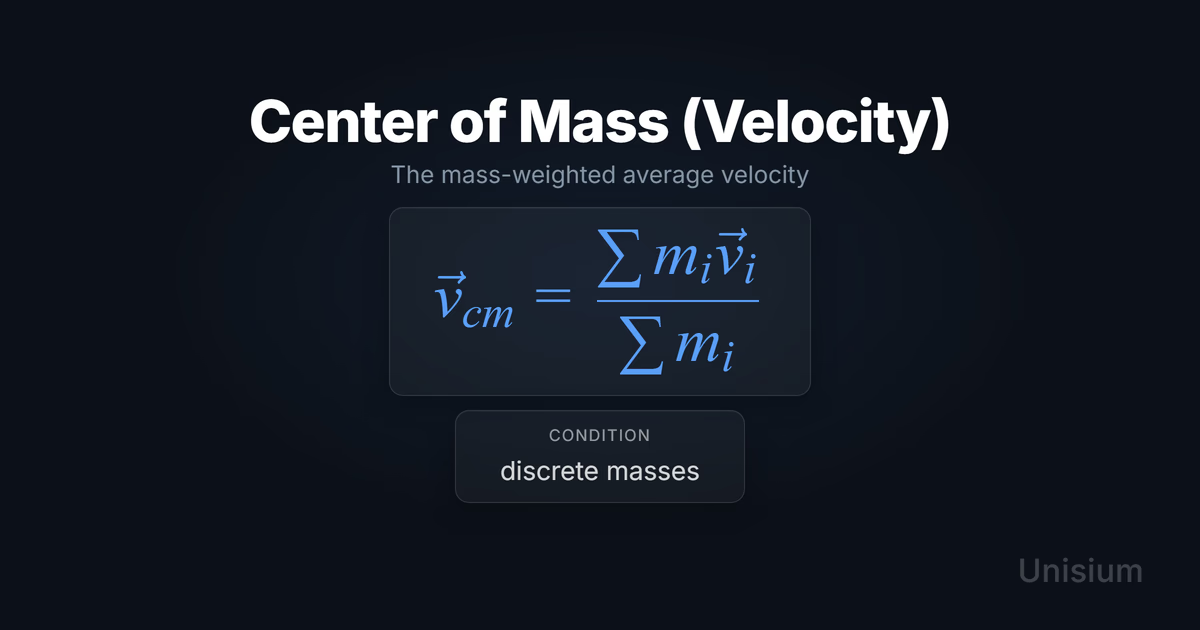
The center of mass velocity of a system is the mass-weighted average of the velocities of its parts. It is the single velocity vector that matches the system’s total momentum via .
Mathematical Form
Where:
- = velocity of the center of mass (m/s)
- = mass of the -th particle (kg)
- = velocity of the -th particle (m/s)
- = total mass of the system (kg)
Alternative Forms
- Scalar (1D motion):
- Momentum form:
Conditions of Applicability
Condition: discrete masses This summation formula applies when you model a system as discrete point masses with known velocities. The “discrete masses” qualifier indicates this formulation applies to systems of point particles or objects treated as point masses, versus the integral form for continuous mass distributions.
Practical modeling notes
- Choosing your system: Decide which objects to include. The center of mass velocity changes meaning depending on your system boundary.
- Reference frame: The center of mass velocity depends on your chosen reference frame. In the center-of-mass frame, by definition.
- Time-varying mass: For systems where mass changes (like rockets), use the instantaneous masses at time .
When You Need Extra Care
This definition always applies mathematically, but its usefulness varies:
- Non-inertial reference frames: The center of mass velocity is still defined, but its interpretation requires accounting for fictitious forces.
- Relativistic speeds: At speeds approaching , you need the relativistic definition of momentum, so must be computed from relativistic momentum expressions.
Want the complete framework behind this guide? Read Masterful Learning.
Common Misconceptions
Misconception 1: The center of mass moves at the average speed
The truth: Center of mass velocity is the mass-weighted average of velocities (a vector sum), not the average of speeds (scalar magnitudes). A 1 kg object moving at 10 m/s east and a 9 kg object at rest give m/s east, not 5 m/s.
Why this matters: Using speed instead of velocity direction produces incorrect results, especially in collision and explosion problems where directions matter.
Misconception 2: The center of mass must lie inside the object
The truth: While the center of mass position can lie outside an object (like a donut), this misconception carries over to velocity: students sometimes think the center of mass velocity must equal the velocity of some actual particle. It doesn’t. is an average that may not correspond to any real particle’s velocity.
Why this matters: In systems with particles moving in different directions, the center of mass may move in a direction no individual particle takes.
Misconception 3: Internal forces change the center of mass velocity
The truth: Only external forces change . By Newton’s third law, internal forces come in action-reaction pairs that cancel out in the sum .
Why this matters: In an isolated system (e.g., rocket plus exhaust) with no external forces, the center of mass moves at constant velocity regardless of internal interactions—explosions, collisions, or rocket thrust don’t change .
Elaborative Encoding
Use these questions to build deep understanding. (See Elaborative Encoding for the full method.)
Within the Principle
- Why is each velocity weighted by mass rather than just taking the arithmetic average? What happens to the center of mass velocity if you double one particle’s mass?
- The equation has a sum in both numerator and denominator. What are the units of ? Why does the total mass appear in the denominator?
For the Principle
- How do you decide which objects to include when computing the center of mass velocity? If you’re analyzing a car-truck collision, does Earth’s velocity matter?
- Can the center of mass velocity change if particles within the system collide with each other? What if they explode apart?
Between Principles
- How does center of mass velocity relate to total momentum? Can you express one in terms of the other?
Generate an Example
- Describe a situation where the center of mass velocity is zero even though all particles are moving. Now describe a situation where the center of mass moves even though it’s located outside all the objects.
Retrieval Practice
Answer from memory, then click to reveal and check. (See Retrieval Practice for the full method.)
State the principle in words: _____The center of mass velocity is the mass-weighted average of all particle velocities in the system.
Write the canonical equation: _____
State the canonical condition: _____discrete masses
Worked Example
Use this worked example to practice Self-Explanation.
Problem
Two ice skaters push off from each other on frictionless ice. Skater A has mass 60 kg and moves east at 2.0 m/s. Skater B has mass 40 kg and moves west at 3.0 m/s. What is the velocity of their center of mass?
Step 1: Verbal Decoding
Target: (velocity of the center of mass in m/s)
Given: , , ,
Constraints: one-dimensional motion
Step 2: Visual Decoding
Draw a horizontal axis. Choose to the east. Label skater A moving at m/s (east) and skater B moving at m/s (west, so negative). (So m/s and m/s.)
Step 3: Physics Modeling
Because this is 1D, we use the scalar form with signs for direction.
Step 4: Mathematical Procedures
Step 5: Reflection
- Units: kg·m/s divided by kg gives m/s. Correct.
- Magnitude: Zero velocity makes sense—the skaters pushed off from rest, so the system’s center of mass remains at rest (no external forces).
- Limiting case: If the skaters had equal masses and equal speeds in opposite directions, we’d also get zero. Here, skater B is lighter but faster, so the momentum contributions exactly cancel.
Before moving on: self-explain the model
Try explaining Step 3 out loud (or in writing): why the chosen principle applies, what the diagram implies, and how the equation encodes the situation.
Physics model with explanation (what “good” sounds like)
Principle: Center of mass velocity definition. We have a two-particle system (the two skaters), so we compute the mass-weighted average of their velocities.
Conditions: This summation form applies when modeling a system as discrete masses with known individual velocities—two skaters treated as point particles.
Relevance: We want to know how the system as a whole moves. Even though the individual skaters move in opposite directions, the center of mass velocity tells us the overall motion.
Description: Skater A (60 kg) moves east at m/s, contributing kg·m/s of momentum. Skater B (40 kg) moves west at m/s, contributing kg·m/s. These contributions exactly cancel, so the total momentum is zero.
Goal: Divide the total momentum by the total mass to get . Since the numerator is zero, the center of mass remains at rest—exactly as expected since they started together and no external horizontal forces act.
Solve a Problem
Apply what you’ve learned with Problem Solving.
Problem
A 900 kg car travels north at 15 m/s. A 1500 kg truck travels east at 20 m/s. Treating these as a two-vehicle system, find the velocity of their center of mass (magnitude and direction).
Hint: Work with components. Find and separately, then combine them.
Show Solution
Step 1: Verbal Decoding
Target: (magnitude and direction in m/s)
Given: , , ,
Constraints: two-dimensional motion; car moves north; truck moves east
Step 2: Visual Decoding
Draw and axes with east as and north as . The car’s velocity is m/s. The truck’s velocity is m/s. (So , m/s; m/s, .)
Step 3: Physics Modeling
Step 4: Mathematical Procedures
Step 5: Reflection
- Units: Each component has units of (kg·m/s) / kg = m/s. The magnitude is also m/s. Angle is dimensionless (radians or degrees). Correct.
- Magnitude: 13.7 m/s is between the individual speeds (15 and 20 m/s) and closer to the truck’s speed because the truck is more massive. Reasonable.
- Limiting case: If both vehicles had equal mass, the center of mass would point at 45° (northeast). Here, the truck’s greater mass pulls the center of mass velocity closer to east, giving 24° instead of 45°.
Related Principles
- Classical Mechanics: The Complete Principle Map — see where this principle fits in the full subdomain.
| Principle | Relationship to Center of Mass Velocity |
|---|---|
| Center of Mass (Position) | The time derivative of center of mass position is center of mass velocity: |
| Linear Momentum | Total momentum equals total mass times center of mass velocity: |
| Newton’s Second Law (System) | For a system of particles, where |
See Principle Structures for how to organize these relationships visually.
FAQ
What is center of mass velocity?
Center of mass velocity is the velocity of the point representing the average position of all mass in a system, weighted by each particle’s mass. It equals total momentum divided by total mass.
When does center of mass velocity apply?
It always applies as a definition. You can compute it for any system of particles or extended object, regardless of the forces acting or the motion type.
What’s the difference between center of mass velocity and average velocity?
Average velocity is the displacement divided by time for a single object. Center of mass velocity is the mass-weighted average of all particles’ instantaneous velocities in a multi-particle system. They’re fundamentally different concepts.
What are the most common mistakes with center of mass velocity?
The most common errors are: (1) averaging speeds instead of velocity vectors, (2) forgetting to weight by mass (just doing an arithmetic average), and (3) thinking internal forces can change .
How do I know which form of center of mass velocity to use?
Use the discrete sum for systems with distinct particles. Use the integral for continuous mass distributions. For momentum-based problems, use .
Related Guides
- Principle Structures — Organize this principle in a hierarchical framework
- Self-Explanation — Learn to explain worked examples step by step
- Masterful Learning — The complete Unisium framework for physics and math mastery
- Problem Solving — Apply principles systematically to new problems
How This Fits in Unisium
Unisium helps you master center of mass velocity through spaced retrieval practice (recalling the definition and equation), elaborative encoding (connecting it to momentum and Newton’s laws), and structured problem solving (applying it in collisions and multi-body systems). By building deep, lasting understanding of how systems move as a whole, you’ll tackle complex mechanics problems with confidence.
Ready to master center of mass velocity? Check access and join the Unisium waitlist or explore the full learning framework in Masterful Learning.
Masterful Learning
The book behind these guides: a study system for physics, math, & programming built on retrieval, connection, explanation, and problem solving.
Ready to apply this strategy?
Unisium turns these evidence-based techniques into guided study sessions for math and physics. Places are limited during early access. Check current availability to start a trial; joining the mailing list is optional.
See plans and availability Read More GuidesAlready have access? Sign in