Newton's Second Law (Rotation): Connecting Torque to Angular Acceleration
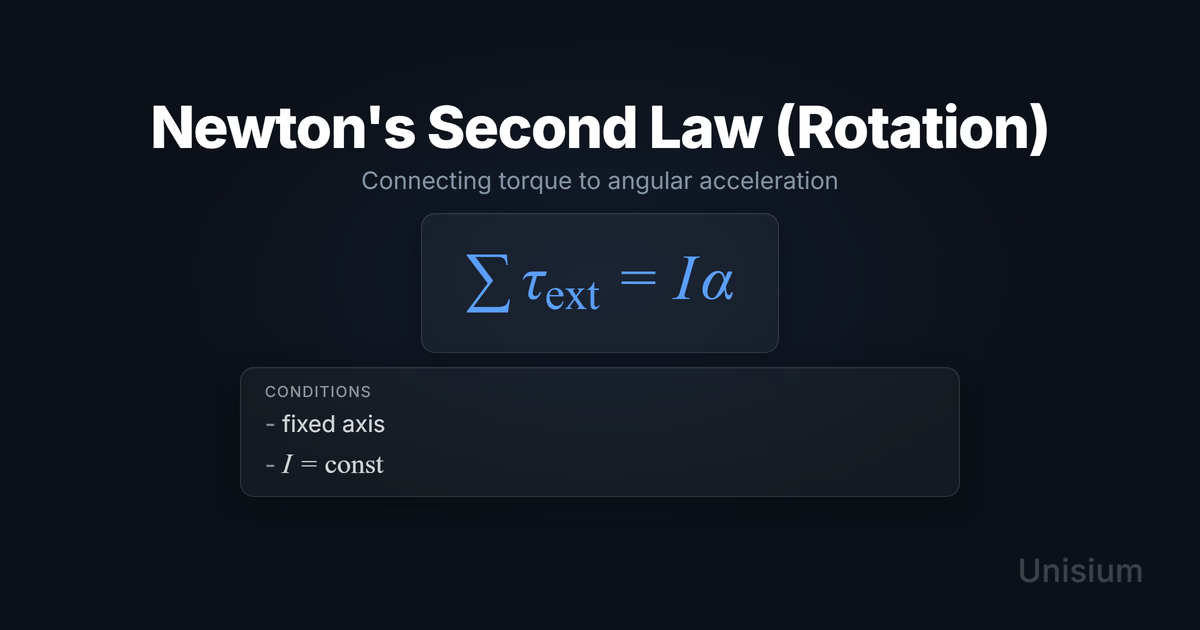
Newton’s Second Law for Rotation states that the net external torque acting on a rigid body about a fixed axis equals the product of its moment of inertia and angular acceleration: . It applies when the axis is fixed in an inertial frame and the moment of inertia is constant.
Just as Newton’s Second Law for translation connects force to linear acceleration, the rotational version connects torque to angular acceleration. This principle is essential for analyzing wheels, pulleys, rotating machinery, and any rigid body turning about a fixed axis. Understanding when and how to apply it is central to solving rotational dynamics problems in classical mechanics.
On this page: The Principle · Conditions · Misconceptions · EE Questions · Retrieval Practice · Worked Example · Solve a Problem · FAQ
The Principle
Statement
Newton’s Second Law for Rotation states that the net external torque acting on a rigid body about a fixed axis equals the product of the body’s moment of inertia about that axis and its angular acceleration. When the sum of torques is unbalanced, the rigid body undergoes angular acceleration in the direction indicated by the sign of the net torque.
Mathematical Form
Where:
- = net external torque about the fixed axis (N·m, newton-meters)
- = moment of inertia about the rotation axis (kg·m², kilogram-meters squared)
- = angular acceleration about the axis (rad/s², radians per second squared)
Alternative Forms
In different contexts, this appears as:
- Signed scalar form (planar rotation): where positive torques produce counterclockwise angular acceleration (or vice versa, depending on sign convention)
- Component form (about axis ):
Conditions of Applicability
Condition: fixed axis; This means:
- Fixed axis: The axis of rotation is fixed in position and orientation in an inertial reference frame. The body rotates about this axis, which does not translate or wobble.
- Constant moment of inertia: The moment of inertia does not change during the motion. This is automatically true for rigid bodies rotating about a fixed axis, since the mass distribution relative to the axis stays constant.
Practical modeling notes
- Inertial frame requirement: The fixed axis must be stationary in an inertial reference frame. In non-inertial frames (e.g., a rotating platform), fictitious torques must be included.
- External torques only: Include only torques due to external forces. Internal forces (between parts of the rigid body) produce torque pairs that cancel by Newton’s Third Law.
- Sign convention: In planar problems, choose counterclockwise positive (or clockwise positive) and apply consistently to all torques and angular acceleration.
When It Doesn’t Apply
- Moving or wobbling axis: When the axis itself moves or precesses (e.g., a spinning top wobbling), you need more general angular momentum methods ().
- Variable moment of inertia: If mass is added, removed, or redistributed during rotation (e.g., a figure skater pulling arms inward), use with to account for changing .
- Free-body rotation in 3D: For general three-dimensional rotation (e.g., a satellite tumbling in space), you need Euler’s equations for rigid body dynamics, which account for the term.
Want the complete framework behind this guide? Read Masterful Learning.
Common Misconceptions
Misconception 1: “Torque causes angular velocity”
The truth: Torque causes angular acceleration, not angular velocity. A rigid body can rotate at constant angular velocity with zero net torque (rotational analog of Newton’s First Law).
Why this matters: Students often write instead of , leading to incorrect solutions. Angular velocity and angular acceleration are fundamentally different—acceleration is the rate of change of velocity.
Misconception 2: “Moment of inertia is like mass—it’s the same for all problems”
The truth: Moment of inertia depends on both the mass distribution and the choice of rotation axis. The same object has different moments of inertia for different axes (e.g., a rod rotating about its center vs. about one end).
Why this matters: You must know the axis of rotation and use the correct formula for about that axis. Using the wrong (e.g., from a different axis) produces wrong results.
Misconception 3: “All forces create torques”
The truth: Only forces not applied at the axis of rotation create torques about that axis. A force applied directly at the axis (where ) produces zero torque. Forces parallel to the position vector also produce zero torque ( with or ).
Why this matters: Students often include torques from forces at the pivot (like a hinge force) or miss that radial forces produce zero torque. Only tangential components of forces at nonzero distances create torque.
Elaborative Encoding
Use these questions to build deep understanding. (See Elaborative Encoding for the full method.)
Within the Principle
- What does each symbol (, , ) mean physically, and what are the units on both sides of the equation?
- How is this equation analogous to the translational Newton’s Second Law ()? What replaces force, mass, and acceleration?
For the Principle
- How do you decide which axis to use as your reference when calculating torques and moment of inertia?
- When does the fixed-axis condition break down, and what do you use instead?
Between Principles
- How is the rotational version of Newton’s First Law (constant angular velocity if ) a special case of this principle?
Generate an Example
- Describe a rotating object where the net torque is zero but the object is still spinning. What real-world devices operate this way?
Retrieval Practice
Answer from memory, then click to reveal and check. (See Retrieval Practice for the full method.)
State the principle in words: _____The net external torque on a rigid body about a fixed axis equals the product of its moment of inertia and angular acceleration.
Write the canonical equation: _____
State the canonical condition: _____
Worked Example
Use this worked example to practice Self-Explanation.
Problem
A solid disk of mass and radius is mounted on a horizontal frictionless axle through its center. A string is wrapped around the disk and pulled with a constant tension tangent to the rim. What is the angular acceleration of the disk? (Moment of inertia for a solid disk: .)
Step 1: Verbal Decoding
Target:
Given: , ,
Constraints: solid disk, horizontal axle, tension tangent to rim, frictionless axle
Step 2: Visual Decoding
Try drawing the disk viewed from the side. Mark the axle (rotation axis), the string wrapped around the rim, and the tension force pulling tangent to the rim. Choose counterclockwise as positive rotation.
Step 3: Physics Modeling
Step 4: Mathematical Procedures
Step 5: Reflection
- Units: ✓
- Magnitude: A tension of 15 N on a 2 kg disk produces significant angular acceleration—this is plausible for a small disk with relatively light mass.
- Limiting case: If (massless disk), —any torque would produce infinite angular acceleration, which makes physical sense for an object with no rotational inertia.
Before moving on: self-explain the model
Try explaining Step 3 out loud (or in writing): why Newton’s second law for rotation applies, what the diagram implies about the torque, and how the equation encodes the situation.
Physics model with explanation (what “good” sounds like)
Principle: Newton’s second law for rotation () applies because the disk is a rigid body rotating about a fixed axis (the axle).
Conditions: The axis is fixed in an inertial frame (horizontal axle), and the moment of inertia is constant (rigid disk).
Relevance: The tension creates a torque about the axle. Since the axle is frictionless, tension is the only external torque acting on the disk.
Description: The tension acts tangent to the rim at distance from the axis, so the torque magnitude is . The torque is counterclockwise (positive by convention). The moment of inertia for a solid disk about its center is .
Goal: Use to solve for . Substitute and simplify to get . Plug in numbers to find the numerical angular acceleration.
Solve a Problem
Apply what you’ve learned with Problem Solving.
Problem
A thin rod of mass and length is hinged at one end and is held horizontal. A vertical downward force is applied at the free end. What is the initial angular acceleration of the rod when released? (Moment of inertia for a rod about one end: .)
Hint: Consider all external torques about the hinge, including the applied force and gravity acting at the rod’s center of mass.
Show Solution
Step 1: Verbal Decoding
Target:
Given: , ,
Constraints: thin rod, hinged at one end, horizontal initially, vertical force at free end
Step 2: Visual Decoding
Try drawing the rod horizontal with the hinge on the left. Mark the applied force pointing downward at the right end, and the weight acting downward at the rod’s center (midpoint). Choose counterclockwise as positive. (So both torques are negative.)
Step 3: Physics Modeling
Step 4: Mathematical Procedures
Step 5: Reflection
- Units: ✓
- Magnitude: Both forces point downward, creating clockwise torques about the hinge. The rod accelerates clockwise at about 33 rad/s²—reasonable for this setup.
- Limiting case: If , the rod would swing down under gravity alone with (clockwise), which is the expected behavior for a horizontal rod released from rest.
Related Principles
- Classical Mechanics: The Complete Principle Map — see where this principle fits in the full subdomain.
| Principle | Relationship to Newton’s Second Law (Rotation) |
|---|---|
| Torque (Definition) | Torque is the cause of angular acceleration; Newton’s second law for rotation quantifies this relationship via . |
| Newton’s Second Law (Translation) | The translational analog: relates force to linear acceleration, while the rotational version relates torque to angular acceleration. |
| Rotational Kinematics (Angular Velocity–Time) | Once you know the angular acceleration from , use rotational kinematics to find angular velocity and position. |
See Principle Structures for how to organize these relationships visually.
FAQ
What is Newton’s Second Law for Rotation?
Newton’s Second Law for Rotation states that the net external torque on a rigid body about a fixed axis equals the product of its moment of inertia and angular acceleration: . It’s the rotational analog of .
When does Newton’s Second Law for Rotation apply?
It applies when a rigid body rotates about a fixed axis in an inertial reference frame, and the moment of inertia is constant. The axis must not move or wobble during the motion.
What’s the difference between Newton’s Second Law for rotation and translation?
The translational version () relates net force to linear acceleration, where mass measures inertia. The rotational version () relates net torque to angular acceleration, where moment of inertia measures rotational inertia. They are direct analogs: torque replaces force, moment of inertia replaces mass, and angular acceleration replaces linear acceleration.
What are the most common mistakes with this principle?
- Confusing angular velocity () with angular acceleration ()—writing instead of .
- Using the wrong moment of inertia (e.g., for a different axis or shape).
- Forgetting to include all external torques (e.g., omitting gravitational torque on an extended object).
How do I know which axis to choose when applying this principle?
If the object has a fixed axis (hinge, axle, pivot), use that axis. If the object is free to rotate, you can choose any axis, but the center of mass or a contact point often simplifies calculations. Always calculate torques and moment of inertia about the same axis.
Related Guides
- Principle Structures — Organize this principle in a hierarchical framework
- Self-Explanation — Learn to explain worked examples step by step
- Retrieval Practice — Make this principle instantly accessible
- Problem Solving — Apply principles systematically to new problems
How This Fits in Unisium
The Unisium Study System helps you master Newton’s Second Law for Rotation through targeted practice in elaborative encoding (building deep conceptual understanding), retrieval practice (strengthening recall), self-explanation (articulating why each step works), and problem solving (applying the principle to novel situations). Together, these strategies ensure you don’t just memorize the equation but truly understand when and how to use it.
Ready to master Newton’s Second Law for Rotation? Check access and join the Unisium waitlist or explore the full learning framework in Masterful Learning.
Masterful Learning
The book behind these guides: a study system for physics, math, & programming built on retrieval, connection, explanation, and problem solving.
Ready to apply this strategy?
Unisium turns these evidence-based techniques into guided study sessions for math and physics. Places are limited during early access. Check current availability to start a trial; joining the mailing list is optional.
See plans and availability Read More GuidesAlready have access? Sign in