Work-Energy Theorem: Connect Force to Speed
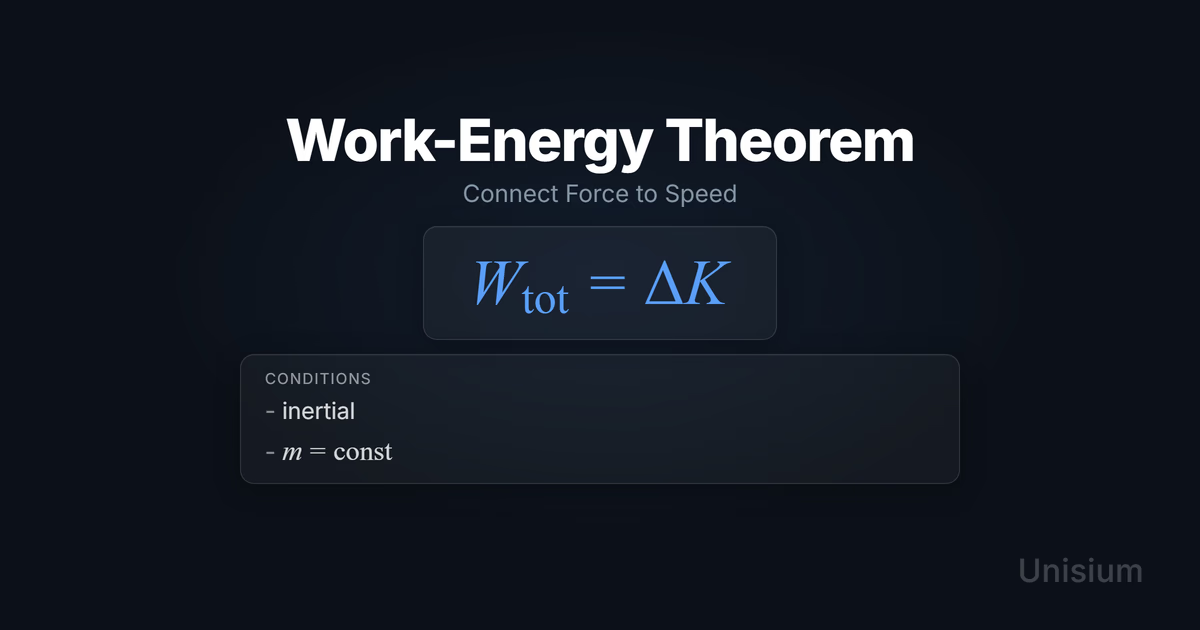
The Work-Energy Theorem states that the net work done on an object equals its change in kinetic energy: . Use it when forces change speed and total work is easier to compute than tracking acceleration through the motion; apply it in an inertial frame with constant mass.
This theorem provides a powerful shortcut for analyzing motion: instead of tracking forces and accelerations at every instant, you can relate the net effect of forces (total work) directly to changes in speed. It’s particularly useful for problems involving variable forces or complex paths where Newton’s second law would be difficult to apply directly.
On this page: The Principle · Conditions · Misconceptions · EE Questions · Retrieval Practice · Worked Example · Solve a Problem · FAQ
The Principle
Statement
The Work-Energy Theorem states that the total work done by all forces acting on an object equals the change in that object’s kinetic energy. This theorem bridges dynamics (forces) and energy (speed), allowing you to solve motion problems without tracking accelerations along the path.
Mathematical Form
Where:
- = total work done by all forces (J, joules)
- = change in kinetic energy (J)
Alternative Forms
In different contexts, this appears as:
- Particle / translation-only (constant mass): where = mass (kg), = final speed (m/s), = initial speed (m/s)
- Component form:
Conditions of Applicability
Condition: inertial; This means the theorem applies when you’re working in an inertial (non-accelerating) reference frame and the object’s mass remains constant throughout the motion.
Practical modeling notes
- The theorem requires identifying all forces acting on the object and calculating their individual work contributions
- Work is a scalar, so you sum work values algebraically (positive and negative contributions)
- The theorem applies to any path shape—straight, curved, or complex
- For deformation or rotation: If the object deforms or rotates, use total kinetic energy (translational + rotational + internal) and don’t assume is the whole story
When It Doesn’t Apply
- Non-inertial reference frames: In accelerating reference frames, fictitious forces appear. Either switch to an inertial frame or account for the fictitious forces explicitly.
- Variable mass systems: When mass changes (like a rocket burning fuel), the theorem in this form is invalid. Use the rocket equation or momentum principles instead.
- Relativistic speeds: At speeds approaching , the classical kinetic energy expression fails. Use the relativistic work-energy theorem where with .
Want the complete framework behind this guide? Read Masterful Learning.
Common Misconceptions
Misconception 1: Work-energy only applies when work is positive
The truth: The theorem applies whether work is positive, negative, or zero. Negative work (when force opposes displacement) decreases kinetic energy; positive work increases it; zero work leaves kinetic energy unchanged.
Why this matters: Students often forget to include braking forces or friction, which do negative work. Missing these terms produces wildly incorrect final speeds.
Misconception 2: Total work equals the sum of force magnitudes times distance
The truth: Work depends on the angle between force and displacement: . Forces perpendicular to motion do zero work.
Why this matters: In circular motion, the centripetal force does no work because it’s always perpendicular to velocity. Treating all forces as doing work leads to energy balance errors.
Misconception 3: The work-energy theorem replaces Newton’s second law
The truth: The work-energy theorem is derived from Newton’s second law and the definition of work. It’s a powerful tool for certain problems, but it doesn’t replace for finding accelerations or analyzing forces at a specific instant.
Why this matters: Some problems require force analysis at a point (like finding tension in a string), which the work-energy theorem cannot provide directly.
Elaborative Encoding
Use these questions to build deep understanding. (See Elaborative Encoding for the full method.)
Within the Principle
- What does represent physically, and why is it written as a difference of squares rather than a square of differences?
- Why is total work a scalar sum even though forces are vectors?
For the Principle
- How do you decide whether to use the work-energy theorem versus Newton’s second law for a given problem?
- What happens to the theorem when an object moves in a circle at constant speed, and what does this reveal about the role of perpendicular forces?
Between Principles
- How does the work-energy theorem relate to the conservation of mechanical energy, and when is one more useful than the other?
Generate an Example
- Describe a situation where multiple forces act on an object, some doing positive work and others doing negative work, and explain how their contributions combine.
Retrieval Practice
Answer from memory, then click to reveal and check. (See Retrieval Practice for the full method.)
State the work-energy theorem in words: _____The total work done by all forces on an object equals the change in its kinetic energy.
Write the canonical equation: _____
State the canonical condition: _____
Worked Example
Use this worked example to practice Self-Explanation.
Problem
A 1500 kg car is traveling at 20 m/s on a level road. The driver applies the brakes, and the car skids to a stop over a distance of 50 m. Assume the only horizontal force is kinetic friction. What is the magnitude of the friction force?
Step 1: Verbal Decoding
Target: (magnitude of kinetic friction force)
Given: , , ,
Constraints: Level road, skidding (kinetic friction only), motion to rest
Step 2: Visual Decoding
Draw a 1D axis. Choose in the direction of initial motion. Label along and . The friction force points opposite to (opposes motion). Draw the car at the initial position and mark the displacement along .
(So displacement is along , while points along .)
Step 3: Physics Modeling
Step 4: Mathematical Procedures
Step 5: Reflection
- Units: kg·(m/s)²/m = kg·m/s² = N ✓
- Magnitude: 6000 N is about 1350 lb—reasonable for stopping a 1500 kg car over 50 m
- Limiting case: If (negligible stopping distance), (requires immense braking force), which makes physical sense
Before moving on: self-explain the model
Try explaining Step 3 out loud (or in writing): why the work-energy theorem applies, what the diagram implies, and how the equations encode the situation.
Physics model with explanation (what “good” sounds like)
Principle: The work-energy theorem relates total work to kinetic energy change. It’s ideal here because we care about initial and final speeds and the stopping distance, not the detailed motion between.
Conditions: We’re in an inertial frame (the road). Mass is constant. The car is non-relativistic, so classical kinetic energy applies.
Relevance: Friction does negative work (force opposes displacement), slowing the car from to zero. The theorem lets us find the friction force without needing to know time or acceleration explicitly.
Description: The car’s kinetic energy decreases from to zero. The only horizontal force doing work is kinetic friction, which does (negative because friction points opposite to displacement). Setting total work equal to the kinetic energy change gives .
Goal: Solve for . The algebra is straightforward: divide both sides by and simplify. Substitute values with units to get the numerical answer.
Solve a Problem
Apply what you’ve learned with Problem Solving.
Problem
A 0.50 kg ball is thrown straight upward with an initial speed of 15 m/s. Use the work-energy theorem to find the maximum height the ball reaches. (Use and neglect air resistance.)
Hint: At maximum height, the ball’s speed is zero. Identify the forces doing work during the upward flight.
Show Solution
Step 1: Verbal Decoding
Target: (maximum height)
Given: , , ,
Constraints: Thrown straight up, no air resistance, motion to momentary rest at top
Step 2: Visual Decoding
Draw a vertical axis. Choose upward. Label the initial position at with velocity upward. Label the final position at with velocity . The gravitational force points downward (opposite to ).
(So displacement is along , while points along .)
Step 3: Physics Modeling
Step 4: Mathematical Procedures
Step 5: Reflection
- Units: (m/s)²/(m/s²) = m ✓
- Magnitude: 11 m (about 36 feet) is reasonable for a ball thrown at 15 m/s (~34 mph)
- Limiting case: If , then (no initial speed means no height gain), which matches intuition
Related Principles
- Classical Mechanics: The Complete Principle Map — see where this principle fits in the full subdomain.
| Principle | Relationship to Work-Energy Theorem |
|---|---|
| Newton’s Second Law | The work-energy theorem is derived from combined with kinematics and the definition of work |
| Conservation of Mechanical Energy | When all forces are conservative (), the work-energy theorem reduces to conservation of mechanical energy: |
| Constant Force Work Definition | Provides the work calculation needed to apply the work-energy theorem |
See Principle Structures for how to organize these relationships visually.
FAQ
What is the Work-Energy Theorem?
The Work-Energy Theorem states that the total work done by all forces on an object equals the change in its kinetic energy: . It connects force-driven changes (work) to motion changes (kinetic energy).
When does the Work-Energy Theorem apply?
It applies in an inertial reference frame when the object’s mass is constant. If you also use , that’s the classical kinetic-energy model (valid for speeds much less than ).
What’s the difference between the Work-Energy Theorem and Conservation of Energy?
The work-energy theorem relates work to kinetic energy change and always applies (when work is done, kinetic energy changes). Conservation of mechanical energy is a special case when no non-conservative forces do work (), so total mechanical energy stays constant.
What are the most common mistakes with the Work-Energy Theorem?
First, forgetting to include negative work from forces like friction or drag. Second, treating all forces as doing work without accounting for the angle in . Third, trying to use the theorem to find forces at a specific instant (it gives net effects over a displacement, not instantaneous force balance).
How do I know which form of the Work-Energy Theorem to use?
Use the standard form for all problems. Then decide what means:
- Translation-only (constant mass):
- Rotation or deformation: Include rotational and internal energy in
- Relativistic speeds: Use the relativistic kinetic energy expression
Related Guides
- Principle Structures — Organize the work-energy theorem in a hierarchical framework
- Work & Energy Anki Deck — Drill the core equations, conditions, and common traps in this mechanics unit
- Self-Explanation — Learn to explain worked examples step by step
- Retrieval Practice — Make this principle instantly accessible
- Problem Solving — Apply principles systematically to new problems
How This Fits in Unisium
Unisium helps you master the work-energy theorem through targeted elaborative encoding questions that reveal the theorem’s structure, retrieval practice prompts that make the principle instantly accessible under exam pressure, guided self-explanation of worked examples to build your modeling skills, and scaffolded problem solving that tracks your growing independence. By cycling through these strategies in an adaptive sequence, you develop both conceptual clarity and procedural fluency—the hallmarks of mastery.
Ready to master the Work-Energy Theorem? Check access and join the Unisium waitlist or explore the full learning framework in Masterful Learning.
Masterful Learning
The book behind these guides: a study system for physics, math, & programming built on retrieval, connection, explanation, and problem solving.
Ready to apply this strategy?
Unisium turns these evidence-based techniques into guided study sessions for math and physics. Places are limited during early access. Check current availability to start a trial; joining the mailing list is optional.
See plans and availability Read More GuidesAlready have access? Sign in