Centripetal Acceleration: Understanding Acceleration in Circular Motion
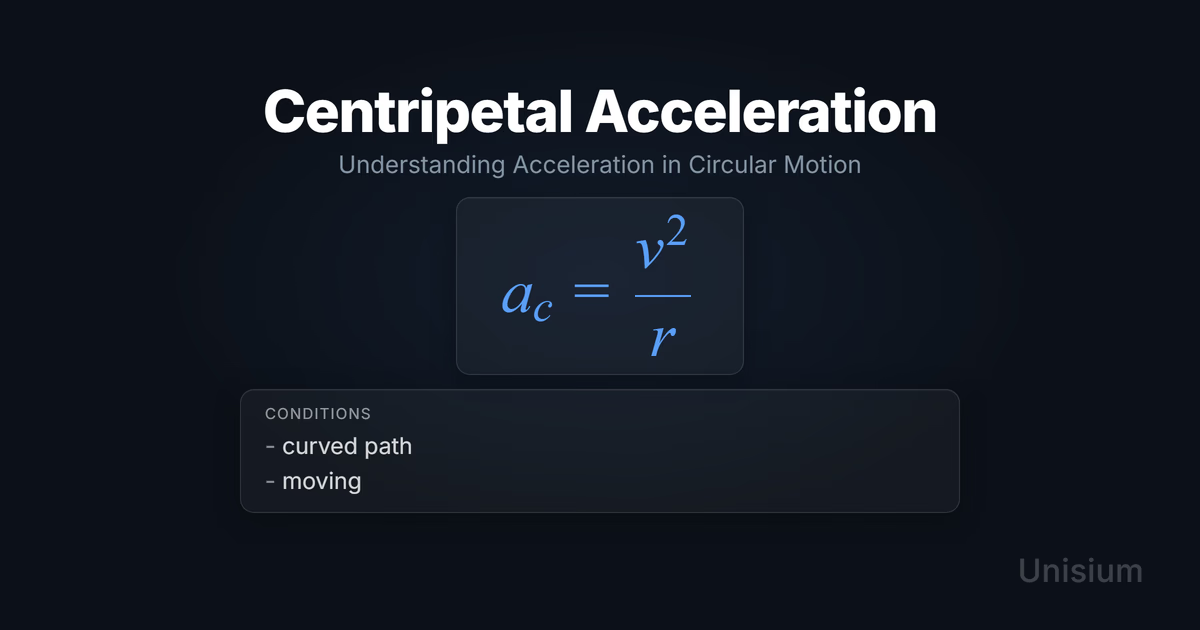
Centripetal acceleration is the inward acceleration toward the center of curvature when an object moves along a curved path. Its magnitude is . Tangential acceleration changes speed; centripetal acceleration changes direction.
Centripetal acceleration is not a new type of acceleration—it’s the name we give to the component of acceleration that changes an object’s direction rather than its speed. When an object moves in a circle at constant speed, it’s still accelerating because velocity is a vector, and the direction is continuously changing.
On this page: The Principle · Conditions · Misconceptions · EE Questions · Retrieval Practice · Worked Example · Solve a Problem · FAQ
The Principle
Statement
Centripetal acceleration is the acceleration toward the center of curvature for an object moving along a curved path. Its magnitude equals the square of the speed divided by the radius of curvature.
Mathematical Form
Where:
- = magnitude of centripetal acceleration (m/s²)
- = instantaneous speed along the path (m/s)
- = radius of curvature at that point (m)
Alternative Forms
In different contexts, this appears as:
- Angular velocity form: (using )
- Period form: (for uniform circular motion with period )
Conditions of Applicability
Condition: curved path; moving
Practical modeling notes
- For circular motion, is the circle’s radius
- For non-circular curves, is the instantaneous radius of curvature at the point of interest
- The centripetal component is perpendicular to the velocity, pointing toward the center of curvature
- This formula gives the magnitude; direction must be determined from the geometry
When It Doesn’t Apply
- Straight-line motion: When (straight path), centripetal acceleration approaches zero
- Object at rest: When , there is no centripetal acceleration even if positioned on a curved path
Want the complete framework behind this guide? Read Masterful Learning.
Common Misconceptions
Misconception 1: Centripetal acceleration only exists in uniform circular motion
The truth: Centripetal acceleration exists whenever an object moves along any curved path, whether the speed is constant or changing. Even if an object is speeding up or slowing down while turning, there is still a centripetal component of acceleration perpendicular to the velocity.
Why this matters: In general curved motion, the total acceleration has two components: tangential (parallel to velocity, changes speed) and centripetal (perpendicular to velocity, changes direction). Ignoring centripetal acceleration in non-uniform motion leads to incorrect force analysis.
Misconception 2: Centripetal acceleration is caused by a special “centripetal force”
The truth: Centripetal acceleration is the result of net force toward the center, not a separate force itself. Real forces (tension, friction, gravity, etc.) provide the required centripetal force. There is no additional “centripetal force” to add to free-body diagrams.
Why this matters: Students often add a fictitious “centripetal force” alongside real forces, leading to double-counting. The correct approach is to identify real forces, then apply Newton’s second law in the radial direction: .
Misconception 3: Faster speed always means larger centripetal acceleration
The truth: While centripetal acceleration does increase with speed squared, it also depends inversely on radius. Doubling the speed quadruples , but doubling the radius halves . The relationship is .
Why this matters: In banked curves or circular tracks, a car moving faster on a wider curve might experience less centripetal acceleration than a slower car on a tighter curve. Understanding the interplay between and is essential for analyzing real scenarios like highway curve design or satellite orbits.
Elaborative Encoding
Use these questions to build deep understanding. (See Elaborative Encoding for the full method.)
Within the Principle
- What physical meaning does the term capture? Why does doubling speed quadruple the centripetal acceleration?
- Why does increasing the radius decrease centripetal acceleration for a given speed?
For the Principle
- How do you decide whether to use versus in a given problem?
- In non-circular curved motion (like a car on a winding road), what does “radius of curvature” mean, and how would you determine it?
Between Principles
- How does centripetal acceleration relate to Newton’s second law? If , what does that imply about the net force?
Generate an Example
- Describe a situation where an object experiences centripetal acceleration but its speed is changing. What additional component of acceleration is present?
Retrieval Practice
Answer from memory, then click to reveal and check. (See Retrieval Practice for the full method.)
State the principle in words: _____Centripetal acceleration is the acceleration toward the center of curvature for an object moving along a curved path, with magnitude equal to the square of the speed divided by the radius of curvature.
Write the canonical equation: _____
State the canonical condition: _____curved path; moving
Worked Example
Use this worked example to practice Self-Explanation.
Problem
A car travels around a horizontal circular track of radius 50 m at a constant speed of 20 m/s. What is the magnitude of the car’s centripetal acceleration?
Step 1: Verbal Decoding
Target:
Given: ,
Constraints: circular path, constant speed, horizontal plane
Step 2: Visual Decoding
Try drawing a top-view diagram of the circular track with the car at one point. Define the radial direction as positive toward the center. Draw tangent to the circle and pointing inward. Label and .
(So is positive inward.)
Step 3: Physics Modeling
Step 4: Mathematical Procedures
Step 5: Reflection
- Units: ✓ (correct acceleration units)
- Magnitude: 8 m/s² is roughly 0.8g, which is plausible for a car on a track (race cars can experience 1–3g in tight turns)
- Limiting case: If radius were much larger (straight road), as expected; if speed increased to 40 m/s (doubled), would become 32 m/s² (quadrupled) as expected from dependence
Before moving on: self-explain the model
Try explaining Step 3 out loud (or in writing): why centripetal acceleration applies here, what the diagram shows about the direction, and how the formula encodes the relationship between speed, radius, and the rate of direction change.
Physics model with explanation (what “good” sounds like)
Principle: Centripetal acceleration applies because the car is moving along a curved (circular) path.
Conditions: The car is moving (not at rest), and the path is curved (not straight), so both conditions are satisfied.
Relevance: Even though the speed is constant, the direction of velocity continuously changes as the car goes around the circle. This change in direction is an acceleration, and it points toward the center of the circle.
Description: The car’s velocity vector is always tangent to the circle, and the centripetal acceleration vector is always perpendicular to the velocity, pointing toward the center. The faster the car goes or the tighter the curve, the greater the rate of direction change.
Goal: We’re finding the magnitude of this inward acceleration. The formula directly gives us this value from the known speed and radius.
Solve a Problem
Apply what you’ve learned with Problem Solving.
Problem
A stone is tied to a string and whirled in a horizontal circle of radius 0.80 m. If the stone makes 2.0 complete revolutions per second, what is the magnitude of its centripetal acceleration?
Hint: First find the speed from the radius and frequency, then apply the centripetal acceleration formula.
Show Solution
Step 1: Verbal Decoding
Target:
Given: , (frequency)
Constraints: circular path, uniform circular motion, horizontal plane
Step 2: Visual Decoding
Try drawing a top-view diagram of the circular path with the stone at one point. Define the radial direction as positive toward the center. Draw tangent to the circle and pointing inward. Label .
(So is positive inward.)
Step 3: Physics Modeling
Step 4: Mathematical Procedures
Step 5: Reflection
- Units: ✓
- Magnitude: About 13g (13 times gravitational acceleration), extremely large but plausible for a fast-spinning object on a short string
- Limiting case: If the frequency doubled to 4 Hz, the speed would double, and would quadruple (to about 500 m/s²), consistent with
Related Principles
- Classical Mechanics: The Complete Principle Map — see where this principle fits in the full subdomain.
| Principle | Relationship to Centripetal Acceleration |
|---|---|
| Newton’s Second Law | Centripetal acceleration requires net force: |
| Kinematics 1 | Relates position and velocity; centripetal acceleration describes how velocity direction changes |
See Principle Structures for how to organize these relationships visually.
FAQ
What is centripetal acceleration?
Centripetal acceleration is the acceleration directed toward the center of curvature when an object moves along a curved path. Its magnitude is , where is the speed and is the radius of curvature.
When does centripetal acceleration apply?
It applies whenever an object is moving along a curved path. The object must be in motion (not at rest) and the path must be curved (not straight).
What’s the difference between centripetal acceleration and tangential acceleration?
Centripetal acceleration is perpendicular to velocity and changes the direction of motion. Tangential acceleration is parallel to velocity and changes the speed. In uniform circular motion, only centripetal acceleration is present. In non-uniform circular motion, both are present.
What are the most common mistakes with centripetal acceleration?
The most common mistakes are: (1) treating “centripetal force” as a separate force rather than the net result of real forces, (2) forgetting that centripetal acceleration exists even when speed is constant, and (3) confusing centripetal (inward) acceleration with tangential (along the path) acceleration.
How do I know which form of centripetal acceleration to use?
Use when you know linear speed. Use when you know angular velocity. Use when you know the period of circular motion. All forms are equivalent; choose based on what’s given in the problem.
Related Guides
- Principle Structures — Organize this principle in a hierarchical framework
- Problem Solving — Apply principles systematically to new problems
- Self-Explanation — Learn to explain worked examples step by step
- Retrieval Practice — Make this principle instantly accessible
How This Fits in Unisium
Unisium helps you master centripetal acceleration through targeted elaborative encoding questions, spaced retrieval practice, self-explanation prompts on worked examples, and graduated problem-solving exercises. The system tracks your understanding of when the principle applies, common traps (like adding fictitious centripetal forces), and how it connects to Newton’s second law in circular motion contexts.
Ready to master centripetal acceleration? Check access and join the Unisium waitlist or explore the full learning framework in Masterful Learning.
Masterful Learning
The book behind these guides: a study system for physics, math, & programming built on retrieval, connection, explanation, and problem solving.
Ready to apply this strategy?
Unisium turns these evidence-based techniques into guided study sessions for math and physics. Places are limited during early access. Check current availability to start a trial; joining the mailing list is optional.
See plans and availability Read More GuidesAlready have access? Sign in