Moment of Inertia (Discrete): Quantifying Rotational Inertia
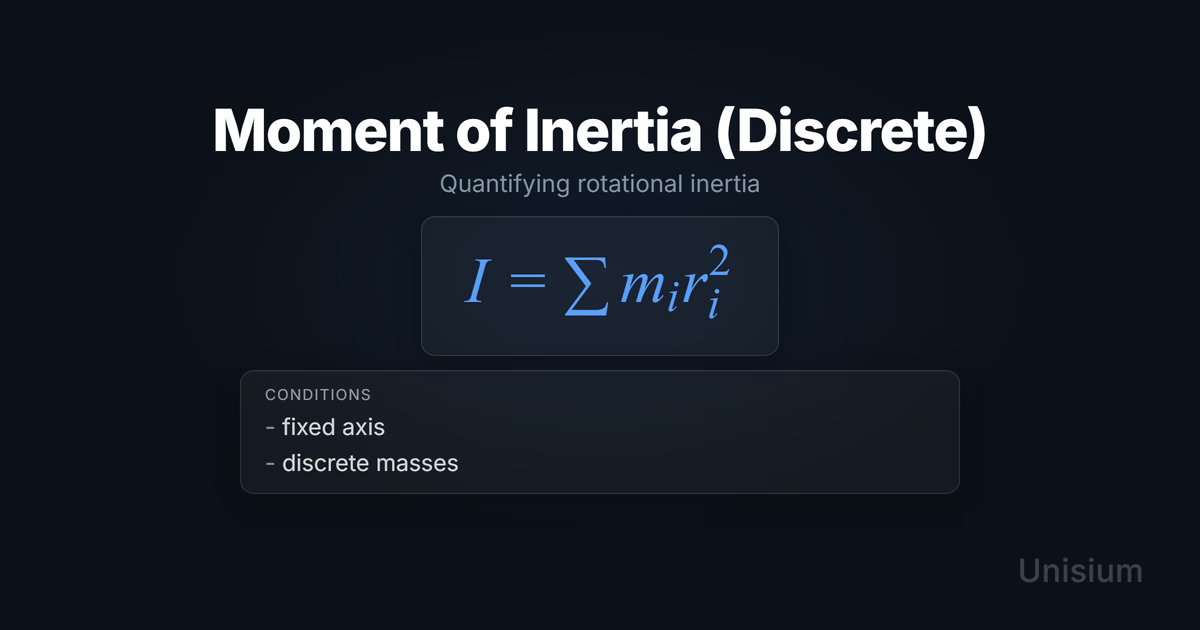
Moment of inertia quantifies how a body’s mass is distributed relative to an axis of rotation, calculated as for discrete point masses. It applies when you have a fixed rotation axis and can treat mass as concentrated at discrete points.
Moment of inertia is the rotational analog of mass—it measures resistance to angular acceleration. Just as a more massive object requires more force to accelerate linearly, an object with a larger moment of inertia requires more torque to achieve the same angular acceleration. Understanding how mass distribution affects rotational behavior is fundamental to analyzing wheels, pulleys, rotating machinery, and any system involving rotation.
On this page: The Principle · Conditions · Misconceptions · EE Questions · Retrieval Practice · Worked Example · Solve a Problem · FAQ
The Principle
Statement
The moment of inertia for a system of discrete point masses about a fixed axis is the sum of each mass times the square of its perpendicular distance from the axis. Masses farther from the axis contribute more strongly to the moment of inertia because of the squared distance factor. This quantity determines how much torque is needed to produce a given angular acceleration, via Newton’s second law for rotation ().
Mathematical Form
Where:
- = moment of inertia about the chosen axis (kg·m², kilogram-meters squared)
- = mass of the -th point mass (kg, kilograms)
- = perpendicular distance from the -th mass to the rotation axis (m, meters)
- The sum extends over all point masses in the system
Expansions (Discrete Systems)
For systems with a specific number of masses:
- Two-mass system:
- Three-mass system:
Conditions of Applicability
Condition: fixed axis; discrete masses This means:
- Fixed axis: The axis of rotation is specified and fixed in position and orientation. The moment of inertia is always calculated relative to a particular axis—the same object has different moments of inertia for different axes.
- Discrete masses: The mass can be treated as concentrated at specific points (point masses). For extended rigid bodies, you would use the continuous (integral) form instead.
Practical modeling notes
- Perpendicular distance: is the perpendicular (shortest) distance from the mass to the rotation axis, not necessarily the straight-line distance from the origin. In planar problems, if the axis is perpendicular to the plane, is just the radial distance from the axis.
- Massless connecting structures: The formula assumes any connecting rods, wires, or frames are massless (or their mass is separately accounted for). Real systems may require treating these structures as additional discrete masses or using the continuous form.
- Axis choice matters: Changing the axis changes . For example, a rod rotating about its center has a smaller moment of inertia than the same rod rotating about one end.
When It Doesn’t Apply
- Continuous mass distribution: When mass is spread continuously over a volume (like a solid disk, sphere, or rod), use the continuous moment of inertia principle (a separate retrieval target with its own guide).
- Moving or precessing axis: If the axis itself moves or changes orientation during rotation (not just shifting to a different parallel axis), you may need 3D rigid body dynamics with inertia tensors.
- Non-rigid systems: If the distances change during motion (e.g., masses sliding on a rod), the moment of inertia varies with time, and conservation of angular momentum (with changing ) becomes relevant.
Want the complete framework behind this guide? Read Masterful Learning.
Common Misconceptions
Misconception 1: “Moment of inertia is the same as mass”
The truth: Moment of inertia depends on both the mass and how that mass is distributed relative to the axis. Two objects with the same total mass can have vastly different moments of inertia if the mass is distributed differently.
Why this matters: Using mass in place of moment of inertia (or vice versa) in rotational problems leads to incorrect results. For example, , not ; the units and physical meaning are different.
Misconception 2: “Distance is measured from the center of mass”
The truth: Distance is measured from the rotation axis, not the center of mass. The center of mass and the rotation axis are often different points (unless the axis happens to pass through the center of mass).
Why this matters: Using the wrong reference point (e.g., measuring from the center of mass when the axis is elsewhere) produces the wrong moment of inertia, leading to incorrect predictions for angular acceleration.
Misconception 3: “Moment of inertia is the same for any axis”
The truth: Moment of inertia depends on which axis you choose. The same masses have different values of for different axes. For example, two equal masses at distances and from an axis give , but if both are moved to distance , then .
Why this matters: You must calculate about the actual rotation axis used in the problem. Using a value calculated for a different axis gives the wrong answer.
Elaborative Encoding
Use these questions to build deep understanding. (See Elaborative Encoding for the full method.)
Within the Principle
- Why is distance squared in the formula ? What happens to the contribution of a mass if you double its distance from the axis?
- What are the units of moment of inertia, and how do they relate to the units of mass and distance?
For the Principle
- How do you identify the rotation axis in a problem, and what if the problem doesn’t explicitly state it?
- If you move the rotation axis to a different location, how does the moment of inertia change? (Hint: relate this to the parallel axis theorem.)
Between Principles
- How does moment of inertia in Newton’s second law for rotation () play the same role that mass plays in the translational version ()?
Generate an Example
- Describe a system of two equal masses placed at different distances from an axis. Which configuration has a larger moment of inertia, and why?
Retrieval Practice
Answer from memory, then click to reveal and check. (See Retrieval Practice for the full method.)
State the principle in words: _____The moment of inertia for discrete point masses about a fixed axis is the sum of each mass times the square of its perpendicular distance from the axis.
Write the canonical equation: _____
State the canonical condition: _____fixed axis; discrete masses
Worked Example
Use this worked example to practice Self-Explanation.
Problem
Two small spheres are attached to the ends of a rigid massless rod of length . The left sphere has mass , and the right sphere has mass . The system rotates about an axis perpendicular to the rod and passing through the center of the rod. Calculate the moment of inertia of this system about the rotation axis.
Step 1: Verbal Decoding
Target:
Given: , ,
Constraints: massless rod, two point masses at ends, axis at center (perpendicular to rod)
Step 2: Visual Decoding
Try drawing a horizontal rod of length with the axis (a dot) at the center. Place on the left end and on the right end. Label the distances: .
Step 3: Physics Modeling
Step 4: Mathematical Procedures
Step 5: Reflection
- Units: is the correct unit for moment of inertia.
- Magnitude: With 5 kg distributed 0.6 m from the axis, 1.8 kg·m² is plausible.
- Limiting case: If both masses were at the axis, (no rotational inertia).
Before moving on: self-explain the model
Try explaining Step 3 out loud (or in writing): why the moment of inertia formula applies here, what the diagram shows about the mass distribution, and how the squared distance affects each mass’s contribution.
Physics model with explanation (what “good” sounds like)
Principle: The moment of inertia for discrete masses () applies because we have two point masses at known distances from a fixed rotation axis.
Conditions: The axis is fixed (at the center of the rod), and the masses are discrete (concentrated at two points).
Relevance: Each mass contributes to the total moment of inertia proportionally to its mass and the square of its distance from the axis.
Description: Both masses are equidistant from the axis (each at ). The total moment of inertia is the sum of the individual contributions: . Since the distances are equal, this factors as .
Goal: Substitute the given masses and length into the formula to calculate the numerical value of .
Solve a Problem
Apply what you’ve learned with Problem Solving.
Problem
Three small masses are arranged as follows: is located from a vertical rotation axis, is located from the axis, and is located from the axis. All three masses lie in the same horizontal plane perpendicular to the axis. Calculate the total moment of inertia of this system about the axis.
Hint: Apply the moment of inertia formula to each mass separately, then sum the contributions.
Show Solution
Step 1: Verbal Decoding
Target:
Given: , , , , ,
Constraints: three discrete masses, fixed vertical axis, masses in horizontal plane
Step 2: Visual Decoding
Try drawing a top-down view showing the vertical axis as a point at the center. Place at distance , at distance , and at distance from the axis. Label these distances on your sketch.
Step 3: Physics Modeling
Step 4: Mathematical Procedures
Step 5: Reflection
- Units: is correct.
- Magnitude: The farthest mass contributes most due to the factor, so 2.02 kg·m² is plausible.
- Limiting case: If all masses were at the axis, (no rotational inertia).
Related Principles
- Classical Mechanics: The Complete Principle Map — see where this principle fits in the full subdomain.
| Principle | Relationship to Moment of Inertia |
|---|---|
| Newton’s Second Law (Rotation) | Moment of inertia appears in , quantifying how much torque is needed for a given angular acceleration. |
| Parallel Axis Theorem | Allows you to calculate about a parallel axis if you know about the center of mass: . |
| Translational Kinetic Energy | Moment of inertia plays the same role in rotational kinetic energy () as mass does in translational kinetic energy. |
| Moment of Inertia (Integral) | Calculus upgrade: extends to continuous mass distributions. |
See Principle Structures for how to organize these relationships visually.
FAQ
What is moment of inertia?
Moment of inertia is a measure of how a body’s mass is distributed relative to a rotation axis. For discrete point masses, it is calculated as , where each mass is weighted by the square of its distance from the axis. It quantifies resistance to angular acceleration.
When does the discrete moment of inertia formula apply?
It applies when you have a fixed axis of rotation and can treat mass as concentrated at specific points (discrete masses). For continuous mass distributions (like solid objects), use the continuous moment of inertia principle (a different guide).
What’s the difference between moment of inertia and mass?
Mass measures resistance to linear acceleration (), independent of how the mass is distributed. Moment of inertia measures resistance to angular acceleration () and depends critically on how far the mass is from the rotation axis. The same object has different values for different axes.
What are the most common mistakes with moment of inertia?
- Measuring distance from the wrong reference point (e.g., from the center of mass instead of the rotation axis).
- Using a tabulated moment of inertia for the wrong axis (e.g., a rod’s about its center vs. about one end).
- Treating moment of inertia as if it were the same as mass ( instead of ).
How do I know which axis to use when calculating moment of inertia?
If the problem specifies an axis (like a pivot, hinge, or axle), use that axis. If the object is free to rotate, you can choose any axis, but the center of mass often simplifies calculations. Always calculate about the same axis used for torques and angular acceleration in Newton’s second law for rotation.
Related Guides
- Principle Structures — Organize this principle in a hierarchical framework
- Self-Explanation — Learn to explain worked examples step by step
- Retrieval Practice — Make this principle instantly accessible
- Problem Solving — Apply principles systematically to new problems
How This Fits in Unisium
The Unisium Study System helps you master moment of inertia through targeted practice in elaborative encoding (building deep understanding of how mass distribution affects rotation), retrieval practice (strengthening instant recall of the formula and conditions), self-explanation (articulating why the squared distance matters), and problem solving (applying the principle to calculate for various configurations). Together, these strategies ensure you can confidently use moment of inertia in rotational dynamics problems.
Ready to master moment of inertia? Check access and join the Unisium waitlist or explore the full learning framework in Masterful Learning.
Masterful Learning
The book behind these guides: a study system for physics, math, & programming built on retrieval, connection, explanation, and problem solving.
Ready to apply this strategy?
Unisium turns these evidence-based techniques into guided study sessions for math and physics. Places are limited during early access. Check current availability to start a trial; joining the mailing list is optional.
See plans and availability Read More GuidesAlready have access? Sign in