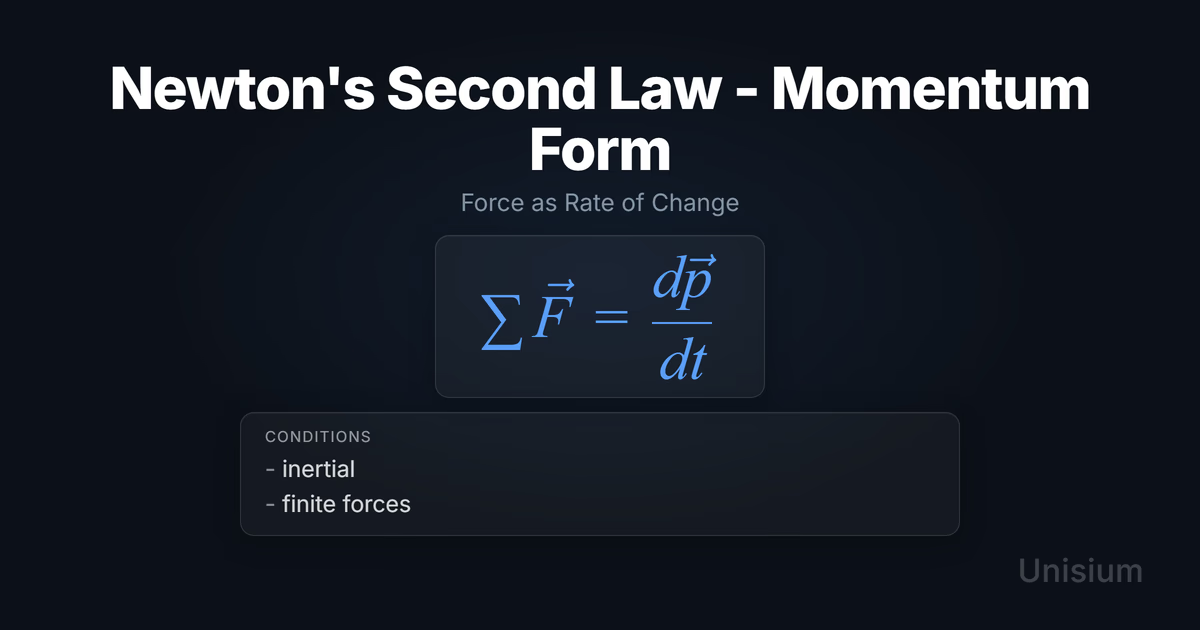
Newton's Second Law - Momentum Form: Force as Rate of Change
Newton’s Second Law in momentum form says the net external force on a system equals the time rate of change of its momentum: . In an inertial frame with finite forces, it tells you exactly how momentum changes over time and gives a clean bridge to impulse and momentum conservation.
Momentum form tracks how net external force changes a system’s momentum directly. For constant mass it reduces to the familiar ; its real value is the direct route to impulse, conservation, and cases where system boundaries or momentum flux matter.
If you’re deciding whether a mechanics problem is better treated with Conservation of Linear Momentum or the Impulse-Momentum Theorem, see When to Use Momentum Conservation vs Impulse.
On this page: The Principle | Conditions | Misconceptions | EE Questions | Retrieval Practice | Worked Example | Solve a Problem | FAQ
The Principle
Statement
Newton’s Second Law in momentum form states that the net external force acting on an object is equal to the time rate of change of the object’s momentum. When no net force acts, momentum is constant; when a net force acts, it produces a change in momentum proportional to the magnitude and direction of that force.
Mathematical Form
Where:
- = net external force (in newtons, N)
- = linear momentum of the object (in kg·m/s)
- = time (in seconds, s)
- = time derivative of momentum (in N)
Alternative Forms
In different contexts, this appears as:
- Constant mass: (the familiar form when mass doesn’t change)
- Expanded product rule: (for , but beware: this only works when the system boundary is fixed and no momentum flux crosses it)
Conditions of Applicability
Condition: inertial; finite forces
Practical modeling notes
- Inertial frame means we’re observing from a reference frame that isn’t accelerating. In most introductory problems, this is satisfied by measuring from the ground or a frame moving at constant velocity.
- Finite forces excludes idealized scenarios with infinite forces (like perfectly rigid collisions at a single instant), though in practice this is rarely a concern.
- Most classical mechanics problems in introductory courses automatically satisfy these conditions.
- Variable-mass systems (like rockets expelling fuel) require careful attention to system boundaries and momentum flux. The rocket equation is a standard result derived from momentum balance, but it’s an advanced application—easy to misuse if you try to apply naively to a subsystem whose mass is changing.
When It Doesn’t Apply
- Non-inertial frames: If you’re in an accelerating elevator or a rotating reference frame, you need to include fictitious forces (like the Coriolis force) or transform to an inertial frame first.
- Relativistic speeds: When objects approach the speed of light, you need to use the relativistic momentum where depends on velocity, and Newton’s Second Law takes a modified form.
- Quantum scales: At atomic and subatomic scales, classical momentum becomes a quantum operator and Newton’s laws are replaced by the Schrödinger equation or quantum field theory.
Want the complete framework behind this guide? Read Masterful Learning.
Common Misconceptions
Misconception 1: The momentum form is only for collisions or impulse problems
The truth: The momentum form is the general statement of Newton’s Second Law. It applies to all situations where forces act, not just collisions. When mass is constant, it reduces to .
Why this matters: Students avoid using the momentum-derivative form in continuous-force problems, missing that is often cleaner than working with acceleration when forces vary with time.
Misconception 2: Force “creates” momentum
The truth: Force changes the rate at which momentum changes. Momentum exists even when no force acts (an object coasting in space has constant momentum). Force is the cause of momentum change, not the cause of momentum itself.
Why this matters: This leads students to incorrectly think an object at rest has “no momentum and therefore no force needed to keep it at rest.” In reality, constant momentum (including zero) requires zero net force—an important distinction when analyzing equilibrium.
Elaborative Encoding
Use these questions to build deep understanding. (See Elaborative Encoding for the full method.)
Within the Principle
- What does the derivative mean physically? If momentum is changing rapidly, what does that say about the net force?
- Why is momentum a vector? What happens to the direction of force if momentum changes direction but not magnitude?
For the Principle
- How do you decide whether to use versus in a problem? What feature of the problem setup matters?
- When analyzing a collision between two objects, why do we focus on momentum rather than directly on forces during the collision?
Between Principles
- How does the momentum form of Newton’s Second Law connect to the impulse-momentum theorem? What happens when you integrate both sides over a time interval?
Generate an Example
- Describe a situation where using with the system’s total mass would give an incorrect answer, but gives the correct result.
Retrieval Practice
Answer from memory, then click to reveal and check. (See Retrieval Practice for the full method.)
State the principle in words: _____The net external force acting on an object equals the time rate of change of the object's momentum.
Write the canonical equation: _____
State the canonical condition: _____inertial; finite forces
Worked Example
Use this worked example to practice Self-Explanation.
Problem
A 1200 kg cart starts from rest on a frictionless horizontal track. A horizontal force ramps up linearly from zero: where N/s. The force acts for 5.0 seconds. What is the cart’s final velocity?
Step 1: Verbal Decoding
Target: (final velocity)
Given: , ,
Constraints: starts from rest, frictionless, force increases linearly with time, 1D motion
Step 2: Visual Decoding
Draw a 1D axis. Choose in the direction of applied force. Label the force pointing in the direction, increasing from zero to over time. (So is positive and grows linearly.)
Step 3: Physics Modeling
Step 4: Mathematical Procedures
Step 5: Reflection
- Units: has units .
- Magnitude: Peak force is N, so 2.5 m/s for a 1200 kg cart over 5 s is plausible.
- Limiting case: If , then .
Before moving on: self-explain the model
Try explaining Step 3 out loud (or in writing): why the chosen principle applies, what the diagram implies, and how the equations encode the situation.
Physics model with explanation (what “good” sounds like)
Principle: We use . The force is time-dependent, so we can’t use constant-acceleration formulas. The momentum form lets us write and integrate directly.
Conditions: We’re in an inertial frame (ground frame). The force is finite (it grows smoothly, no impulses).
Relevance: When force varies with time, the momentum-derivative form is the cleanest tool. You could alternatively use and integrate to get , but is more direct—it reveals that velocity change equals the area under the curve (divided by mass).
Description: The cart starts from rest. The force increases linearly from zero to over the interval . The momentum change is , so the final velocity is .
Goal: We’re finding how much velocity the cart gains when pushed by a time-varying force—a textbook case for using the momentum form with integration.
Solve a Problem
Apply what you’ve learned with Problem Solving.
Problem
A 500 g hockey puck slides on frictionless ice at 12 m/s. A player applies a braking force that decreases linearly from 20 N to zero over 0.80 seconds (a triangular force pulse). What is the puck’s final velocity?
Hint: The force varies with time, so find the impulse (area under the force–time triangle) and use .
Show Solution
Step 1: Verbal Decoding
Target: (final velocity)
Given: , , ,
Constraints: frictionless ice, force decays linearly (triangular pulse), 1D motion
Step 2: Visual Decoding
Draw a 1D axis. Choose in the puck’s initial direction of motion. Label the puck’s velocity as positive. The braking force points in the direction (opposing motion), starting at and ramping to zero. (So m/s and the force is negative.)
Step 3: Physics Modeling
Step 4: Mathematical Procedures
Step 5: Reflection
- Units: Impulse has units kg·m/s, which divided by kg gives m/s.
- Magnitude: The puck reversed direction because the impulse magnitude (8.0 kg·m/s) exceeded initial momentum (6.0 kg·m/s).
- Limiting case: If , then and .
Related Principles
- Classical Mechanics: The Complete Principle Map — see where this principle fits in the full subdomain.
| Principle | Relationship to Newton’s Second Law - Momentum Form |
|---|---|
| Newton’s Second Law () | The constant-mass special case; equivalent when |
| Impulse-Momentum Theorem | Direct integration of over a time interval |
| Conservation of Linear Momentum | When , this principle gives (constant momentum) |
See Principle Structures for how to organize these relationships visually.
FAQ
What is Newton’s Second Law in momentum form?
Newton’s Second Law in momentum form states that the net external force on an object equals the time rate of change of its momentum: . It’s the most general statement of Newton’s Second Law.
When does Newton’s Second Law in momentum form apply?
It applies in inertial reference frames (non-accelerating observation points) with finite forces. This covers almost all introductory physics problems and extends to variable-mass systems like rockets.
What’s the difference between Newton’s Second Law in momentum form and the familiar F = ma?
The momentum form is more general. When mass is constant, it reduces to . But when mass changes (rockets, conveyor belts), only the momentum form gives correct results without special handling.
What are the most common mistakes with this principle?
The most common mistakes are: (1) assuming momentum exists only when force acts (momentum is constant without net force), (2) using with changing mass instead of the momentum form, and (3) forgetting that momentum is a vector—direction changes require force even if speed is constant.
How do I know when to use the momentum form versus F = ma?
Use the momentum form when: (1) mass is changing, (2) you’re connecting to impulse or momentum conservation, or (3) you want to emphasize the time-integral perspective. Use when mass is constant and you’re focused on instantaneous acceleration. They’re equivalent when mass is constant.
Related Guides
- Principle Structures — Organize this principle in a hierarchical framework
- Self-Explanation — Learn to explain worked examples step by step
- Impulse-Momentum Theorem — See how integrating this principle leads to impulse reasoning
- Problem Solving — Apply principles systematically to new problems
How This Fits in Unisium
Understanding Newton’s Second Law in momentum form deepens your grasp of the fundamental connection between force, time, and motion. Unisium helps you master this principle through spaced retrieval practice (so becomes automatic), elaborative encoding questions (to see why it’s more general than ), and self-explanation of worked examples (especially variable-mass problems where the momentum form shines).
Ready to master Newton’s Second Law in momentum form? Check access and join the Unisium waitlist or explore the full learning framework in Masterful Learning.

Masterful Learning
The book behind these guides: a study system for physics, math, & programming built on retrieval, connection, explanation, and problem solving.
Ready to apply this strategy?
Unisium turns these evidence-based techniques into guided study sessions for math and physics. Places are limited during early access. Check current availability to start a trial; joining the mailing list is optional.
See plans and availability Read More GuidesAlready have access? Sign in