Gravitational Potential Energy (Near Surface): Mastering the mgh Formula
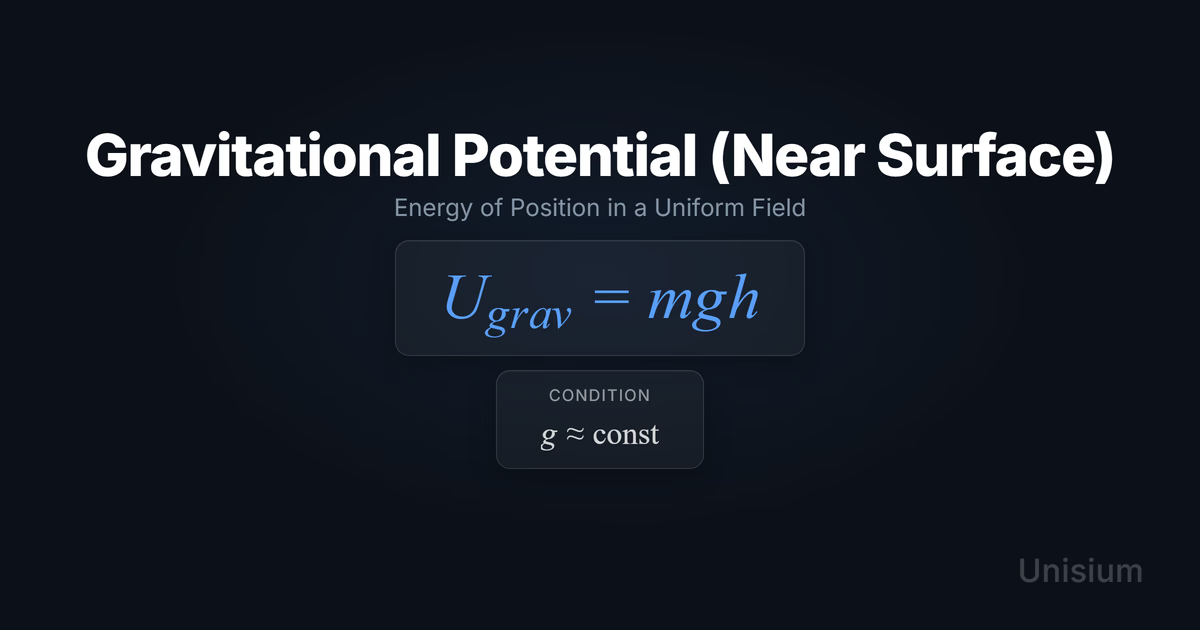
Gravitational Potential Energy (Near Surface) quantifies the energy stored in an object due to its position in a uniform gravitational field. The formula applies when height changes are small compared to Earth’s radius, so over the motion.
Gravitational potential energy depends on the zero point you choose. Choose the zero point first, then measure height relative to it: points above it have positive , and points below it have negative .
On this page: The Principle · Conditions · Misconceptions · EE Questions · Retrieval Practice · Worked Example · Solve a Problem · FAQ
The Principle
Statement
Gravitational potential energy near Earth’s surface is the energy an object possesses by virtue of its vertical position in a uniform gravitational field. It is given by , where the height is measured from an arbitrary reference level (zero-point) and increases upward.
Mathematical Form
Where:
- = gravitational potential energy (joules, J)
- = mass of the object (kilograms, kg)
- = acceleration due to gravity ( near Earth’s surface)
- = height above the chosen reference level (meters, m)
Alternative Forms
In problem solving, the change form is often more useful:
- Change form:
- Explicit endpoints:
If you use a vertical coordinate measured from the same reference level, you can write , giving .
Conditions of Applicability
Condition: This formula applies when the gravitational field strength is approximately constant over the range of motion—specifically, when height changes are small compared to Earth’s radius. This assumption breaks down for large vertical distances (satellite orbits, interplanetary trajectories), where the inverse-square law must be used instead.
Practical modeling notes
- Typical range: For motions within a few kilometers of Earth’s surface, is effectively constant.
- Choice of zero-point: The reference level () is arbitrary. Choose it strategically to simplify calculations (e.g., at the lowest point of motion, or at the final position).
- Work with changes: In problem solving, you’ll typically use the change , which is independent of the reference level.
- Sign convention: Height is positive above the reference and negative below. This makes positive above the zero-point and negative below.
- Multiple objects: For a system of objects, sum the potential energies: .
When It Doesn’t Apply
- Large altitude changes: For satellites or high-altitude balloons (hundreds of kilometers), varies noticeably with distance from Earth’s center. For a point mass or spherically symmetric source, use with zero potential energy at infinity.
- Non-uniform fields: Near the surface of the Moon or another planet, can still apply over a small enough region when you use that body’s local . Use a more complete potential model when the field varies appreciably across the motion or when multiple sources contribute significantly.
- Relativistic contexts: At extreme velocities or near massive compact objects (black holes), general relativity is required.
Want the complete framework behind this guide? Read Masterful Learning.
Common Misconceptions
Misconception 1: “The zero-point must be at ground level”
The truth: The reference level is completely arbitrary. You can set at the ground, at a tabletop, at the final position, or anywhere else. Height is always measured from your chosen reference, not necessarily from the ground.
Why this matters: Choosing the zero-point strategically often simplifies algebra. For example, if an object ends on the ground, setting there means , eliminating one term in energy conservation. Always explicitly state your zero-point before solving.
Misconception 2: “Gravitational PE is always positive”
The truth: can be positive, negative, or zero, depending on the chosen reference level. Only differences in potential energy have physical meaning.
Why this matters: Confusing absolute with leads to sign errors in energy conservation. Always track what happens to , not the individual values.
Misconception 3: “Height equals distance traveled”
The truth: Height is the signed vertical position relative to the chosen zero, not the path length. The change is the vertical displacement or endpoint height difference. An object moving along a curved ramp experiences the same as one dropped straight down if they have the same .
Why this matters: Using path length instead of vertical displacement gives the wrong PE change. Only the vertical component of displacement matters for gravitational PE.
Elaborative Encoding
Use these questions to build deep understanding. (See Elaborative Encoding for the full method.)
Within the Principle
- What does each symbol in physically represent? Why does potential energy increase with height?
- What are the SI units for each term, and do they combine correctly to give joules?
For the Principle
- How do you decide where to place the reference level () in a problem involving gravitational potential energy?
- What happens to the formula when the gravitational field is not constant (e.g., in orbit)?
Between Principles
- How does gravitational PE near the surface () relate to the work done by gravity ()?
Generate an Example
- Describe a situation where choosing a non-ground reference level simplifies the energy conservation calculation.
Retrieval Practice
Answer from memory, then click to reveal and check. (See Retrieval Practice for the full method.)
State the principle in words: _____Gravitational potential energy near Earth's surface is the energy an object possesses due to its vertical position in a uniform gravitational field; it is given by U_grav = mgh.
Write the canonical equation: _____
State the canonical condition: _____
Worked Example
Use this worked example to practice Self-Explanation.
Problem
A 2.0 kg textbook falls from a shelf 1.5 m above the floor to the floor. Taking the floor as the reference level, what is the change in gravitational potential energy?
Step 1: Verbal Decoding
Target:
Given: , , ,
Constraints: Near Earth’s surface; ; reference level at floor
Step 2: Visual Decoding
Draw a 1D vertical axis. Choose upward. Define height measured from the reference level. Set at the floor. Mark and . (So is positive and is zero.)
Step 3: Physics Modeling
Step 4: Mathematical Procedures
Step 5: Reflection
- Units: ✓
- Magnitude: 29 J for a 2 kg object falling 1.5 m is reasonable (compare: a 1 kg object falling 3 m would be J).
- Limiting case: If the book stayed on the shelf (), , which makes sense (no energy change if no motion).
Before moving on: self-explain the model
Try explaining Step 3 out loud: why applies here, how your sign convention makes negative, and why that means .
Physics model with explanation (what “good” sounds like)
Principle: Gravitational potential energy applies because we are near Earth’s surface where is constant.
Conditions: The vertical displacement (1.5 m) is tiny compared to Earth’s radius, so the uniform-field approximation is excellent.
Relevance: We define the floor as (the reference level). This makes the math clean: initially the book is at ; finally it’s at . The change captures the physics directly.
Description: The book starts at above the floor and ends at (floor). The change is negative because the book moves downward, meaning the gravitational field does positive work (by Work-Energy Theorem, this work becomes kinetic energy).
Goal: We want . Step 3 gives the change form; Step 4 substitutes with the correct sign and computes the result.
Solve a Problem
Apply what you’ve learned with Problem Solving.
Problem
A 0.50 kg apple is moved from a branch 3.0 m above the ground to a basket on the ground. Taking the ground as the reference level, what is ? Use .
Hint: Identify the initial and final heights carefully. Remember the sign of .
Show Solution
Step 1: Verbal Decoding
Target:
Given: , , ,
Constraints: Near Earth’s surface; ; reference level at ground
Step 2: Visual Decoding
Draw a 1D vertical axis. Choose upward. Define height measured from the reference level. Set at the ground. Mark and . (So is positive and is zero.)
Step 3: Physics Modeling
Step 4: Mathematical Procedures
Step 5: Reflection
- Units: ✓
- Magnitude: 15 J for a half-kilogram object falling 3 m is plausible (half the mass of the textbook, twice the fall distance).
- Limiting case: If the apple stayed on the branch (), (no energy change). If the branch were at ground level, initially, so no PE to lose.
Related Principles
- Classical Mechanics: The Complete Principle Map — see where this principle fits in the full subdomain.
| Principle | Relationship to Gravitational PE |
|---|---|
| Work - Constant Force | Gravitational PE is derived from the work done by the constant gravitational force () over a vertical displacement. |
| Translational Kinetic Energy | In energy conservation problems, gravitational PE converts to kinetic energy and vice versa: (when ). |
| Work-Energy Theorem | The change in PE () relates to the work done by gravity: . |
See Principle Structures for how to organize these relationships visually.
FAQ
What is gravitational potential energy?
Gravitational potential energy is the energy stored in an object due to its position in a gravitational field. Near Earth’s surface, it is given by , where is the height above an arbitrary reference level.
When does the near-surface formula apply?
The formula applies when the gravitational field is approximately constant, specifically when height changes are small compared with the scale over which the field varies. Near Earth, this is often a good model within a few kilometers of the surface. For a point mass or spherically symmetric source over larger distances, use with zero potential energy at infinity. For multiple significant sources, add the relevant potential-energy contributions or use a more complete field model.
What’s the difference between and ?
is the potential energy at a specific position (depends on your choice of reference level). is the change in potential energy between two positions (independent of reference level). Only has absolute physical meaning.
What are the most common mistakes with gravitational PE?
The top mistakes are: (1) forgetting that the reference level is arbitrary and can be chosen for convenience, (2) confusing the sign of (positive when increases, negative when decreases), and (3) using the wrong height (measured from the reference, not always from the ground).
How do I know which reference level to choose?
Choose the reference level to simplify the algebra. Common choices: the lowest point of motion, the final position, or the ground. If an object ends at , its final PE is zero, reducing the number of terms in energy conservation.
Related Guides
- Principle Structures — Organize gravitational PE in a hierarchical energy framework
- Work-Energy Theorem — Understand the connection between work and potential energy
- Problem Solving — Apply energy principles systematically to new problems
How This Fits in Unisium
Gravitational potential energy is a core principle in mechanics, appearing in energy conservation, work problems, and projectile motion. Unisium helps you master this principle through spaced retrieval practice (so becomes automatic), elaborative encoding (understanding when the constant- approximation holds), self-explanation (articulating why has a particular sign), and problem solving (applying the principle to varied contexts).
Ready to master gravitational potential energy? Check access and join the Unisium waitlist or explore the full learning framework in Masterful Learning.
Masterful Learning
The book behind these guides: a study system for physics, math, & programming built on retrieval, connection, explanation, and problem solving.
Ready to apply this strategy?
Unisium turns these evidence-based techniques into guided study sessions for math and physics. Places are limited during early access. Check current availability to start a trial; joining the mailing list is optional.
See plans and availability Read More GuidesAlready have access? Sign in