Rotational Kinetic Energy: Master Energy in Rotating Systems
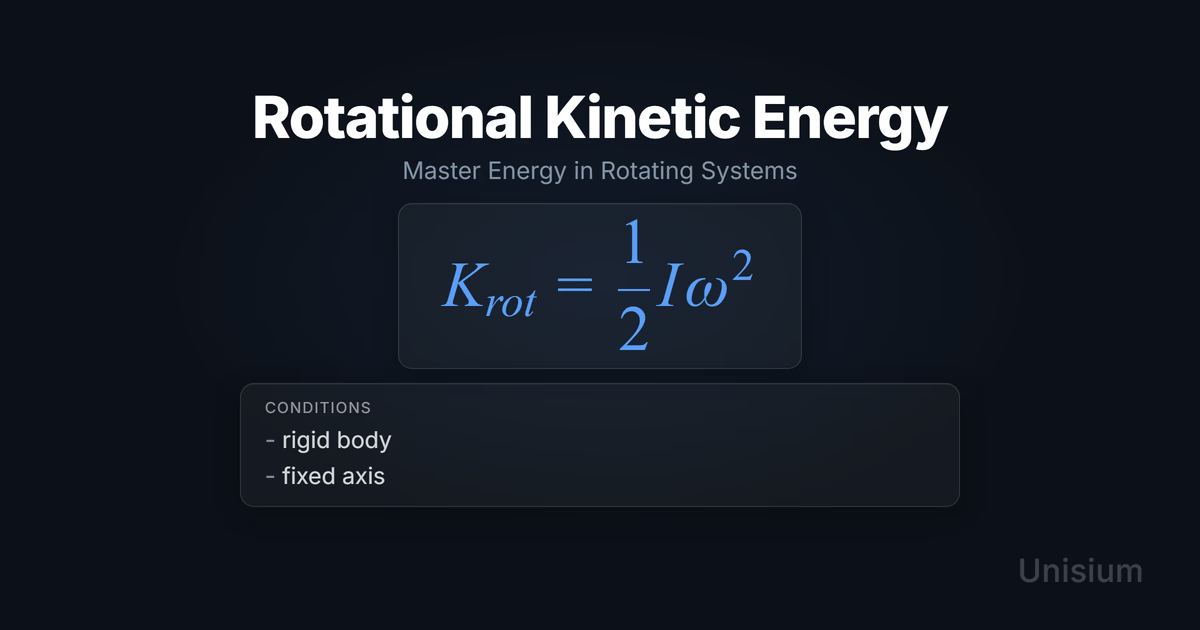
Rotational Kinetic Energy is the energy stored in a rigid body’s rotation: , where captures mass distribution about the axis and is angular velocity.
It applies for rigid-body motion about a fixed axis; unlike , the same mass can store different amounts of energy depending on how far it sits from the axis.
Use it when a rigid body is spinning about a fixed axis and some of the system’s energy is stored in rotation, not just translation.
This principle is the rotational analog of translational kinetic energy (). Where mass measures resistance to linear acceleration, moment of inertia captures how mass is distributed relative to the rotation axis. It’s essential for analyzing rotating machinery, rolling objects, and energy transformations in rotational systems.
On this page: The Principle · Conditions · Misconceptions · EE Questions · Retrieval Practice · Worked Example · Solve a Problem · FAQ
The Principle
Statement
The rotational kinetic energy of a rigid body rotating about a fixed axis equals half the product of its moment of inertia and the square of its angular velocity. Just as translational kinetic energy depends on mass and speed, rotational kinetic energy depends on how mass is distributed (moment of inertia) and how fast the object spins (angular velocity).
Mathematical Form
Where:
- = rotational kinetic energy (J)
- = moment of inertia about the rotation axis (kg·m²)
- = angular velocity (rad/s)
Alternative Forms
In different contexts, this appears as:
- Angular momentum form: (using )
- For rolling without slipping: Total kinetic energy is (translational + rotational about center of mass)
Conditions of Applicability
Condition: rigid body; fixed axis This requires two conditions to be met:
- Rigid body: The object doesn’t deform—every point maintains fixed distances from every other point. Internal forces hold the shape constant.
- Fixed axis: The axis of rotation stays in the same orientation in space. The axis itself doesn’t wobble or precess.
Practical modeling notes
Common rigid-body idealizations include disks, cylinders, spheres, and rods. For rolling objects, use the moment of inertia about the rotation axis (often the center of mass). If the axis passes through a point other than the center of mass, use the parallel axis theorem to find . Many engineering problems assume bearings or pivots create a fixed axis even when small vibrations exist.
When It Doesn’t Apply
The principle must be modified or replaced when these conditions fail:
- Deformable body: For flexible objects (diving boards, vibrating beams, fluids), the moment of inertia changes with deformation. Use continuum mechanics or break the body into rigid segments.
- Precession or nutation: When the axis orientation changes (spinning top, gyroscope), the scalar form is insufficient. Use the full tensor formulation or equivalently with the angular momentum vector.
- Variable moment of inertia: If mass distribution changes during motion (ice skater pulling arms in, extending ladder), you must account for the changing in energy and momentum analysis.
Want the complete framework behind this guide? Read Masterful Learning.
Common Misconceptions
Misconception 1: “Rotational kinetic energy and translational kinetic energy are interchangeable”
The truth: They are distinct forms. A rolling object has both translational kinetic energy () and rotational kinetic energy (). The total kinetic energy is the sum.
Why this matters: Ignoring rotational kinetic energy in rolling problems leads to incorrect speeds. For example, a disk rolling down a ramp reaches a lower speed than a sliding block starting from the same height because some energy goes into rotation.
Misconception 2: “Moment of inertia is the same as mass”
The truth: Moment of inertia depends on both mass and how that mass is distributed relative to the rotation axis. Two objects with identical mass can have vastly different moments of inertia.
Why this matters: Using mass instead of moment of inertia in rotational energy calculations gives nonsensical results. A hollow cylinder has higher than a solid cylinder of the same mass and radius, so it stores more rotational energy at the same .
Misconception 3: “Angular velocity and linear velocity are the same thing”
The truth: Angular velocity measures rotation rate (rad/s), while linear velocity measures translation speed (m/s). They are related by for a point at distance from the axis, but they are fundamentally different quantities.
Why this matters: Plugging into the rotational energy formula instead of (or vice versa) produces incorrect units and values. Always convert using the tangential speed relationship when needed.
Elaborative Encoding
Use these questions to build deep understanding. (See Elaborative Encoding for the full method.)
Within the Principle
- Why does the equation square rather than having appear linearly?
- What does moment of inertia represent physically, and why does it play the same role as mass does in ?
For the Principle
- How do you decide which axis to use when calculating moment of inertia for a rotating object?
- For an object that is both translating and rotating (like a rolling wheel), how do you account for both forms of kinetic energy?
Between Principles
- How is rotational kinetic energy related to angular momentum? (Hint: compare and .)
Generate an Example
- Describe a physical situation where an object has zero translational kinetic energy but non-zero rotational kinetic energy.
Retrieval Practice
Answer from memory, then click to reveal and check. (See Retrieval Practice for the full method.)
State the principle in words: _____The rotational kinetic energy of a rigid body rotating about a fixed axis equals half the product of its moment of inertia and the square of its angular velocity.
Write the canonical equation: _____
State the canonical condition: _____rigid body; fixed axis
Worked Example
Use this worked example to practice Self-Explanation.
Problem
A solid disk of mass 4.0 kg and radius 0.30 m is rotating about its central axis at 120 rpm. What is the rotational kinetic energy of the disk?
Step 1: Verbal Decoding
Target:
Given: , ,
Constraints: solid disk, rotation about central axis
Step 2: Visual Decoding
Draw the disk from above. Mark the rotation axis perpendicular to the disk through the center. Choose counterclockwise as positive and label with that sign. (So is positive.)
Step 3: Physics Modeling
Step 4: Mathematical Procedures
Step 5: Reflection
- Units: kg·m² × (rad/s)² = kg·m²/s² = J ✓ (radians are dimensionless)
- Magnitude: 14 J is reasonable for a few-kilogram disk spinning at about 2 revolutions per second—comparable to kinetic energy of a small moving object.
- Limiting case: If , then , which makes sense—no rotation, no rotational energy.
Before moving on: self-explain the model
Try explaining Step 3 out loud (or in writing): why the rotational kinetic energy principle applies, what moment of inertia represents, and why we use the solid disk formula.
Physics model with explanation (what “good” sounds like)
Principle: We use rotational kinetic energy because the disk is a rigid body rotating about a fixed axis through its center.
Conditions: The disk is rigid (maintains its shape) and the axis is fixed (perpendicular through the center, not wobbling).
Relevance: The energy stored in rotation depends on both how mass is distributed () and how fast it spins (). The moment of inertia for a solid disk is derived from the mass distribution: points closer to the axis contribute less to than points farther out.
Description: The disk has mass uniformly distributed. We convert the given rpm to rad/s because must be in radians per second. We use the standard formula for a solid disk about its central axis.
Goal: We calculate from geometry, convert to proper units, then apply to find the energy.
Solve a Problem
Apply what you’ve learned with Problem Solving.
Problem
A hollow cylindrical shell has mass 2.5 kg, inner radius 0.15 m, and outer radius 0.20 m. It rotates about its central axis at 90 rpm. Find its rotational kinetic energy. (Hint: For a hollow cylinder, where and are inner and outer radii.)
Show Solution
Step 1: Verbal Decoding
Target:
Given: , , ,
Constraints: hollow cylindrical shell, rotation about central axis
Step 2: Visual Decoding
Draw the hollow cylinder from above. Mark the rotation axis perpendicular through the center. Indicate inner radius and outer radius . Choose counterclockwise as positive and label with that sign. (So is positive.)
Step 3: Physics Modeling
Step 4: Mathematical Procedures
Step 5: Reflection
- Units: kg·m² × (rad/s)² = J ✓
- Magnitude: 3.5 J is smaller than the solid disk example because this cylinder has less mass and spins slower, which makes sense.
- Limiting case: If inner and outer radii were equal (infinitely thin cylinder), would be , recovering the thin-ring formula.
Related Principles
- Classical Mechanics: The Complete Principle Map — see where this principle fits in the full subdomain.
| Principle | Relationship to Rotational Kinetic Energy |
|---|---|
| Translational Kinetic Energy | Rotational analog: plays the role of , and plays the role of |
| Moment of Inertia | Defines the term in rotational kinetic energy; depends on mass distribution and axis |
| Work-Energy Theorem | Net work done by torques equals change in rotational kinetic energy: |
| Translational Kinetic Energy | Translation analog: mass replaces moment of inertia, speed replaces angular speed. |
See Principle Structures for how to organize these relationships visually.
FAQ
What is Rotational Kinetic Energy?
Rotational kinetic energy is the energy possessed by a rigid object due to its rotation about a fixed axis. It’s given by , where is moment of inertia and is angular velocity.
When does Rotational Kinetic Energy apply?
It applies when a rigid body (one that doesn’t deform) rotates about a fixed axis (the axis orientation doesn’t change in space).
What’s the difference between Rotational Kinetic Energy and Translational Kinetic Energy?
Translational kinetic energy () measures energy of motion through space. Rotational kinetic energy measures energy of spinning motion. A rolling object has both: it translates (center of mass moves) and rotates (spins about its center).
What are the most common mistakes with Rotational Kinetic Energy?
- Using mass instead of moment of inertia
- Forgetting to include rotational energy when analyzing rolling objects
- Using linear velocity instead of angular velocity
How do I know which moment of inertia formula to use?
The moment of inertia depends on the object’s shape and the axis of rotation. Common shapes (solid disk, hollow cylinder, sphere, rod) have standard formulas. Always use the formula for the actual rotation axis—if it’s not through the center of mass, use the parallel axis theorem.
Related Guides
- Principle Structures — Organize this principle in a hierarchical framework
- Self-Explanation — Learn to explain worked examples step by step
- Retrieval Practice — Make this principle instantly accessible
- Problem Solving — Apply principles systematically to new problems
How This Fits in Unisium
Unisium helps you master rotational kinetic energy through spaced retrieval practice, elaborative encoding prompts, worked example self-explanation, and progressively challenging problems. The system tracks your understanding of how moment of inertia and angular velocity combine to determine rotational energy, and connects it to related principles like the work-energy theorem and conservation of mechanical energy.
Ready to master Rotational Kinetic Energy? Check access and join the Unisium waitlist or explore the full learning framework in Masterful Learning.
Masterful Learning
The book behind these guides: a study system for physics, math, & programming built on retrieval, connection, explanation, and problem solving.
Ready to apply this strategy?
Unisium turns these evidence-based techniques into guided study sessions for math and physics. Places are limited during early access. Check current availability to start a trial; joining the mailing list is optional.
See plans and availability Read More GuidesAlready have access? Sign in