Torque - Angular Momentum Form: Rotational Dynamics in Calculus Form
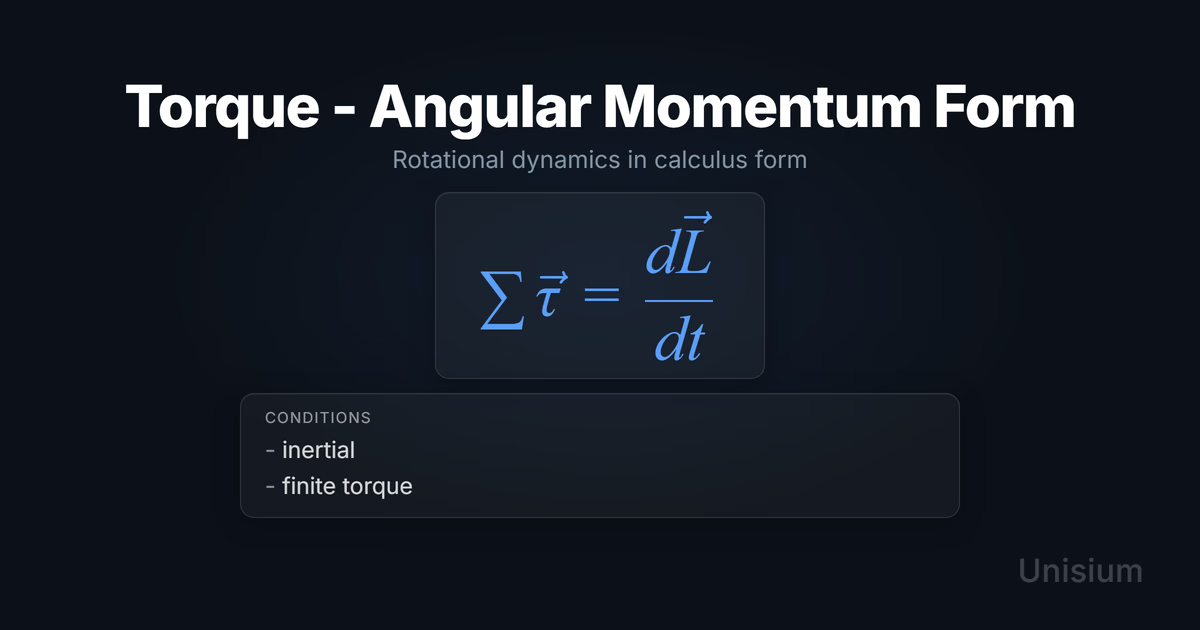
Torque - Angular Momentum Form () is the general rotational second law: in an inertial frame, the net torque equals the time rate of change of angular momentum. Unlike the algebraic shortcut , it remains correct even when the moment of inertia changes—making it the right tool whenever mass redistributes during motion. Knowing this form lets you decide which version to reach for, and carry through the integration without errors.
This is the most general rotational second law. Unlike its algebraic counterpart , which requires a constant moment of inertia, holds even when the mass distribution—and therefore —changes over time. Understanding the derivative form deepens your ability to apply Newton’s Second Law (Rotation) and see how Angular Momentum (Rigid Body) is altered by applied torques.
On this page: The Principle · Conditions · Misconceptions · EE Questions · Retrieval Practice · Worked Example · Solve a Problem · FAQ
The Principle
Statement
In an inertial reference frame, the net torque acting on a system equals the time rate of change of the system’s total angular momentum. This holds whether or not the moment of inertia is constant, making it the general—and more fundamental—statement of rotational dynamics.
Mathematical Form
Where:
- = net torque on the system (SI unit: )
- = total angular momentum of the system (SI unit: )
- = time (SI unit: )
The derivative is a vector: the rate of change of angular momentum has both magnitude and direction. A torque aligned with changes its magnitude (speeding up or slowing down the spin); a torque perpendicular to changes its direction instead, producing precession.
Alternative Forms
In different contexts, this appears as:
- Scalar component about a fixed axis: (rotation restricted to a fixed -axis)
Conditions of Applicability
Condition: inertial; finite torque
Practical modeling notes
- “Inertial” means the reference frame has no translational or rotational acceleration relative to an inertial background. For Earth-based laboratory problems this condition is satisfied unless the problem explicitly involves rotating frames.
- “Finite torque” means the torque is integrable over the time interval of interest. Impulsive interactions (sharp collisions where force spikes to infinity for an infinitesimal time) require the angular impulse–momentum form, not the derivative form.
- When is constant, this principle reduces to Newton’s Second Law (Rotation): differentiating gives .
When It Doesn’t Apply
- Non-inertial frames: Fictitious torques arise from the frame’s own acceleration. The equation must be modified or the problem transformed to an inertial frame first.
- Impulsive torques: If the torque becomes effectively infinite over a zero-duration collision, integrate the angular impulse using the angular impulse–momentum theorem instead.
Want the complete framework behind this guide? Read Masterful Learning.
Common Misconceptions
Misconception 1: “This principle and are the same equation”
The truth: is a special case that holds only when is constant. The general law is . When mass redistributes (for example, a skater extending her arms while an external torque is applied), changes with time and only the derivative form is correct.
Why this matters: Applying to a variable- system produces wrong results. Always check whether is constant before simplifying to the algebraic form.
Misconception 2: “A large net torque means large angular momentum”
The truth: Net torque governs the rate of change of , not the value of itself. A system can have large with zero net torque (isolated spinning body), or zero with a nonzero torque (starting from rest under an applied torque).
Why this matters: This is the rotational analogue of confusing force with momentum. The sign of net torque tells you whether is increasing or decreasing at that instant, not what currently is.
Elaborative Encoding
Use these questions to build deep understanding. (See Elaborative Encoding for the full method.)
Within the Principle
- What are the SI units of ? Verify by dimensional analysis that they equal the units of torque ().
- The equation is a full vector equation. What physical effect occurs when is perpendicular to rather than parallel to it?
For the Principle
- Under what condition does simplify to ? How would you check that condition in a given problem?
- Suppose the moment of inertia changes over time (for example, a rod with a sliding mass under an external torque). Which form of the rotational second law do you need, and why does the algebraic form fail?
Between Principles
- How does Conservation of Angular Momentum emerge from ? What condition on the net torque is required?
Generate an Example
- Describe a physical setup where substituting instead of gives an incorrect prediction. What feature of the setup makes the calculus form necessary?
Retrieval Practice
Answer from memory, then click to reveal and check. (See Retrieval Practice for the full method.)
State the principle in words: _____In an inertial frame, the net external torque on a system equals the time rate of change of its total angular momentum.
Write the canonical equation: _____
State the canonical condition: _____inertial; finite torque
Worked Example
Use this worked example to practice Self-Explanation.
Problem
A flywheel modeled as a solid disk has moment of inertia and starts from rest. A motor applies a constant net torque of for a duration of . Find the flywheel’s angular velocity at the end of this interval.
Step 1: Verbal Decoding
Target:
Given: , , ,
Constraints: inertial frame; constant; torque constant and finite; starts from rest
Step 2: Visual Decoding
Sketch the flywheel as a circle viewed end-on. Choose along the motor’s torque direction using the right-hand rule. Label at and at . (So and .)
Step 3: Physics Modeling
Step 4: Mathematical Procedures
Step 5: Reflection
- Units: ✓
- Magnitude: 100 rad/s under 8 N·m for 5 s on a 0.40 kg·m² flywheel is plausible.
- Limiting case: As , , consistent with no applied torque.
Before moving on: self-explain the model
Try explaining Step 3 out loud (or in writing): why the torque–angular momentum derivative form applies, what the integration from Step 4 line 1 means physically, and how the constant-torque assumption makes the area under the -vs- curve a simple rectangle.
Physics model with explanation (what “good” sounds like)
Principle: Torque–Angular Momentum Form, , because the frame is inertial and the torque is constant (finite).
Conditions: The frame is inertial; is constant and finite—both conditions are satisfied. Because is also constant, , but we use the integral of the derivative form to make the step from torque to explicit.
Relevance: The problem supplies and asks for —a change-in-angular-momentum question. Integrating the derivative form over connects the applied torque directly to in one step.
Description: The motor exerts a steady torque, causing to grow linearly with time from zero. After 5 s the accumulated angular momentum equals .
Goal: Isolate by computing and then dividing by .
Solve a Problem
Apply what you’ve learned with Problem Solving.
Problem
A turntable (treat as a disk) has initial moment of inertia and spins at . While a motor applies a constant net torque , clay is dropped symmetrically onto the rim so the total moment of inertia grows as (with in seconds). Find the angular velocity at .
Hint (if needed): Because changes with time, is invalid here. Integrate directly.
Show Solution
Step 1: Verbal Decoding
Target: at
Given: , , , ,
Constraints: inertial frame; finite constant torque; (variable, not constant — fails)
Step 2: Visual Decoding
Choose along the initial spin. Label at and at . (So , , and .)
Step 3: Physics Modeling
Step 4: Mathematical Procedures
Step 5: Reflection
- Units: Numerator has units , denominator , giving ✓
- Magnitude: Starting at 10 rad/s, gaining torque-boost but losing angular velocity to added inertia, ~13 rad/s is plausible.
- Limiting case: As (constant ), , matching the constant- algebraic result ✓
Related Principles
- Classical Mechanics: The Complete Principle Map — see where this principle fits in the full subdomain.
| Principle | Relationship to Torque – Angular Momentum Form |
|---|---|
| Newton’s Second Law (Rotation) | Special case when is constant: reduces this law to |
| Angular Momentum (Rigid Body) | Provides the expression for that is differentiated in this law |
| Conservation of Angular Momentum | Direct consequence when : implies is constant |
| Torque Definition | Algebraic form: torque as cross product of position and force. |
See Principle Structures for how to organize these relationships visually.
FAQ
What is the Torque–Angular Momentum Form?
The Torque–Angular Momentum Form is the general rotational second law, . It states that the net torque on a system equals the time rate of change of its total angular momentum, and it holds whether or not the moment of inertia is constant.
When does apply?
The frame must be inertial and the torques must be finite (not impulsive). Both conditions are satisfied in almost all standard mechanics problems that do not involve collisions or rotating reference frames.
What is the difference between and ?
follows from when is constant—differentiating with constant gives . When changes with time (a variable-mass-distribution system), only the general derivative form is correct.
How do I use in problem solving?
For constant torque, integrate both sides over the time interval to get . For time-varying torque, substitute and solve the resulting differential equation for or .
What are the most common mistakes with this principle?
Substituting when is not constant, omitting the sign of the torque (direction matters), and applying the derivative form to impulsive torques. For collision-like interactions use the angular impulse–momentum form instead.
Related Guides
- Principle Structures — Organize this principle in a hierarchical framework
- Self-Explanation — Learn to explain worked examples step by step
- Retrieval Practice — Make this equation retrievable under exam pressure
- Problem Solving — Apply this principle systematically to new problems
How This Fits in Unisium
Unisium tracks the Torque–Angular Momentum Form as a separate learning target with its own elaboration questions, cloze prompts, and worked problems, all scheduled at the spacing intervals that evidence shows are most effective for long-term retention. When you practice this principle, you build the ability to recognize when the derivative form is needed over the algebraic one, choose the correct sign conventions, and carry through the integration in a single clean step.
Ready to master the Torque–Angular Momentum Form? Check access and join the Unisium waitlist or explore the full learning framework in Masterful Learning.
Masterful Learning
The book behind these guides: a study system for physics, math, & programming built on retrieval, connection, explanation, and problem solving.
Ready to apply this strategy?
Unisium turns these evidence-based techniques into guided study sessions for math and physics. Places are limited during early access. Check current availability to start a trial; joining the mailing list is optional.
See plans and availability Read More GuidesAlready have access? Sign in