Angular Momentum of a Rigid Body: Fixed-Axis L = Iω
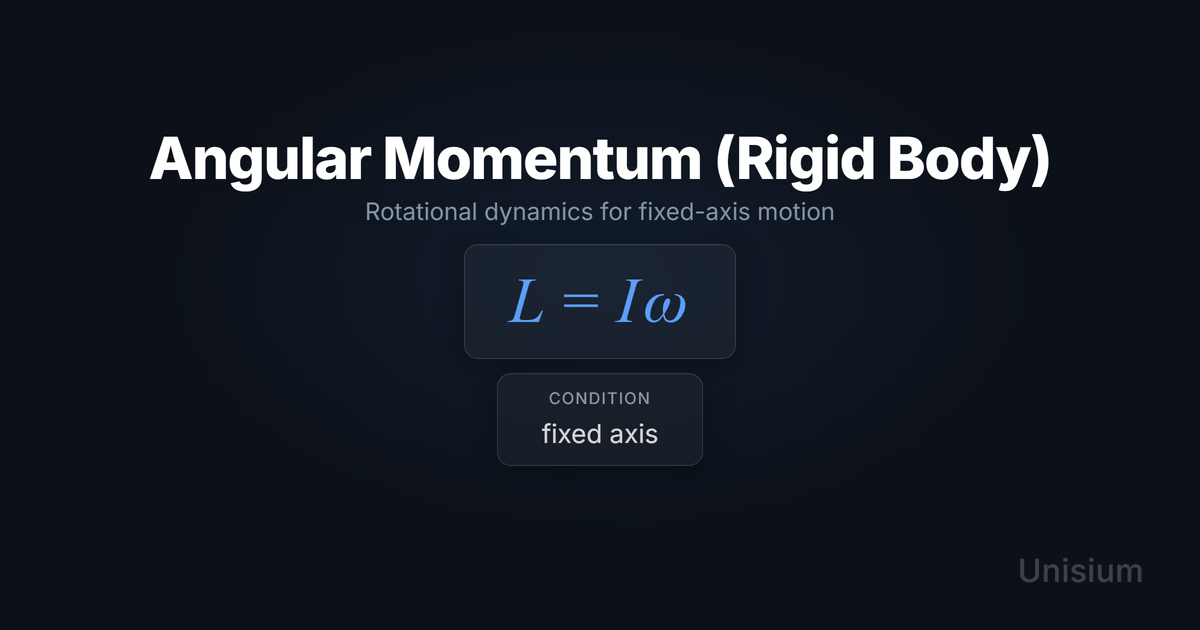
Angular Momentum (Rigid Body) states that for a rigid body rotating about a fixed axis, the angular momentum equals the moment of inertia times the angular velocity. It applies when the rotation axis remains fixed in direction.
Angular momentum for rigid bodies is a cornerstone of rotational dynamics, connecting an object’s resistance to rotation (moment of inertia) with its rate of spin. Unlike point particles where , rigid bodies require integrating contributions from all mass elements, producing the elegant product for fixed-axis rotation.
On this page: The Principle · Conditions · Misconceptions · EE Questions · Retrieval Practice · Worked Example · Solve a Problem · FAQ
The Principle
Statement
For a rigid body rotating about a fixed axis, the angular momentum is the product of the moment of inertia about that axis and the angular velocity . In the common case where the fixed axis is a principal (symmetry) axis, is along the axis and we can use the scalar or component form where is the rotation axis.
Mathematical Form
Where:
- = angular momentum (SI unit: )
- = moment of inertia about the rotation axis (SI unit: )
- = angular velocity (SI unit: )
The direction follows the right-hand rule: curl your fingers in the direction of rotation and your thumb points along the angular momentum vector.
Pedagogical note: A common fixed-axis shorthand is . In general, (tensor form). In this guide we emphasize the axial/component relation for fixed-axis problems. When the axis is a principal (symmetry) axis, and many texts write the signed-scalar shorthand .
Alternative Forms
In different contexts, this appears as:
- Vector form (principal axis): — applies when the fixed axis is a principal (symmetry) axis; both quantities point along the rotation axis
- Component form: — the axial component relation; always valid for fixed-axis rotation (even if has perpendicular components when the axis isn’t principal)
Conditions of Applicability
Condition: fixed axis
The rotation axis must remain fixed in direction throughout the motion. This means:
- The axis does not wobble, precess, or change orientation
- External forces/torques do not cause the axis to tilt
- You can calculate a single moment of inertia about that axis
Practical modeling notes
- Symmetry helps: Objects with rotational symmetry (cylinders, spheres, disks) often rotate naturally about fixed axes through their centers.
- Hinges and axles: Real-world constraints like hinges, axles, or bearings enforce fixed-axis rotation.
When It Doesn’t Apply
- Fixed axis but not a principal axis: When the rotation axis is fixed but not aligned with a principal axis of the inertia tensor, use . Only the axial component simplifies: , but may not be parallel to .
- 3D rotation (tumbling): When an object rotates about multiple axes simultaneously (like a football in flight), you need the full tensor formulation where is the inertia tensor. and may not be parallel.
- Precession: When external torques cause the rotation axis to change direction (like a spinning top precessing under gravity), the fixed-axis condition breaks. Use instead.
- Deformable bodies: If the object changes shape while rotating (like a collapsing star or a figure skater pulling arms in), use conservation principles with time-varying rather than treating as constant.
Want the complete framework behind this guide? Read Masterful Learning.
Common Misconceptions
Misconception 1: applies to all rotations
The truth: This simple form requires a fixed rotation axis. For general 3D rotation, angular momentum and angular velocity need not be parallel, and you must use the inertia tensor: .
Why this matters: Applying to a tumbling object (like a thrown wrench) gives wrong predictions because angular momentum remains constant in magnitude and direction while angular velocity changes direction.
Misconception 2: Larger always means larger
The truth: Angular momentum depends on both and . A slowly spinning flywheel (large , small ) can have more angular momentum than a rapidly spinning toy top (small , large ).
Why this matters: In collisions or energy transfers, you cannot judge outcomes by angular speed alone. A door () swinging at has , but a spinning disk () at has .
Misconception 3: Moment of inertia is a fixed property like mass
The truth: Moment of inertia depends on the choice of rotation axis. The same object has different values about different axes (parallel axis theorem: ).
Why this matters: When analyzing rotation, you must first identify the axis, then compute about that specific axis. Using the wrong (e.g., using when the axis is off-center) leads to incorrect angular momentum calculations.
Elaborative Encoding
Use these questions to build deep understanding. (See Elaborative Encoding for the full method.)
Within the Principle
- Why is a scalar multiplier rather than a vector in this equation? What does this tell you about the relationship between and for fixed-axis rotation?
- The SI units of are . How do these units emerge from , and what do they represent physically (mass, distance, time)?
For the Principle
- How do you decide whether a real object’s rotation qualifies as “fixed axis”? What observable signs indicate the axis is changing?
- If you know an object is spinning about a fixed axis, what information do you need to calculate ? What if the object has unusual geometry?
Between Principles
- How does for a rigid body relate to for a point particle? Conceptually, how does summing point-particle angular momentum lead to an effective moment of inertia ?
Generate an Example
- Describe a real-world situation where applies accurately, and another where it fails because the axis is not fixed. What distinguishes them?
Retrieval Practice
Answer from memory, then click to reveal and check. (See Retrieval Practice for the full method.)
State the principle in words: _____For rotation about a fixed axis, the angular momentum about that axis equals the moment of inertia times the angular velocity. When the axis is a principal axis, this is often written as the signed scalar L = Iω.
Write the canonical equation (vector form): _____
State the canonical condition: _____fixed axis
Worked Example
Use this worked example to practice Self-Explanation.
Problem
A uniform solid disk of mass and radius rotates about an axis perpendicular to its face through its center. At , the disk spins at . A constant braking torque (negative because it opposes rotation) acts on the disk for . Find the disk’s angular momentum at .
Step 1: Verbal Decoding
Target: (angular momentum at )
Given: , , , ,
Constraints: Uniform solid disk, axis through center perpendicular to face, constant torque
Step 2: Visual Decoding
Try drawing the disk viewed from above. Choose the positive rotation direction (counterclockwise). Label the initial direction and show the braking torque vector pointing in the opposite sense.
(So is positive and is negative.)
Step 3: Physics Modeling
Step 4: Mathematical Procedures
Step 5: Reflection
- Units: emerges from and from (since ), confirming dimensional consistency.
- Magnitude: The braking torque removed exactly over 2 seconds, bringing the disk to rest, which is physically reasonable.
- Limiting case: If , then and , as expected for no net torque.
Before moving on: self-explain the model
Try explaining Step 3 out loud (or in writing): why the chosen principles apply, what the diagram implies, and how the equations encode the situation.
Physics model with explanation (what “good” sounds like)
Principle: We use to relate the disk’s moment of inertia and angular velocity to its angular momentum. We also use angular impulse because a constant torque acts over a time interval.
Conditions: The disk rotates about a fixed axis (perpendicular through its center), so the simple form holds. The torque is constant, so the impulse integral reduces to multiplication.
Relevance: We need , and we know the initial state and the torque history, so applying angular impulse connects the initial and final angular momenta.
Description: The disk starts with positive angular momentum. The braking torque (negative) steadily reduces over 2 seconds, bringing the disk to rest.
Goal: We compute from the disk’s geometry, then . The angular impulse gives , and adding these yields .
Solve a Problem
Apply what you’ve learned with Problem Solving.
Problem
A solid sphere of mass and radius rotates about an axis through its center. At , the sphere has angular velocity . A net torque acts on it for . What is the sphere’s angular momentum at ?
Hint: The moment of inertia of a solid sphere about an axis through its center is .
Show Solution
Step 1: Verbal Decoding
Target: (angular momentum at )
Given: , , , ,
Constraints: Solid sphere, axis through center, constant torque
Step 2: Visual Decoding
Try drawing the sphere. Choose the positive rotation direction. Label and show the applied torque vector in the same direction (since ).
(So both and are positive, increasing angular momentum.)
Step 3: Physics Modeling
Step 4: Mathematical Procedures
Step 5: Reflection
- Units: appears in both and , confirming correctness.
- Magnitude: The torque added to the initial , nearly an order-of-magnitude increase, which is plausible for a strong torque acting over 4 seconds.
- Limiting case: If , then and , as expected for no torque.
Related Principles
- Classical Mechanics: The Complete Principle Map — see where this principle fits in the full subdomain.
| Principle | Relationship to Angular Momentum (Rigid Body) |
|---|---|
| Angular Momentum (Particle) | The point-particle form becomes after integrating over a rigid body’s mass distribution. |
| Conservation of Angular Momentum | When , remains constant (though and can vary inversely if the body deforms). |
| Rotational Kinetic Energy | can be rewritten as using , linking energy and angular momentum. |
See Principle Structures for how to organize these relationships visually.
FAQ
What is Angular Momentum (Rigid Body)?
Angular momentum for a rigid body rotating about a fixed axis is the product of the moment of inertia and the angular velocity . It quantifies the “amount of rotation” and resists changes due to external torques.
When does apply?
It applies when the rotation axis remains fixed in direction. This includes wheels on axles, spinning disks, and symmetric objects rotating about principal axes through their centers.
What’s the difference between and ?
The latter is the definition for a point particle. The former is the result of summing over all mass elements in a rigid body when the rotation axis is fixed, producing the scalar moment of inertia .
What are the most common mistakes with ?
- Using the wrong (forgetting to account for the specific rotation axis)
- Applying it to non-fixed-axis rotation (tumbling objects)
- Assuming proportional to alone, ignoring that varies with mass distribution
How do I know which form of to use?
If the object rotates about a fixed axis (hinges, axles, or symmetric spin), use . If it’s a point mass moving in space, use . For general 3D rotation (tumbling), use the tensor form .
Related Guides
- Principle Structures — Organize this principle in a hierarchical framework
- Self-Explanation — Learn to explain worked examples step by step
- Retrieval Practice — Make this principle instantly accessible
- Problem Solving — Apply principles systematically to new problems
How This Fits in Unisium
Unisium helps you master angular momentum through targeted elaboration (EE questions), spaced retrieval practice (ClozeLine prompts), self-explained worked examples, and progressive problem solving. Each principle connects to your personalized study plan, ensuring you build deep, transferable understanding of rotational dynamics.
Ready to master Angular Momentum (Rigid Body)? Check access and join the Unisium waitlist or explore the full learning framework in Masterful Learning.

Masterful Learning
The book behind these guides: a study system for physics, math, & programming built on retrieval, connection, explanation, and problem solving.
Ready to apply this strategy?
Unisium turns these evidence-based techniques into guided study sessions for math and physics. Places are limited during early access. Check current availability to start a trial; joining the mailing list is optional.
See plans and availability Read More GuidesAlready have access? Sign in