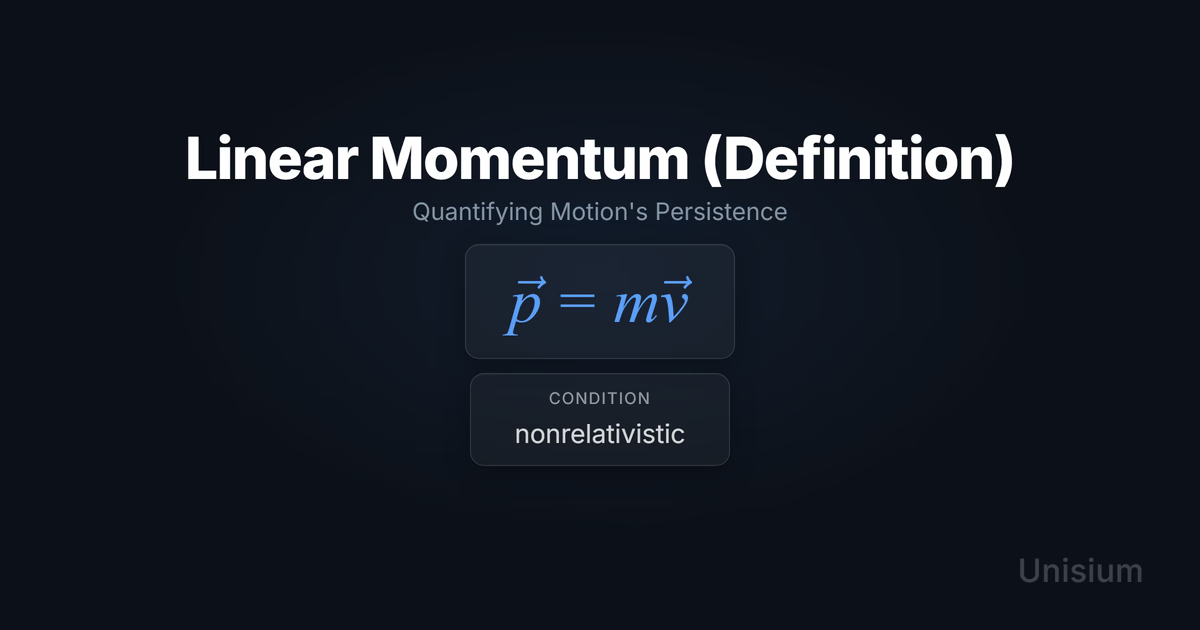
Linear Momentum (Definition): Quantifying Motion's Persistence
Linear momentum is the mass-weighted velocity of a particle (or point-mass model): a vector defined by in classical (non-relativistic) mechanics. It’s the bookkeeping quantity behind collisions and impulse because interactions often change momentum even when forces are hard to track moment-by-moment. Use it when collisions, impulse, or whole-system motion are easier to analyze through momentum transfer than through force-by-force tracking.
Linear momentum is central to understanding interactions between objects. From car crashes to rocket propulsion to billiard balls, momentum provides a way to predict outcomes when forces are brief or difficult to measure directly. It’s the bridge between kinematics (describing motion) and dynamics (explaining forces).
If you’re not defining momentum but deciding between Conservation of Linear Momentum and the Impulse-Momentum Theorem, see When to Use Momentum Conservation vs Impulse.
On this page: The Principle · Conditions · Misconceptions · EE Questions · Retrieval Practice · Worked Example · Solve a Problem · FAQ
The Principle
Statement
Linear momentum is the mass-weighted velocity of a particle (or point-mass model): a vector defined by in classical mechanics. An object’s momentum describes how difficult it is to stop: greater mass or speed means greater momentum.
Mathematical Form
Where:
- = linear momentum (kg·m/s)
- = mass (kg)
- = velocity (m/s)
Alternative Forms
In different contexts, this appears as:
- Component form: , ,
- Magnitude form: (for motion along a line or when only magnitude matters)
Conditions of Applicability
Condition: nonrelativistic This equation defines linear momentum in classical mechanics. The “nonrelativistic” boundary flags that this form is replaced by at speeds approaching light speed (). For systems of particles, total momentum is the vector sum: .
Practical modeling notes
- For rigid bodies, use the velocity of the center of mass:
- In relativistic contexts (speeds approaching light speed), the definition becomes where
When the classical form is replaced
The classical form is replaced in extreme regimes:
- Relativistic speeds: At speeds near the speed of light, momentum grows faster than due to relativistic effects. Use instead.
Want the complete framework behind this guide? Read Masterful Learning.
Common Misconceptions
Misconception 1: Momentum is the same as velocity
The truth: Momentum depends on both mass and velocity. A slow-moving truck can have far more momentum than a fast-moving baseball because of its much greater mass.
Why this matters: Students who conflate momentum with velocity fail to account for mass differences in collision problems, leading to incorrect predictions about which object “wins” in an interaction.
Misconception 2: Momentum is a scalar (just a number)
The truth: Momentum is a vector. It has both magnitude and direction. A car moving east at 20 m/s has different momentum than the same car moving west at 20 m/s—the magnitudes are equal, but the directions are opposite.
Why this matters: In two-dimensional collisions, you must track and separately. Treating momentum as a scalar leads to wrong answers when directions differ.
Misconception 3: More momentum always means more kinetic energy
The truth: Momentum is while kinetic energy is . A heavy truck moving slowly can have large momentum but small kinetic energy. A light bullet moving fast can have small momentum but large kinetic energy.
Why this matters: In collisions, momentum is always conserved (if no external forces), but kinetic energy is conserved only in elastic collisions. Confusing the two leads to incorrect analysis of collision outcomes.
Elaborative Encoding
Use these questions to build deep understanding. (See Elaborative Encoding for the full method.)
Within the Principle
- Why is momentum a vector quantity rather than a scalar? What information would be lost if we only tracked magnitude?
- The units of momentum are kg·m/s. How do these units connect to the underlying quantities, and what do they tell you about the physical meaning of momentum?
For the Principle
- How would you decide whether to use the vector form or the component form in a specific problem?
- When analyzing a collision, how do you identify the system for which momentum is defined? Can you choose different systems, and how does that choice affect your analysis?
Between Principles
- How does linear momentum relate to Newton’s second law ? Why is momentum sometimes more useful than force for analyzing interactions?
Generate an Example
- Describe a situation where two objects have the same kinetic energy but different momenta. What determines which object has greater momentum?
Retrieval Practice
Answer from memory, then click to reveal and check. (See Retrieval Practice for the full method.)
State the principle in words: _____Linear momentum is a vector quantity equal to the product of a particle's (or point-mass model's) mass and velocity.
Write the canonical equation: _____
State the canonical condition: _____nonrelativistic
Worked Example
Use this worked example to practice Self-Explanation.
Problem
A 1200 kg car travels east at 15 m/s. What is its momentum?
Step 1: Verbal Decoding
Target:
Given: ,
Constraints: Motion in one dimension (east)
Step 2: Visual Decoding
Draw a horizontal axis. Choose to the east. Label the car’s velocity as m/s. (So is positive because the car moves in the direction.)
Step 3: Physics Modeling
Step 4: Mathematical Procedures
Step 5: Reflection
- Units: kg·m/s is correct for momentum (mass × velocity).
- Magnitude: kg·m/s is reasonable for a car at highway speed.
- Limiting case: If the car were at rest (), momentum would be zero—matches the definition .
Before moving on: self-explain the model
Try explaining Step 3 out loud (or in writing): why the momentum definition applies, what the diagram implies, and how the equation encodes the situation.
Physics model with explanation (what “good” sounds like)
Principle: We use the 1D component form because this is a direct application of the definition to find momentum along a chosen axis.
Conditions: This principle requires nonrelativistic speeds (). We have a well-defined mass and velocity.
Relevance: This definition is the starting point for any momentum calculation. It’s not a derived law but the fundamental way we quantify motion’s persistence.
Description: The car is a single rigid body moving at constant velocity eastward. We model it as a point mass. The horizontal axis lets us track the direction through sign convention.
Goal: We’re solving for . The direction is encoded by the sign because we chose to point east.
Solve a Problem
Apply what you’ve learned with Problem Solving.
Problem
A 0.15 kg baseball is thrown north at 40 m/s. What is its momentum?
Hint: Choose a coordinate axis and assign a sign to the velocity based on direction.
Show Solution
Step 1: Verbal Decoding
Target:
Given: ,
Constraints: Motion in one dimension (north)
Step 2: Visual Decoding
Draw a vertical axis. Choose to the north. Label the baseball’s velocity as m/s. (So is positive because the ball moves in the direction.)
Step 3: Physics Modeling
Step 4: Mathematical Procedures
Step 5: Reflection
- Units: kg·m/s is correct for momentum.
- Magnitude: 6.0 kg·m/s is reasonable for a baseball—smaller mass than the car example, so smaller momentum even at higher speed.
- Limiting case: If the ball were dropped (), momentum would be zero—consistent with .
Related Principles
- Classical Mechanics: The Complete Principle Map — see where this principle fits in the full subdomain.
| Principle | Relationship to Linear Momentum (Definition) |
|---|---|
| Conservation of Linear Momentum | Uses this definition to express conservation: when , total momentum is constant |
| Impulse-Momentum Theorem | Connects force and time to change in momentum: |
| Newton’s Second Law | Can be written as , showing force as rate of momentum change |
See Principle Structures for how to organize these relationships visually.
FAQ
What is linear momentum?
Linear momentum is a vector quantity that measures an object’s motion, defined as the product of mass and velocity: . It quantifies how difficult it is to stop an object.
When does linear momentum apply?
In classical (non-relativistic) mechanics, applies to point particles (and point-mass models). For extended objects, use center-of-mass velocity. At relativistic speeds, use .
What’s the difference between momentum and velocity?
Velocity describes only how fast and in what direction an object moves. Momentum includes mass, so it accounts for both the object’s motion and its inertia. A truck moving slowly can have more momentum than a fast car.
What are the most common mistakes with linear momentum?
The most common mistakes are: (1) treating momentum as a scalar instead of a vector, (2) confusing momentum with kinetic energy, and (3) forgetting that momentum depends on mass as well as velocity.
How do I know which form of momentum to use?
Use the vector form when direction matters (collisions in 2D or 3D). Use component forms like when working along a single axis. Use the magnitude only when direction is already clear or irrelevant.
Related Guides
- Principle Structures — Organize this principle in a hierarchical framework
- Self-Explanation — Learn to explain worked examples step by step
- Retrieval Practice — Make this principle instantly accessible
- Problem Solving — Apply principles systematically to new problems
How This Fits in Unisium
Unisium helps you master linear momentum through structured practice: elaborative encoding to understand why is a vector product, retrieval practice to recall it instantly, self-explanation to articulate how it applies in worked examples, and problem-solving to transfer it to new contexts. The platform tracks your progress across momentum-related principles, connecting this definition to conservation laws and the impulse-momentum theorem.
Ready to master linear momentum? Check access and join the Unisium waitlist or explore the full learning framework in Masterful Learning.

Masterful Learning
The book behind these guides: a study system for physics, math, & programming built on retrieval, connection, explanation, and problem solving.
Ready to apply this strategy?
Unisium turns these evidence-based techniques into guided study sessions for math and physics. Places are limited during early access. Check current availability to start a trial; joining the mailing list is optional.
See plans and availability Read More GuidesAlready have access? Sign in