Kinetic Friction: Understanding Sliding Resistance in Mechanics
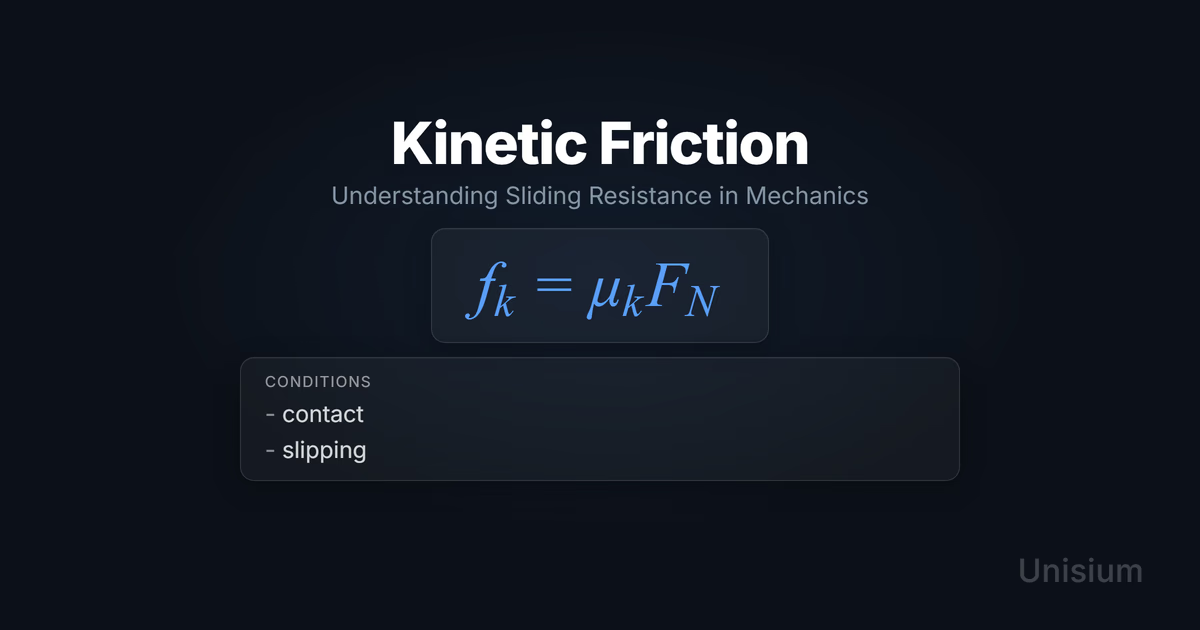
Kinetic friction is the resistive force that opposes relative motion between two surfaces in contact. It applies when surfaces are sliding past each other and is proportional to the normal force. Use kinetic friction when surfaces are sliding relative to each other; if they are not slipping, the relevant model is static friction instead.
Kinetic friction is central to understanding real-world motion in classical mechanics. Unlike idealized frictionless scenarios, most everyday situations involve surfaces in contact that resist sliding. This principle connects directly to Newton’s laws and helps explain why objects slow down, why brakes work, and how energy is dissipated through heat.
On this page: The Principle · Conditions · Misconceptions · EE Questions · Retrieval Practice · Worked Example · Solve a Problem · FAQ
The Principle
Statement
Kinetic friction is the force that opposes the relative motion between two surfaces in contact. The magnitude of the kinetic friction force is proportional to the normal force pressing the surfaces together, with the proportionality constant being the coefficient of kinetic friction, which depends on the materials in contact.
Mathematical Form
Where:
- = magnitude of kinetic friction force (N)
- = coefficient of kinetic friction (dimensionless, typically 0.01–1.5)
- = magnitude of normal force (N)
Alternative Forms
In different contexts, this appears as:
- Vector form: (direction opposes relative velocity)
- Along the surface: (tangential direction opposite the relative sliding velocity)
Conditions of Applicability
Condition: contact; slipping
Practical modeling notes (optional)
- The surfaces must be sliding (not rolling) relative to each other
- The coefficient is assumed constant, though it can vary with speed in some materials
- The normal force must be perpendicular to the contact surface
- This is an empirical model that works well for dry, solid surfaces at moderate speeds
When It Doesn’t Apply
- No relative motion: When surfaces are at rest relative to each other, use static friction instead. Static friction can vary from zero up to .
- Rolling contact: When an object rolls without slipping, kinetic friction doesn’t apply. Use rolling resistance or static friction at the contact point.
- Fluid resistance: When moving through fluids (air, water), use drag force models instead. Drag typically depends on speed squared, not linearly on normal force.
- High speeds or temperatures: At extreme conditions, the simple proportionality may break down due to surface deformation or melting.
Want the complete framework behind this guide? Read Masterful Learning.
Common Misconceptions
Misconception 1: Kinetic friction depends on contact area
The truth: The kinetic friction force depends only on the normal force and the coefficient of kinetic friction, not on the contact area.
Why this matters: Students often think that increasing contact area increases friction, leading to incorrect force diagrams. While larger area may distribute pressure and affect wear, it doesn’t change the friction force magnitude in this idealized model.
Misconception 2: Kinetic friction always equals
The truth: The magnitude of kinetic friction is , but the direction always opposes relative motion between the surfaces.
Why this matters: In problems with changing motion direction or reference frames, incorrectly assigning the direction of leads to sign errors and wrong accelerations.
Misconception 3: Kinetic friction always does negative work on an object
The truth: Kinetic friction always dissipates mechanical energy at the contact, but the work on a single object can be positive or negative depending on what the other surface is doing (e.g., a box on a moving conveyor belt experiences positive friction work).
Why this matters: It prevents sign mistakes in work–energy problems and stops you from assuming friction always removes energy from the object in every scenario. The key is that while friction does negative work on one surface, it may do positive work on the other, with net energy dissipated as heat.
Elaborative Encoding
Use these questions to build deep understanding. (See Elaborative Encoding for the full method.)
Within the Principle
- What does represent physically, and why is it dimensionless?
- Why does kinetic friction depend on the normal force rather than weight directly?
For the Principle
- How do you determine the direction of the kinetic friction force in a problem?
- What happens to the kinetic friction force if the normal force changes while surfaces remain in contact?
Between Principles
- How does kinetic friction differ from static friction, and when does the transition occur?
Generate an Example
- Describe a situation where kinetic friction acts but the normal force is not equal to the object’s weight.
Retrieval Practice
Answer from memory, then click to reveal and check. (See Retrieval Practice for the full method.)
State the kinetic friction principle in words: _____The kinetic friction force opposing relative motion between two surfaces equals the coefficient of kinetic friction times the normal force.
Write the canonical equation for kinetic friction: _____
State the canonical condition: _____contact; slipping
Worked Example
Use this worked example to practice Self-Explanation.
Problem
A 5.0 kg wooden block slides across a horizontal floor with an initial speed of 8.0 m/s. The coefficient of kinetic friction between the block and the floor is . How far does the block slide before coming to rest?
Step 1: Verbal Decoding
Target: (sliding distance)
Given: , , ,
Constraints: Horizontal surface, block slides to rest, constant kinetic friction
Step 2: Visual Decoding
Try drawing a side view of the block on the floor with a free-body diagram showing weight, normal force, and kinetic friction. Choose a horizontal axis with in the direction of initial motion. Label along and note that kinetic friction opposes motion (points opposite ). (So is in the direction.)
Step 3: Physics Modeling
Step 4: Mathematical Procedures
Step 5: Reflection
- Units: divided by gives , correct for distance.
- Magnitude: About 11 meters for an object sliding at 8 m/s on wood-on-wood friction is reasonable—not too short or absurdly long.
- Limiting case: If (frictionless), then (never stops), which makes sense.
Before moving on: self-explain the model
Try explaining Step 3 out loud (or in writing): why the chosen principles apply, what the diagram implies, and how the equations encode the situation.
Physics model with explanation (what “good” sounds like)
Principle: We use Newton’s second law in both directions and the kinetic friction formula. The vertical direction establishes the normal force, and the horizontal direction connects friction to acceleration. The kinematic equation relates acceleration, velocity change, and distance.
Conditions: The surfaces are in contact and sliding (kinetic friction applies). The floor is horizontal (normal force equals weight). Friction is constant (uniform acceleration).
Relevance: Kinetic friction is the only horizontal force, so it determines the deceleration. The normal force appears in the friction formula.
Description: The block slides on a horizontal surface with initial velocity and zero final velocity. Kinetic friction opposes motion, creating a constant deceleration . The stopping distance emerges from the kinematic relation.
Goal: We solve for by first finding from friction, then using kinematics to connect acceleration, initial speed, and distance traveled.
Solve a Problem
Apply what you’ve learned with Problem Solving.
Problem
A 2.0 kg box is pushed across a horizontal table by a horizontal force of 15 N. The coefficient of kinetic friction between the box and the table is . What is the acceleration of the box?
Hint (if needed): Find the normal force first, then calculate the kinetic friction force, and finally apply Newton’s second law in the horizontal direction.
Show Solution
Step 1: Verbal Decoding
Target: (horizontal acceleration)
Given: , ,
Constraints: Horizontal table, horizontal push, kinetic friction opposes motion
Step 2: Visual Decoding
Try drawing a side view of the box with a free-body diagram showing weight, normal force, applied push, and kinetic friction. Choose in the direction of the push. Label kinetic friction opposing the push.
Step 3: Physics Modeling
Step 4: Mathematical Procedures
Step 5: Reflection
- Units: Force in N divided by mass in kg gives , correct for acceleration.
- Magnitude: About 5.1 m/s² is reasonable for a 15 N push on a 2 kg box with moderate friction—less than the frictionless case (7.5 m/s²).
- Limiting case: If (frictionless), then , which matches .
Related Principles
- Classical Mechanics: The Complete Principle Map — see where this principle fits in the full subdomain.
| Principle | Relationship to Kinetic Friction |
|---|---|
| Newton’s Second Law | Kinetic friction appears as a force term in ; determines acceleration |
| Static Friction | Applies before sliding starts; kinetic friction takes over once motion begins |
| Work-Energy Theorem | Kinetic friction does negative work on the two-surface system, dissipating mechanical energy as heat |
See Principle Structures for how to organize these relationships visually.
FAQ
What is kinetic friction?
Kinetic friction is the resistive force that opposes relative motion between two surfaces in contact. It is proportional to the normal force and depends on the materials through the coefficient of kinetic friction.
When does kinetic friction apply?
Kinetic friction applies when two surfaces are in contact and sliding relative to each other. If the surfaces are at rest relative to each other, static friction applies instead.
What’s the difference between kinetic friction and static friction?
Static friction prevents surfaces from starting to slide and can vary from zero up to a maximum value . Kinetic friction opposes ongoing sliding and has a constant magnitude (typically ).
What are the most common mistakes with kinetic friction?
The top mistakes are: (1) thinking friction depends on contact area, (2) forgetting that friction direction opposes relative motion, and (3) using kinetic friction when surfaces are not sliding.
How do I know which form of friction to use?
Use static friction if surfaces are at rest relative to each other or if you’re checking whether motion starts. Use kinetic friction once surfaces are sliding. If unsure, check whether relative motion exists.
Related Guides
- Principle Structures — Organize this principle in a hierarchical framework
- Self-Explanation — Learn to explain worked examples step by step
- Retrieval Practice — Make this principle instantly accessible
- Problem Solving — Apply principles systematically to new problems
How This Fits in Unisium
Unisium helps you build fluency with kinetic friction through targeted practice in elaborative encoding (connecting the equation to physical meaning), retrieval practice (recalling the formula and conditions instantly), self-explanation (verbalizing why each step works in problems), and problem solving (applying the principle to varied scenarios). The system tracks your understanding and adapts practice to strengthen weak connections.
Ready to practice kinetic friction? Check access and join the Unisium waitlist or explore the full learning framework in Masterful Learning.

Masterful Learning
The book behind these guides: a study system for physics, math, & programming built on retrieval, connection, explanation, and problem solving.
Ready to apply this strategy?
Unisium turns these evidence-based techniques into guided study sessions for math and physics. Places are limited during early access. Check current availability to start a trial; joining the mailing list is optional.
See plans and availability Read More GuidesAlready have access? Sign in