Angular Acceleration - Derivative Definition: Instantaneous Rotational Change
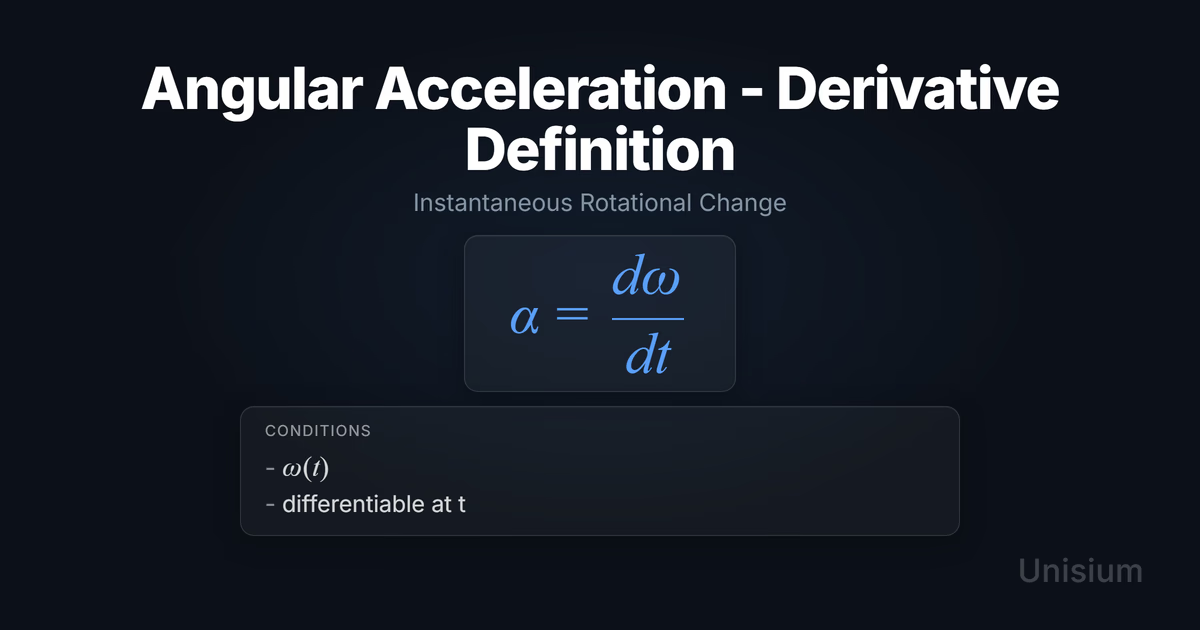
Angular acceleration (the derivative definition) states that the instantaneous angular acceleration equals the time derivative of angular velocity: . It applies when angular velocity is differentiable at time , so is the instantaneous slope of the – curve (not an average over an interval).
This principle extends the concept of instantaneous rate of change from linear kinematics to rotational motion. Just as linear acceleration measures how quickly velocity changes, angular acceleration quantifies how rapidly an object’s rotational speed changes. It’s essential for analyzing spinning objects with time-varying angular velocities—from accelerating flywheels to slowing tops.
On this page: The Principle | Conditions | Misconceptions | EE Questions | Retrieval Practice | Worked Example | Solve a Problem | FAQ
The Principle
Statement
Angular acceleration is the instantaneous rate of change of angular velocity with respect to time. At any moment , the angular acceleration equals the derivative of angular velocity with respect to time: .
Mathematical Form
Where:
- = angular acceleration (rad/s²)
- = angular velocity (rad/s)
- = time (s)
- = derivative of angular velocity with respect to time
Alternative Forms
In different contexts, this appears as:
- Vector form (for 3D rotation):
- Component form: (for rotation about the -axis)
Conditions of Applicability
Condition: ; differentiable at t
This means angular velocity must be a function of time and must be differentiable at the instant you’re evaluating. The derivative exists only if is smooth (no jumps or kinks) at that moment.
Practical modeling notes
- For piecewise motion, check differentiability at transition times—impulsive torques can create discontinuities in , making undefined at those instants
- Numerical differentiation approximates from discrete data when an analytical function isn’t available
- Sign convention: positive means is increasing (speeding up if , or slowing down less quickly if )
When It Doesn’t Apply
- Discontinuous : If angular velocity jumps instantaneously (e.g., during an impulsive collision), is undefined at that instant. Use angular impulse-momentum methods instead.
- Discrete-time measurements: If you only have at isolated time points (not a continuous function), you cannot take a derivative. Use or numerical differentiation techniques.
Want the complete framework behind this guide? Read Masterful Learning.
Common Misconceptions
Misconception 1: Angular acceleration is always proportional to torque
The truth: Angular acceleration equals net torque divided by moment of inertia () when torque is present, but is a kinematic definition—it describes how changes regardless of what causes the change.
Why this matters: Confusing kinematic definitions with dynamic laws leads to circular reasoning. Use to describe motion; use to explain what forces cause that motion.
Misconception 2: If is negative, must also be negative
The truth: The sign of tells you whether is increasing or decreasing, not the direction of rotation. If and , the object is spinning clockwise (negative ) but slowing down (angular velocity becoming less negative).
Why this matters: Sign errors in rotational kinematics problems often stem from conflating the direction of rotation (‘s sign) with the direction of angular acceleration (‘s sign). Always interpret relative to changes in , not the rotation direction itself.
Misconception 3: You can always use to find by integrating
The truth: Integration works only if you know explicitly as a function of time. If depends on other variables, you cannot directly integrate—you need additional relations or must solve a more complex system.
Why this matters: Recognizing when direct integration applies helps you choose the right kinematic approach and avoid getting stuck trying to invert a definition that requires additional physical input.
Elaborative Encoding
Use these questions to build deep understanding. (See Elaborative Encoding for the full method.)
Within the Principle
- What does the derivative physically represent? How is it different from average angular acceleration ?
- Why are the units of in rad/s² consistent with the derivative structure ?
For the Principle
- How do you decide whether to use the derivative definition versus the average definition for a given problem?
- What physical situations would make not differentiable at a particular instant, and what should you do in those cases?
Between Principles
- How does relate to linear acceleration ? What changes when you move from translational to rotational kinematics?
Generate an Example
- Describe a realistic scenario where angular velocity is continuous but not differentiable at a specific moment, making angular acceleration undefined there.
Retrieval Practice
Answer from memory, then click to reveal and check. (See Retrieval Practice for the full method.)
State the principle in words: _____Angular acceleration is the instantaneous rate of change of angular velocity with respect to time.
Write the canonical equation: _____
State the canonical condition: _____
Worked Example
Use this worked example to practice Self-Explanation.
Problem
A flywheel’s angular velocity varies with time according to (in rad/s, with in seconds). Find the angular acceleration at .
Step 1: Verbal Decoding
Target:
Given: ,
Constraints: evaluate at ; differentiable at
Step 2: Visual Decoding
Draw a 2D graph with on the horizontal axis (positive to the right) and on the vertical axis (positive upward). Plot as a parabola. Draw the tangent line at . (The slope there is positive, meaning .)
Step 3: Physics Modeling
Step 4: Mathematical Procedures
Step 5: Reflection
- Units: has units of rad/s², which matches the derivative of rad/s with respect to seconds.
- Magnitude: A positive value means is increasing at , consistent with the positive derivative.
- Limiting case: At , the derivative equals zero, implying has a local extremum (minimum, in this case).
Before moving on: self-explain the model
Try explaining Step 3 out loud (or in writing): why the derivative definition applies, what the slope of represents physically, and how the polynomial structure makes differentiation straightforward.
Physics model with explanation (what “good” sounds like)
Principle: The derivative definition of angular acceleration applies because we have an explicit analytical function and need the instantaneous rate of change at a specific moment.
Conditions: The function is a polynomial, which is differentiable everywhere, so the condition is satisfied at .
Relevance: When is given as a formula, taking its derivative directly yields —no need for finite-difference approximations.
Description: The quadratic term dominates at large times, making increase linearly with time. The constant term shifts the initial angular velocity but doesn’t affect the derivative.
Goal: We want the instantaneous angular acceleration at , so we differentiate once and evaluate at that time.
Solve a Problem
Apply what you’ve learned with Problem Solving.
Problem
A turntable’s angular velocity decreases according to rad/s. Determine the angular acceleration at .
Hint: Use the chain rule to differentiate the exponential function.
Show Solution
Step 1: Verbal Decoding
Target:
Given: ,
Constraints: evaluate at ; differentiable at
Step 2: Visual Decoding
Draw a 2D graph with on the horizontal axis (positive to the right) and on the vertical axis (positive upward). Plot as a decaying exponential starting at rad/s. Draw the tangent line at . (The slope is negative everywhere, so .)
Step 3: Physics Modeling
Step 4: Mathematical Procedures
Step 5: Reflection
- Units: rad/s²—correct for angular acceleration.
- Magnitude: The negative sign indicates is decreasing, consistent with the exponential decay model.
- Limiting case: As , both and approach zero, meaning the turntable eventually stops spinning.
Related Principles
- Classical Mechanics: The Complete Principle Map — see where this principle fits in the full subdomain.
| Principle | Relationship to Angular Acceleration (Derivative) |
|---|---|
| Angular Velocity - Derivative Definition | Angular acceleration is the derivative of angular velocity, which itself is the derivative of angular position—a second-order kinematic relationship |
| Linear Acceleration - Derivative Definition | Angular acceleration parallels linear acceleration; replace , , |
| Newton’s Second Law (Rotation) | This principle is kinematic (describes motion); Newton’s 2nd law for rotation provides the dynamic cause for via |
See Principle Structures for how to organize these relationships visually.
FAQ
What is angular acceleration (derivative definition)?
Angular acceleration is the instantaneous rate of change of angular velocity with respect to time, defined by . It quantifies how quickly an object’s rotational speed is changing at any given moment.
When does the derivative definition of angular acceleration apply?
It applies whenever angular velocity is a differentiable function of time at the instant you’re evaluating. If has a discontinuity or kink, the derivative is undefined at that moment.
What’s the difference between angular acceleration and torque?
Angular acceleration is a kinematic quantity (describes how rotational motion changes), while torque is a dynamic quantity (describes the twisting force causing that change). They’re related by , where is moment of inertia.
What are the most common mistakes with angular acceleration?
The top mistakes are: (1) confusing the sign of with the rotation direction (negative doesn’t always mean clockwise rotation—it means is decreasing), (2) trying to use the derivative definition when isn’t given as a formula (use average definition instead), and (3) assuming is constant when the problem gives a time-varying .
How do I know when to use the derivative definition versus the average definition?
Use the derivative definition () when you have an analytical function and need instantaneous values. Use the average definition () when you have discrete measurements or want the overall change over a time interval.
Related Guides
- Principle Structures — Organize angular acceleration in a hierarchical framework with other rotational kinematics principles
- Self-Explanation — Learn to explain worked examples step by step, especially derivative calculations
- Retrieval Practice — Make this calculus-based definition instantly accessible through spaced review
- Problem Solving — Apply kinematic principles systematically to rotational motion problems
How This Fits in Unisium
Unisium helps you master the derivative definition of angular acceleration through targeted elaborative encoding questions (clarifying what means physically), retrieval practice (recalling the condition and equation under time pressure), and self-explanation prompts (verbalizing why the derivative exists and what it represents). The system schedules calculus-based principles separately from their algebraic counterparts, ensuring you build fluency with both representations.
Ready to master angular acceleration? Check access and join the Unisium waitlist or explore the full learning framework in Masterful Learning.

Masterful Learning
The book behind these guides: a study system for physics, math, & programming built on retrieval, connection, explanation, and problem solving.
Ready to apply this strategy?
Unisium turns these evidence-based techniques into guided study sessions for math and physics. Places are limited during early access. Check current availability to start a trial; joining the mailing list is optional.
See plans and availability Read More GuidesAlready have access? Sign in