Rotational Kinematics 3: Angular Velocity Without Time
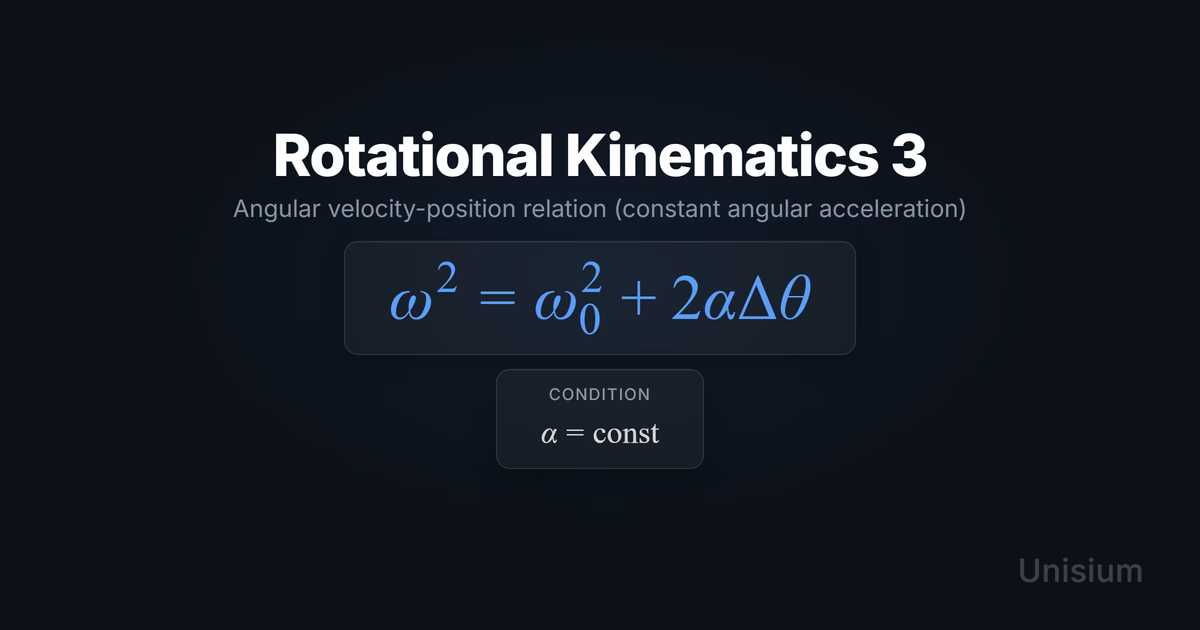
Rotational Kinematics 3 links angular speed to angular displacement without using time: . Use it when angular acceleration is constant and you know (or can infer) the direction signs, but time is unknown or unnecessary.
This is the rotational analog of the translational kinematic equation . Use it as the constant-angular-acceleration decision rule when a problem gives angular velocities and angular displacement but leaves time absent or irrelevant.
On this page: The Principle · Conditions · Misconceptions · EE Questions · Retrieval Practice · Worked Example · Solve a Problem · FAQ
The Principle
Statement
Rotational Kinematics 3 states that for a rotating object with constant angular acceleration, the square of the final angular velocity equals the square of the initial angular velocity plus twice the product of angular acceleration and angular displacement.
Mathematical Form
Where:
- = final angular velocity (rad/s)
- = initial angular velocity (rad/s)
- = angular acceleration (rad/s²)
- = angular displacement (rad)
Alternative Forms
In different contexts, this appears as:
- Solving for angular acceleration:
- Solving for angular displacement:
Conditions of Applicability
Condition: The angular acceleration must remain constant throughout the motion. This is the single defining constraint—if angular acceleration changes with time or position, this equation does not apply.
Typical assumptions in 1D rotational kinematics models
These aren’t part of the canonical condition; they’re common simplifications that keep the motion 1D:
- Rigid body assumption: The object rotates as a single solid unit (no internal deformation or phase shifts between parts)
- Single axis: Rotation occurs about a fixed axis; the axis itself doesn’t precess or wobble
- Sign conventions: Choose a positive direction for rotation (commonly counterclockwise looking down the axis). Angular velocity, acceleration, and displacement are positive in that direction and negative in the opposite direction.
When It Doesn’t Apply
- Variable angular acceleration: If torque changes with time or position (e.g., a motor with time-varying torque, friction that depends on angular velocity), use or and integrate from the rotational form of Newton’s second law ()
- Non-rigid deformation: If parts of the system flex, slip, or change moment of inertia during rotation, the single-equation model breaks down; you need coupled equations or energy methods
- Multi-axis rotation: For spinning tops, gyroscopes, or tumbling satellites, the full 3D Euler equations govern the motion
Want the complete framework behind this guide? Read Masterful Learning.
Common Misconceptions
Misconception 1: “I can use this equation even if the angular acceleration isn’t constant”
The truth: This equation is only valid when . If angular acceleration varies (for example, due to changing torque or friction), the derivation (which assumes constant to eliminate time) breaks down.
Why this matters: Applying this equation when isn’t constant produces nonsense results. You must first check that angular acceleration is constant or model it as piecewise-constant over intervals.
Misconception 2: “The ± sign in means I have two different answers”
The truth: The ± indicates direction. You choose the sign based on the physical context—whether the object is speeding up or slowing down, and which direction is positive.
Why this matters: If you keep both roots without physical reasoning, you’re claiming the object rotates at two different velocities simultaneously. Always resolve the sign using your coordinate system and the problem’s setup.
Misconception 3: “This equation only works when starting from rest ()”
The truth: The equation applies to any constant- rotation, regardless of whether is zero, positive, or negative.
Why this matters: Many problems involve an already-spinning object that speeds up or slows down. Ignoring (or incorrectly setting it to zero) loses key information and leads to wrong answers.
Elaborative Encoding
Use these questions to build deep understanding. (See Elaborative Encoding for the full method.)
Within the Principle
- Why does the equation have and instead of and alone? (Hint: think about how squaring eliminates time when you combine the other rotational kinematic equations.)
- What does the term represent physically—how much angular velocity squared is gained or lost per radian of rotation?
For the Principle
- In a problem, how do you decide whether to use Rotational Kinematics 3 () versus Rotational Kinematics 1 ()?
- If a wheel starts spinning clockwise (negative in a counterclockwise-positive system) and a counterclockwise torque slows it down, what are the signs of , , and as it comes to rest?
Between Principles
- How is this equation related to the translational kinematic equation ? What quantities correspond to each other in the analogy?
Generate an Example
- Describe a real-world situation (e.g., a potter’s wheel, a car tire, a wind turbine) where you know the initial and final angular velocities and the angle turned, but not the time elapsed. Why is Rotational Kinematics 3 the right tool?
Retrieval Practice
Answer from memory, then click to reveal and check. (See Retrieval Practice for the full method.)
State the principle in words: _____For a rotating object with constant angular acceleration, the square of the final angular velocity equals the square of the initial angular velocity plus twice the product of angular acceleration and angular displacement.
Write the canonical equation: _____
State the canonical condition: _____
Worked Example
Use this worked example to practice Self-Explanation.
Problem
A bicycle wheel initially spinning at is subjected to a constant angular acceleration of (the negative sign indicates it’s slowing down). How many radians does it turn through before coming to rest?
Step 1: Verbal Decoding
Target:
Given: , ,
Constraints: Constant angular acceleration, wheel slows to rest
Step 2: Visual Decoding
Draw a rotation axis. Choose counterclockwise as , and mark the initial rotation as . Mark the final state “at rest” as . Mark opposite the rotation direction. (So is positive, is zero, and is negative.)
Step 3: Physics Modeling
Step 4: Mathematical Procedures
Step 5: Reflection
- Units: ✓
- Magnitude check: The wheel was spinning fairly fast and the deceleration is modest, so turning through about 2 full rotations ( revolutions) is plausible.
- Limiting case: If , the equation reduces to , so it can’t determine without time or other information—exactly what you’d expect when there’s no acceleration.
Before moving on: self-explain the model
Try explaining Step 3 out loud (or in writing): why the chosen principle applies, what the diagram implies, and how the equations encode the situation.
Physics model with explanation (what “good” sounds like)
Principle: Rotational Kinematics 3 () relates angular velocities, angular acceleration, and angular displacement without time.
Conditions: The problem states the wheel experiences a constant angular acceleration of , so the condition is satisfied.
Relevance: The problem gives initial angular velocity, final angular velocity (zero, since it comes to rest), and angular acceleration, but does not give time. Rotational Kinematics 3 is the equation that eliminates time, making it the right tool.
Description: The wheel starts spinning counterclockwise at and decelerates due to friction or braking (represented by ). The negative sign on indicates it opposes the motion. At rest, . We want to find how far (in radians) the wheel turns during this deceleration.
Goal: Rearrange the equation to solve for , then substitute the known values. Because , the term drops out, simplifying the algebra. The result tells us the angular displacement from the start of braking to complete rest.
Solve a Problem
Apply what you’ve learned with Problem Solving.
Problem
A turbine blade starts from rest and accelerates uniformly. After rotating through , it reaches an angular velocity of . What is the angular acceleration of the blade?
Hint: You know the initial angular velocity (zero, from rest), the final angular velocity, and the angular displacement. Which rotational kinematic equation eliminates time?
Show Solution
Step 1: Verbal Decoding
Target:
Given: , ,
Constraints: Starts from rest, constant angular acceleration
Step 2: Visual Decoding
Draw a rotation axis. Choose counterclockwise as . Mark the initial state as at rest. Mark and in the positive direction. (So is zero, and and are positive.)
Step 3: Physics Modeling
Step 4: Mathematical Procedures
Step 5: Reflection
- Units: ✓
- Magnitude check: The blade reaches over , so an acceleration of is reasonable—not too fast, not too slow.
- Limiting case: If (extremely small acceleration over a large angle), , which makes sense: a tiny acceleration over a huge distance can still produce finite velocity.
Related Principles
- Classical Mechanics: The Complete Principle Map — see where this principle fits in the full subdomain.
| Principle | Relationship to Rotational Kinematics 3 |
|---|---|
| Rotational Kinematics 1 () | Relates angular displacement to time and angular acceleration; use when time is given or sought. This equation uses time explicitly, while RK3 eliminates time. |
| Rotational Kinematics 2 () | Relates angular velocities to time; use when you need to find time or when angular displacement is irrelevant. RK3 is derived by eliminating from RK2 and RK1. |
| Translational Kinematics 3 () | The linear analog; every symbol has a direct rotational counterpart (, , ). |
| Kinematics 3 (Velocity-Position) | Translation analog: linear velocity vs displacement. |
See Principle Structures for how to organize these relationships visually.
FAQ
What is Rotational Kinematics 3?
Rotational Kinematics 3 is the equation , which relates angular velocities, angular acceleration, and angular displacement for an object rotating with constant angular acceleration. It’s used when time is not given or needed in the problem.
When does Rotational Kinematics 3 apply?
It applies whenever the angular acceleration is constant () and you want to relate initial angular velocity, final angular velocity, angular acceleration, and angular displacement without involving time.
What’s the difference between Rotational Kinematics 3 and Rotational Kinematics 2?
Rotational Kinematics 2 () explicitly includes time and is used when time is known or is the target variable. Rotational Kinematics 3 eliminates time and is used when you have angular displacement and angular velocities but not time.
What are the most common mistakes with Rotational Kinematics 3?
- Using it when isn’t constant: The derivation assumes ; if angular acceleration changes, this equation doesn’t apply.
- Forgetting sign conventions: Angular velocity, acceleration, and displacement are vectors (in 1D rotation, they have signs). Forgetting to assign and track signs leads to wrong results.
- Misinterpreting the ± in the solved form: When you solve for , you get . The sign must be chosen based on physical reasoning (direction of rotation), not left ambiguous.
How do I know which form of Rotational Kinematics 3 to use?
If you’re solving for , compute from the equation first, then assign the sign based on the direction of rotation. If you’re solving for , use . If you’re solving for , use . Always check that the form you choose isolates the target variable.
Related Guides
- Principle Structures — Organize rotational kinematics in a hierarchical framework
- Self-Explanation — Learn to explain worked examples step by step
- Problem Solving — Apply principles systematically to new problems
- Elaborative Encoding — Build deep understanding of kinematic relationships
How This Fits in Unisium
Unisium helps you master Rotational Kinematics 3 through spaced retrieval practice (so the equation becomes automatic), elaborative encoding (so you understand why must be constant and when to choose this equation over the others), self-explanation of worked examples (so you see how to model real rotation problems), and systematic problem solving (so you build fluency applying the principle). The platform tracks your progress and surfaces this principle in mixed practice with related rotational and translational kinematic equations, ensuring you don’t just memorize formulas but learn to choose and apply the right tool for each problem.
Ready to master Rotational Kinematics 3? Check access and join the Unisium waitlist or explore the full learning framework in Masterful Learning.
Masterful Learning
The book behind these guides: a study system for physics, math, & programming built on retrieval, connection, explanation, and problem solving.
Ready to apply this strategy?
Unisium turns these evidence-based techniques into guided study sessions for math and physics. Places are limited during early access. Check current availability to start a trial; joining the mailing list is optional.
See plans and availability Read More GuidesAlready have access? Sign in