Moment of Inertia - Integral Definition: Continuous Mass Distributions
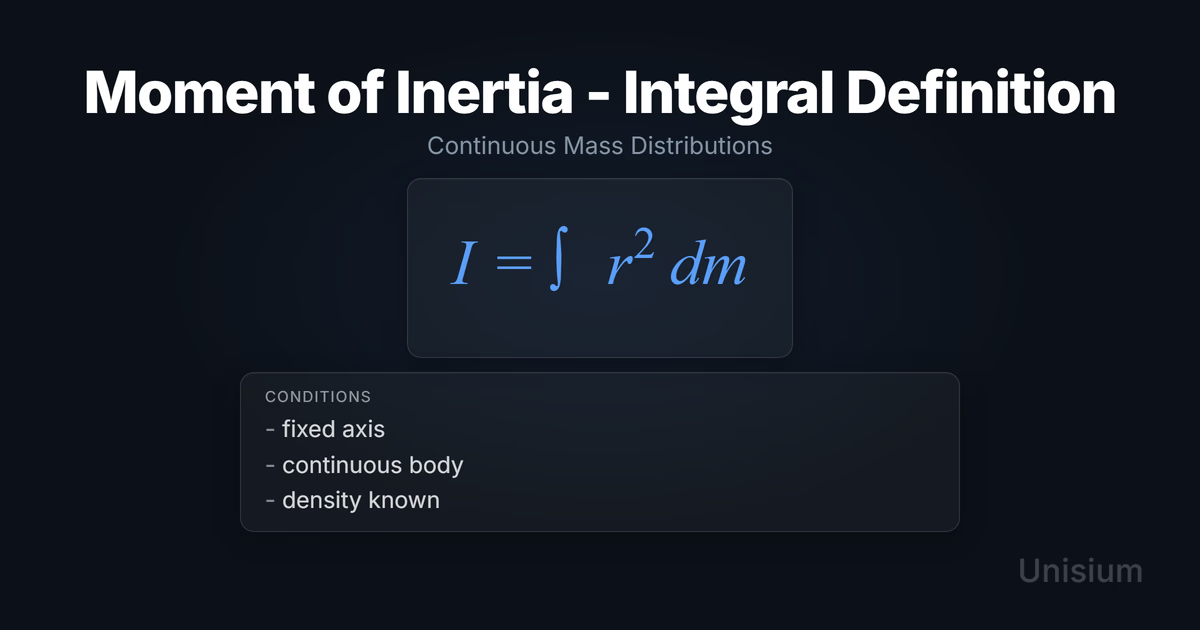
Moment of inertia for a continuous body is found by adding up each mass element’s contribution to rotational inertia. In classical mechanics, the integral form is , where is the distance from the rotation axis. Use it when mass is spread through a rod, disk, shell, sphere, or other continuous body and you need to choose from density and geometry.
When mass is spread continuously through a rigid body—like a disk, cylinder, sphere, or rod—you cannot simply sum discrete masses. Instead, you integrate over the mass distribution. The main setup step is choosing a mass element from the body’s density and geometry, then integrating about the fixed axis. This integral definition is the foundation for calculating moments of inertia for all extended objects, and it lets you derive standard formulas (like for a disk) from first principles.
On this page: The Principle · Conditions · Misconceptions · EE Questions · Retrieval Practice · Worked Example · Solve a Problem · FAQ
The Principle
Statement
The moment of inertia of a continuous rigid body about a fixed axis is the integral of , where is the perpendicular distance from each infinitesimal mass element to the rotation axis. Masses farther from the axis contribute more strongly due to the factor. The result determines how much torque is needed for a given angular acceleration ().
Mathematical Form
Where:
- = moment of inertia about the chosen axis ()
- = perpendicular distance from the mass element to the rotation axis ()
- = infinitesimal mass element ()
- The integral is taken over the entire body
Converting to Spatial Coordinates
To evaluate the integral, express in terms of spatial coordinates using density:
- Linear mass density (1D): where ()
- Surface mass density (2D): where ()
- Volume mass density (3D): where ()
For uniform density, , , or are constants pulled out of the integral. For nonuniform density, they are functions of position.
For a uniform disk, the highlighted annulus is the slice with . That is why the setup keeps the axis explicit, labels the radius , and treats the thin thickness as part of the mass element rather than a separate afterthought.
Common Results
Use these as known results once derived from . These formulas are only valid for the stated axis; if the axis changes, use the parallel-axis theorem or re-derive.
| Shape | Axis | Moment of Inertia |
|---|---|---|
| Thin rod, length | Through center, perpendicular to rod | |
| Thin rod, length | Through end, perpendicular to rod | |
| Solid disk/cylinder, radius | Through center, along symmetry axis | |
| Thin hoop (ring), radius | Through center, along symmetry axis | |
| Solid sphere, radius | Through center, any diameter | |
| Thick spherical shell (uniform density), inner radius , outer radius | Through center, any diameter |
Conditions of Applicability
Condition: fixed axis; continuous body; density known
This means:
- Fixed axis: The axis of rotation is specified and fixed. As in the discrete case, moment of inertia depends on which axis you choose.
- Continuous body: Mass is distributed continuously over a region (line, surface, or volume), not concentrated at discrete points. Examples include rods, disks, cylinders, spheres, and shells.
- Density known: You must know how mass is distributed in space—either a uniform density or a density function , , or . Without the density, you cannot set up the integral.
Practical modeling notes
- Choosing coordinates: Select a coordinate system that makes and easy to express. For example, use polar coordinates for disks, cylindrical coordinates for cylinders, or linear coordinates for rods.
- Symmetry helps: Exploit symmetry to simplify integrals. For example, a uniform disk about its central axis has radial symmetry, so in a single-variable integral.
- Uniform vs. nonuniform density: If density is uniform, express the total mass in terms of density and geometry, then solve the integral. If density varies, keep the density function inside the integral and solve symbolically or numerically.
When It Doesn’t Apply
- Discrete mass distributions: If mass is concentrated at a finite number of points, use the discrete sum (separate principle).
- Unknown or changing density: If you don’t know the density function, you cannot set up and cannot evaluate the integral.
- Nonrigid bodies: If the mass distribution changes during rotation (deformable bodies), becomes time-dependent. You must model the deformation explicitly and treat as a function of time.
Want the complete framework behind this guide? Read Masterful Learning.
Common Misconceptions
Misconception 1: “You integrate over , not over ”
The truth: The moment of inertia is the result of the integral, not the integrand. You integrate (the contribution from each mass element) to obtain . The integral sums infinitesimal contributions across the entire body.
Why this matters: Confusing the integrand with the result leads to nonsensical setups like . The correct form is always , where is expressed in terms of spatial coordinates and density.
Misconception 2: “Distance is measured from the origin”
The truth: Distance is the perpendicular distance from the mass element to the rotation axis, not from the coordinate origin (unless the origin happens to lie on the axis). For a rod rotating about one end, is measured from that end, not from the center of the rod.
Why this matters: Using the wrong reference (like the origin when the axis is elsewhere) produces an incorrect value, leading to wrong predictions for angular acceleration or kinetic energy.
Misconception 3: “All objects have the same moment of inertia formula”
The truth: The result of the integral depends on the shape, density, and axis. A disk, sphere, and rod all have different formulas for even if they have the same mass, because the mass distribution is different. For example, a thin rod of mass and length about its center has , but about one end has .
Why this matters: You cannot blindly apply a tabulated formula without checking that the object shape, mass distribution, and axis match your problem. When in doubt, rederive from the integral definition.
Elaborative Encoding
Use these questions to build deep understanding. (See Elaborative Encoding for the full method.)
Within the Principle
- Why does the integral include rather than just ? How does this weighting affect the contribution of mass elements far from the axis?
- What are the units of the integrand , and how do they combine to give the units of ?
For the Principle
- How do you choose the differential mass element ? What determines whether you use , , or ?
- If you shift the rotation axis to a new parallel position, what changes in the moment of inertia calculation and what stays the same?
Between Principles
- How does the integral form generalize the discrete sum ? In what sense is the discrete form a special case (or limit) of the integral form?
Generate an Example
- Describe a continuous object (like a rod or disk) and an axis. Would you expect its moment of inertia to be larger or smaller than the same mass concentrated at the outer edge? Why?
Retrieval Practice
Answer from memory, then click to reveal and check. (See Retrieval Practice for the full method.)
State the principle in words: _____The moment of inertia of a continuous rigid body about a fixed axis is the integral of the perpendicular distance squared times the differential mass element, summed over the entire body.
Write the canonical equation: _____
State the canonical condition: _____fixed axis; continuous body; density known
Worked Example
Use this worked example to practice Self-Explanation.
Problem
A thin uniform rod of mass and length rotates about an axis perpendicular to the rod and passing through one end. Use the integral definition to calculate the moment of inertia about this axis.
Step 1: Verbal Decoding
Target:
Given: ,
Constraints: thin uniform rod, axis perpendicular to rod at one end
Step 2: Visual Decoding
Draw a 1D axis along the rod with the origin at the pivot. Choose away from the pivot along the rod. Mark a mass element at position with thickness , so its perpendicular distance to the axis is .
(So and .)
Step 3: Physics Modeling
Step 4: Mathematical Procedures
Step 5: Reflection
- Units: is correct for moment of inertia.
- Magnitude: A 2 kg rod 1.5 m long about one end gives , which is plausible given the weighting favors the far end.
- Limiting case: If , then (no extension means no rotational inertia).
Before moving on: self-explain the model
Try explaining Step 3 out loud (or in writing): why the integral definition applies, how you set up for a uniform rod, and why the limits of integration run from to .
Physics model with explanation (what “good” sounds like)
Principle: The integral definition applies because the rod is a continuous mass distribution, not discrete point masses.
Conditions: The axis is fixed (at one end of the rod), the body is continuous (a thin rod), and the density is known (uniform, so ).
Relevance: For a thin rod, mass is distributed along a line. We use linear mass density and express . The distance from the axis to a mass element at position is just .
Description: With the origin at the axis (left end), ranges from to . Substituting and into the integral gives the instantiated model equation shown in Step 3.
Goal: Execute the integral in Step 4, then substitute the given mass and length to obtain the numerical value.
Solve a Problem
Apply what you’ve learned with Problem Solving.
Problem
A thin uniform disk of mass and radius rotates about an axis perpendicular to the disk and passing through its center. Use the integral definition to calculate the moment of inertia. (Hint: use polar coordinates with where is the surface mass density.)
Hint: Set up the integral over the radial coordinate from to , with the differential area element for a thin ring at radius .
Show Solution
Step 1: Verbal Decoding
Target:
Given: ,
Constraints: thin uniform disk, axis perpendicular through center
Step 2: Visual Decoding
Draw the disk face-on. Choose polar coordinates centered on the axis. Mark a thin ring at radius with thickness , and note every point on the ring has the same distance to the axis.
(So and .)
Step 3: Physics Modeling
Step 4: Mathematical Procedures
Step 5: Reflection
- Units: is correct.
- Magnitude: A 3 kg disk with 0.5 m radius gives , consistent with the formula.
- Limiting case: If , then (no size means no rotational inertia).
Related Principles
- Classical Mechanics: The Complete Principle Map — see where this principle fits in the full subdomain.
| Principle | Relationship to Moment of Inertia Integral |
|---|---|
| Moment of Inertia (Discrete) | The discrete sum is the algebraic limit of the integral when mass is concentrated at discrete points. |
| Newton’s Second Law (Rotation) | Moment of inertia from the integral appears in , determining torque requirements for angular acceleration. |
| Parallel Axis Theorem | Allows calculation of about a parallel axis using , avoiding re-integration when switching axes. |
See Principle Structures for how to organize these relationships visually.
FAQ
What is the integral definition of moment of inertia?
The integral definition is , where is the perpendicular distance from each infinitesimal mass element to the rotation axis. This formula applies when mass is distributed continuously over a body, and it generalizes the discrete sum used for point masses.
When do I use the integral form instead of the discrete sum?
Use the integral form when mass is spread continuously (like a rod, disk, cylinder, or sphere). Use the discrete sum when mass is concentrated at a finite number of points. The integral form is the calculus generalization that covers all continuous bodies.
How do I set up for different shapes?
- Rod (1D): Use linear density , so .
- Disk or plate (2D): Use surface density , so (e.g., for a disk).
- Solid (3D): Use volume density , so (e.g., for a sphere).
Choose coordinates that make and easy to express for the given shape and axis.
What are the most common mistakes with the integral definition?
- Measuring distance from the wrong point (like the origin instead of the rotation axis).
- Setting up incorrectly (e.g., using volume density for a thin rod or forgetting the factor in for a disk).
- Using the wrong integration limits (e.g., integrating from to when the axis is at one end, not the center).
Can I use tabulated formulas instead of integrating every time?
Yes! Once you derive for a standard shape and axis using the integral, you can use that result (like for a disk about its center) in future problems. But always check that the axis and shape match the tabulated formula. If they don’t, either rederive from the integral or use the parallel axis theorem to shift axes.
Related Guides
- Principle Structures — Organize this principle in a hierarchical framework
- Self-Explanation — Learn to explain worked examples step by step
- Retrieval Practice — Make this principle instantly accessible
- Problem Solving — Apply principles systematically to new problems
How This Fits in Unisium
The Unisium Study System helps you master the integral definition of moment of inertia through targeted practice in elaborative encoding (building deep understanding of how continuous mass distributions affect rotation), retrieval practice (strengthening instant recall of the integral formula and conditions), self-explanation (articulating how to set up and evaluate integrals for different shapes), and problem solving (applying the principle to derive standard formulas from first principles). Together, these strategies ensure you can confidently use the integral definition in advanced rotational dynamics problems.
Ready to master continuous moment of inertia? Check access and join the Unisium waitlist or explore the full learning framework in Masterful Learning.
Masterful Learning
The book behind these guides: a study system for physics, math, & programming built on retrieval, connection, explanation, and problem solving.
Ready to apply this strategy?
Unisium turns these evidence-based techniques into guided study sessions for math and physics. Places are limited during early access. Check current availability to start a trial; joining the mailing list is optional.
See plans and availability Read More GuidesAlready have access? Sign in