Angular Momentum (Particle): Rotational Motion About a Point
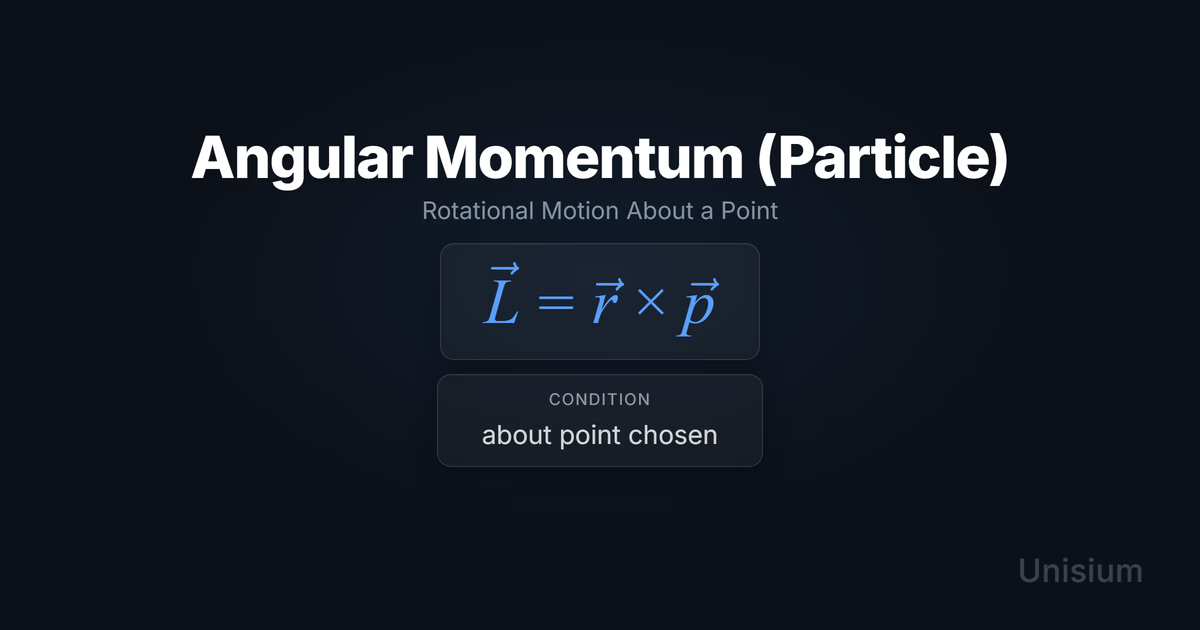
Angular momentum of a particle measures how strongly a moving particle tends to rotate about a specified point. It’s defined from the particle’s position relative to that point and its linear momentum, and it changes when a net torque acts about the same point (otherwise it can be conserved).
Angular momentum starts with a modeling choice: choose the reference point, measure from that point to the particle, then compute . Torque and conservation statements must use the same reference point; changing the point can change even when the particle’s motion is unchanged.
On this page: The Principle · Conditions · Misconceptions · EE Questions · Retrieval Practice · Worked Example · Solve a Problem · FAQ
The Principle
Statement
Angular momentum of a particle is the vector cross product of the particle’s position vector (measured from a chosen reference point) and its linear momentum . The magnitude depends on how far the particle is from the reference point, how fast it’s moving, and the angle between position and velocity. The direction follows the right-hand rule, perpendicular to the plane containing and .
Mathematical Form
Where:
- = angular momentum vector (units: )
- = position vector from the chosen reference point to the particle (units: )
- = linear momentum of the particle, (units: )
- = cross product operation
Alternative Forms
In different contexts, this appears as:
- Magnitude (planar motion): , where is the angle between and
- Perpendicular distance form: , where is the perpendicular distance from the reference point to the line of motion
Conditions of Applicability
Condition: about point chosen
This principle always applies for any particle, but the value of depends entirely on your choice of reference point. Different points yield different angular momentum values for the same physical motion.
Practical modeling notes
- Choose a convenient point: Often the origin, a fixed pivot, or the center of mass. The best choice simplifies calculations or reveals symmetries.
- Point must be specified: Angular momentum is meaningless without stating “about which point.” Always declare your reference explicitly.
- Inertial vs. non-inertial frames: While is defined in any frame, the dynamics (rate of change of ) simplify in inertial frames or when measured about the center of mass.
When This Form Isn’t the Best Tool
Angular momentum is always definable for a particle using this cross product, but alternative formulations are more efficient in certain contexts:
- Extended rigid bodies: For rigid bodies rotating about a fixed axis, the form is more practical than summing individual particle contributions.
- Quantum systems: At atomic scales, angular momentum is quantized and governed by quantum mechanical operators, not classical cross products.
Want the complete framework behind this guide? Read Masterful Learning.
Common Misconceptions
Misconception 1: Angular momentum is the same for all reference points
The truth: Angular momentum depends critically on the chosen reference point. A particle has different angular momentum values when measured about different points, even though its physical motion is unchanged.
Why this matters: In problem solving, picking the wrong reference point can make calculations unnecessarily complex or obscure conservation laws. Always state your reference point explicitly and check that torques are computed about the same point.
Misconception 2: Only circular motion has angular momentum
The truth: Any particle in any motion has angular momentum about any reference point (though it may be zero if the particle moves directly through that point). Straight-line motion away from a point still has non-zero angular momentum if the line doesn’t pass through the point.
Why this matters: Students often skip angular momentum analysis for non-circular problems, missing powerful conservation insights. Even projectiles or sliding objects have angular momentum about a pivot or origin.
Misconception 3: Angular momentum magnitude is just
The truth: The general formula includes the angle: . Only when (velocity perpendicular to position) does it simplify to . For collinear and (motion directly toward or away from the point), .
Why this matters: Forgetting the factor leads to wrong magnitudes when analyzing oblique motion, such as a particle approaching a point at an angle or swinging through an orbit.
Elaborative Encoding
Use these questions to build deep understanding. (See Elaborative Encoding for the full method.)
Within the Principle
- What does the cross product mean geometrically? Why does it produce a vector perpendicular to both and ?
- What are the units of angular momentum, and how do they reflect the combination of rotational distance and momentum?
For the Principle
- How do you decide which reference point to choose when computing angular momentum for a problem?
- If a particle moves in a straight line that passes through the reference point, what is its angular momentum about that point, and why?
Between Principles
- How does angular momentum of a particle () relate to angular momentum of a rigid body ()? When is each form appropriate?
Generate an Example
- Describe a situation where a particle has zero angular momentum about one point but non-zero angular momentum about a different point.
Retrieval Practice
Answer from memory, then click to reveal and check. (See Retrieval Practice for the full method.)
State the principle in words: _____Angular momentum of a particle is the cross product of the particle's position vector (from a chosen reference point) and its linear momentum.
Write the canonical equation: _____
State the canonical condition: _____about point chosen
Worked Example
Use this worked example to practice Self-Explanation.
Problem
A 2.0-kg particle moves with velocity at position relative to the origin. Find the angular momentum of the particle about the origin.
Step 1: Verbal Decoding
Target:
Given: , ,
Constraints: particle motion; reference point is the origin
Step 2: Visual Decoding
Draw an - axis with the origin as the reference point. Place the particle on the axis at . From that point, draw with a component and a component. Label from the origin to the particle and label the components of . (So is positive, is positive, and is positive.)
Step 3: Physics Modeling
Step 4: Mathematical Procedures
Step 5: Reflection
- Units: Units reduce to kg·m²/s, correct for angular momentum.
- Magnitude: 40 units is plausible for a 2-kg particle several meters away with modest velocity.
- Limiting case: If the velocity had no perpendicular component (purely radial), angular momentum would be zero.
Before moving on: self-explain the model
Try explaining Step 3 out loud (or in writing): why the cross product formula applies, what the diagram implies about the direction of , and how the equations encode the situation.
Physics model with explanation (what “good” sounds like)
Principle: We use because angular momentum for a particle is defined as the cross product of position (from the chosen reference) and momentum.
Conditions: The condition “about point chosen” is satisfied—we’ve explicitly chosen the origin as our reference point.
Relevance: The cross product captures how the tangential component of motion contributes to rotation about the origin, while radial motion contributes nothing.
Description: The particle is 5 meters along the x-axis with velocity having both radial and tangential components. The cross product isolates the perpendicular component’s contribution, yielding angular momentum in the positive z-direction (counterclockwise rotation when viewed from above).
Goal: We seek the vector , which requires computing the cross product in components. The result’s direction (out of the plane) and magnitude (40 units) quantify the particle’s rotational tendency about the origin.
Solve a Problem
Apply what you’ve learned with Problem Solving.
Problem
A 0.50-kg ball moves at constant speed in a horizontal circle of radius . Find the magnitude of the ball’s angular momentum about the center of the circle.
Hint: For circular motion, the velocity is always perpendicular to the radius vector.
Show Solution
Step 1: Verbal Decoding
Target: (magnitude)
Given: , ,
Constraints: circular motion; velocity perpendicular to radius; reference point is the center
Step 2: Visual Decoding
Draw a top-down view of the circle. Mark the center as the reference point. Draw from the center to the ball. Draw tangent to the circle, perpendicular to . (So velocity is perpendicular to the radius.)
Step 3: Physics Modeling
Step 4: Mathematical Procedures
Step 5: Reflection
- Units: Units reduce to kg·m²/s, correct.
- Magnitude: 6.0 units is reasonable for a half-kilogram ball moving at 8 m/s a meter and a half away.
- Limiting case: If the speed approaches zero, angular momentum approaches zero—no motion means no angular momentum.
Related Principles
- Classical Mechanics: The Complete Principle Map — see where this principle fits in the full subdomain.
| Principle | Relationship to Angular Momentum (Particle) |
|---|---|
| Linear Momentum () | Angular momentum is the cross product of position and linear momentum; linear momentum is a prerequisite component. |
| Torque () | Torque is the rate of change of angular momentum (); the cross-product structure parallels angular momentum. |
| Angular Momentum (Rigid Body) () | For extended objects rotating about a fixed axis, this specializes to ; the particle form is the general definition. |
See Principle Structures for how to organize these relationships visually.
FAQ
What is angular momentum of a particle?
Angular momentum of a particle is the cross product of the particle’s position vector (from a chosen reference point) and its linear momentum. It quantifies rotational motion about that point, with units of .
When does angular momentum of a particle apply?
It applies for any particle motion relative to any chosen reference point. The value of depends on which point you choose—different points yield different angular momentum values for the same physical motion.
What’s the difference between angular momentum of a particle and angular momentum of a rigid body?
The particle form () is the general definition for a point mass. The rigid body form () is a specialized result for extended objects rotating about a fixed axis, summing contributions from all constituent particles when symmetry allows.
What are the most common mistakes with angular momentum?
- Forgetting that depends on the chosen reference point; 2) thinking only circular motion has angular momentum (any motion does, unless it passes through the reference point); 3) omitting the factor when using the magnitude formula.
How do I know when to use the cross product vs. the magnitude formula?
Use the vector cross product () when you need the direction or are working in 3D. Use the magnitude formula () for 2D problems where you only need the scalar value and the geometry is clear.
Related Guides
- Principle Structures — Organize this principle in a hierarchical framework
- Self-Explanation — Learn to explain worked examples step by step
- Retrieval Practice — Make this principle instantly accessible
- Problem Solving — Apply principles systematically to new problems
How This Fits in Unisium
Unisium helps you master angular momentum through targeted elaboration questions (building geometric and conceptual understanding), spaced retrieval prompts (cementing the formula and conditions), and scaffolded problem practice (applying the cross product in varied contexts). The system tracks which reference points and geometries challenge you most, adapting practice to close gaps.
Ready to master angular momentum? Check access and join the Unisium waitlist or explore the full learning framework in Masterful Learning.

Masterful Learning
The book behind these guides: a study system for physics, math, & programming built on retrieval, connection, explanation, and problem solving.
Ready to apply this strategy?
Unisium turns these evidence-based techniques into guided study sessions for math and physics. Places are limited during early access. Check current availability to start a trial; joining the mailing list is optional.
See plans and availability Read More GuidesAlready have access? Sign in