Rotational Kinematics 2: Angular Velocity with Constant Angular Acceleration
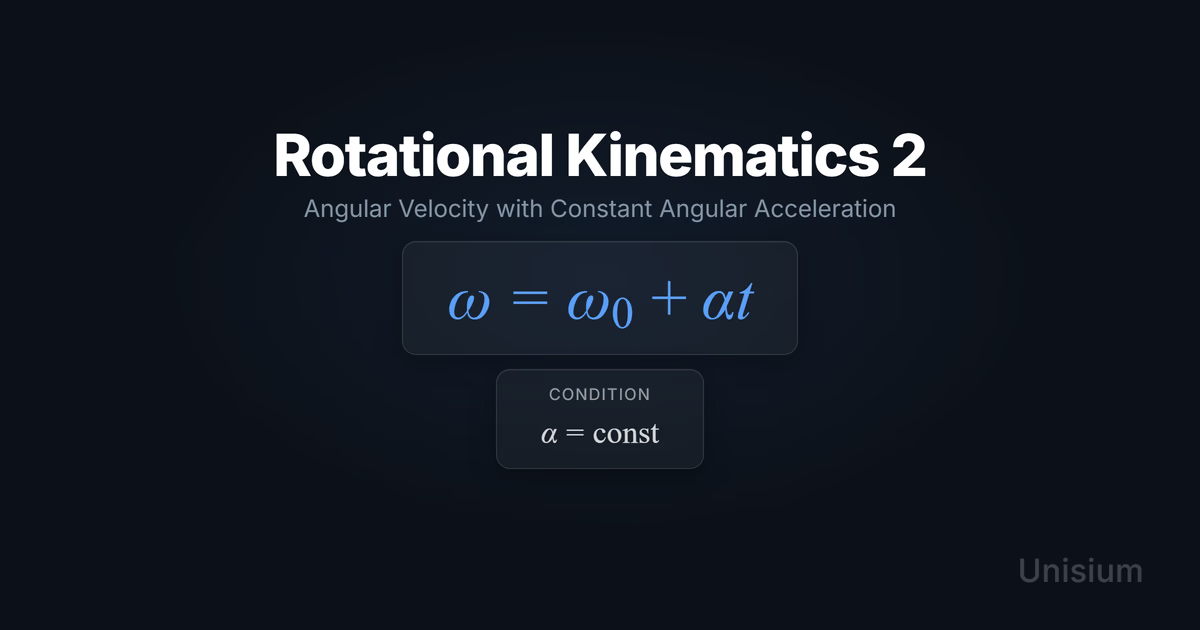
Rotational Kinematics 2 states that angular velocity changes linearly with time under constant angular acceleration: . It applies when is constant over the interval and you’re modeling rotation about a fixed axis with a consistent sign convention.
This equation is the rotational analog of the linear equation , mapping directly from translational to rotational motion. It’s one of three core kinematic equations for rotation and is essential for analyzing turntable spin-up, wheel braking, and any rotational motion with constant angular acceleration.
On this page: The Principle · Conditions · Misconceptions · EE Questions · Retrieval Practice · Worked Example · Solve a Problem · FAQ
The Principle
Statement
Rotational Kinematics 2 states that angular velocity changes linearly with time under constant angular acceleration: the final angular velocity equals the initial angular velocity plus the product of constant angular acceleration and elapsed time.
Mathematical Form
Where:
- = final angular velocity (rad/s)
- = initial angular velocity at (rad/s)
- = angular acceleration (rad/s²)
- = elapsed time (s)
Alternative Forms
In different contexts, this appears as:
- Change in angular velocity:
- Solving for time: (for )
Conditions of Applicability
Condition:
Practical modeling notes
- The condition requires that angular acceleration be constant (including sign) throughout the time interval.
- Time must be measured from the instant when .
- A common reason is roughly constant: net torque is roughly constant and is roughly constant, so is roughly constant.
- Typically used for rotation about a fixed axis; if the axis direction changes, use vector angular kinematics instead.
- Sign conventions matter: choose a positive rotational direction (typically counterclockwise when viewed from above) and apply it consistently to , , and .
When It Doesn’t Apply
- Variable angular acceleration: When changes with time (e.g., a motor ramping up non-linearly), you must use or break the motion into intervals where is approximately constant.
- Changing moment of inertia: Often makes time-dependent; in those cases use or solve via angular momentum/torque to find first.
- Precessing axes: When the axis of rotation itself changes direction, this scalar equation is insufficient—use full vector angular velocity and torque analysis.
Want the complete framework behind this guide? Read Masterful Learning.
Common Misconceptions
Misconception 1: and are always positive
The truth: Both angular velocity and angular acceleration are algebraic quantities that can be positive, negative, or zero depending on your sign convention and the physical situation.
Why this matters: A spinning wheel slowing down has and with opposite signs. If and , the wheel is decelerating. Treating all quantities as positive magnitudes will give wrong answers when direction matters.
Misconception 2: This equation only works when the object is speeding up
The truth: The equation applies whenever is constant, regardless of whether the rotation is speeding up, slowing down, or reversing direction.
Why this matters: A wheel coming to rest and then spinning backward has constant throughout if the braking torque is steady. You can use this equation across the entire interval, including the instant when .
Misconception 3: You can mix degrees and radians freely
The truth: All rotational kinematic equations require radians for angular quantities. Using degrees or rpm without conversion produces wrong numerical answers even if the algebra looks correct. Radians are dimensionless, but we still track “rad” to avoid unit mistakes.
Why this matters: If a wheel spins at 60 rpm and you plug that directly into , you’ll get a meaningless result. Always convert: 60 rpm = rad/s ≈ 6.28 rad/s.
Elaborative Encoding
Use these questions to build deep understanding. (See Elaborative Encoding for the full method.)
Within the Principle
- What does each symbol represent physically, and what are their SI units?
- If is doubled while remains the same, how does the change in angular velocity respond? What does this tell you about the linear dependence of on ?
For the Principle
- How do you decide whether angular acceleration is constant in a real situation? What physical clues indicate constant vs. variable ?
- When constructing a rotational kinematics problem, how do you choose which direction counts as positive rotation, and why must you apply that convention consistently to all angular quantities?
Between Principles
- What extra quantity does Rotational Kinematics 1 introduce that Rotational Kinematics 2 doesn’t, and what quantity does Rotational Kinematics 3 eliminate compared to Rotational Kinematics 2?
Generate an Example
- Describe a real-world rotating system where angular acceleration is approximately constant (e.g., a turntable motor starting up uniformly). Then describe a system where is clearly not constant (e.g., a ceiling fan controlled by a dimmer switch).
Retrieval Practice
Answer from memory, then click to reveal and check. (See Retrieval Practice for the full method.)
State the principle in words: _____Angular velocity changes linearly with time under constant angular acceleration: the final angular velocity equals the initial angular velocity plus the product of constant angular acceleration and elapsed time.
Write the canonical equation: _____
State the canonical condition: _____
Worked Example
Use this worked example to practice Self-Explanation.
Problem
A car wheel initially spinning at 120 rad/s experiences a constant angular deceleration of magnitude 15 rad/s² as the brakes are applied. How long does it take for the wheel to come to rest?
Step 1: Verbal Decoding
Target: (time for wheel to stop)
Given: , ,
Constraints: constant angular deceleration; wheel comes to rest (so )
Step 2: Visual Decoding
Draw a 1D rotation axis. Choose CCW as . Label as positive, as negative, and .
(So , , .)
Step 3: Physics Modeling
Step 4: Mathematical Procedures
Step 5: Reflection
- Units: rad/s divided by rad/s² gives seconds, which is correct for time.
- Magnitude: 8 seconds to stop a wheel spinning at 120 rad/s with deceleration of 15 rad/s² is reasonable—the wheel loses 15 rad/s every second, so it takes 120/15 = 8 seconds.
- Limiting case: If (no braking), then (wheel never stops), which matches physical intuition.
Before moving on: self-explain the model
Try explaining Step 3 out loud (or in writing): why the Rotational Kinematics 2 equation applies, what the sign choices mean, and how the algebra isolates the time to rest.
Physics model with explanation (what “good” sounds like)
Principle: We use Rotational Kinematics 2 because the wheel experiences a constant angular deceleration and we need to find the time for a specific change in angular velocity (from to zero).
Conditions: The problem states the deceleration is constant, so is satisfied.
Relevance: This is a one-dimensional rotational kinematics problem where we know the initial and final angular velocities and the constant angular acceleration. The equation directly relates these quantities to time.
Description: The wheel starts with positive angular velocity (counterclockwise) and undergoes negative angular acceleration (clockwise torque from brakes). The angular velocity decreases linearly with time until the wheel stops.
Goal: We solve for by setting and rearranging to isolate . The negative signs cancel (negative initial velocity change divided by negative acceleration) to give a positive time.
Solve a Problem
Apply what you’ve learned with Problem Solving.
Problem
A grinding wheel starts from rest and reaches an angular velocity of 90 rad/s after 6.0 seconds of uniform angular acceleration. What is the angular acceleration of the wheel?
Hint: “Starts from rest” means .
Show Solution
Step 1: Verbal Decoding
Target: (angular acceleration)
Given: , ,
Constraints: starts from rest; uniform (constant) angular acceleration
Step 2: Visual Decoding
Draw a 1D rotation axis. Choose CCW as . Label at the start, as positive, and as positive.
(So , , .)
Step 3: Physics Modeling
Step 4: Mathematical Procedures
Step 5: Reflection
- Units: rad/s divided by s gives rad/s², which is correct for angular acceleration.
- Magnitude: Gaining 90 rad/s in 6 seconds means an average rate of 15 rad/s per second, which is consistent with constant angular acceleration.
- Limiting case: If , then (instantaneous spin-up requires infinite angular acceleration), which makes sense.
Related Principles
- Classical Mechanics: The Complete Principle Map — see where this principle fits in the full subdomain.
| Principle | Relationship to Rotational Kinematics 2 |
|---|---|
| Rotational Kinematics 1 () | Gives angular displacement as a function of time under constant ; integrate to derive this. |
| Rotational Kinematics 3 () | Eliminates time from the equations; useful when you know angular displacement but not time. |
| Linear Kinematics 2 () | Direct translational analog: replace , , and the structure is identical. |
| Kinematics 2 (Velocity-Time) | Translation analog: linear velocity vs time. |
See Principle Structures for how to organize these relationships visually.
FAQ
What is Rotational Kinematics 2?
Rotational Kinematics 2 is the equation , which states that angular velocity changes linearly with time under constant angular acceleration. It is the rotational analog of from linear kinematics.
When does Rotational Kinematics 2 apply?
It applies when the angular acceleration is constant throughout the time interval of interest. This is common in situations with steady torques or uniform braking.
What’s the difference between Rotational Kinematics 2 and Rotational Kinematics 1?
Rotational Kinematics 2 () gives angular velocity as a function of time, while Rotational Kinematics 1 () gives angular displacement as a function of time. They describe the same constant- motion from different perspectives.
What are the most common mistakes with Rotational Kinematics 2?
The top mistakes are: (1) treating and as always positive instead of respecting sign conventions, (2) using this equation when angular acceleration is not constant, and (3) mixing degrees, rpm, or revolutions with radians without proper conversion.
How do I know which rotational kinematics equation to use?
List what you know and what you need to find. Rotational Kinematics 2 () is best when you know three of and need the fourth. If angular displacement is involved but time is not, use Rotational Kinematics 3. If you need and have time, use Rotational Kinematics 1.
Related Guides
- Principle Structures — Organize this principle in a hierarchical framework
- Self-Explanation — Learn to explain worked examples step by step
- Retrieval Practice — Make this principle instantly accessible
- Problem Solving — Apply principles systematically to new problems
How This Fits in Unisium
Unisium helps you master Rotational Kinematics 2 through spaced retrieval, elaborative encoding prompts that expose the structure of the equation, and guided problem solving that scaffolds the Five-Step Strategy. The system tracks which principles you’ve practiced and when you need review, ensuring this equation becomes an automatic tool in your rotational mechanics toolkit.
Ready to master Rotational Kinematics 2? Check access and join the Unisium waitlist or explore the full learning framework in Masterful Learning.
Masterful Learning
The book behind these guides: a study system for physics, math, & programming built on retrieval, connection, explanation, and problem solving.
Ready to apply this strategy?
Unisium turns these evidence-based techniques into guided study sessions for math and physics. Places are limited during early access. Check current availability to start a trial; joining the mailing list is optional.
See plans and availability Read More GuidesAlready have access? Sign in