Conservation of Angular Momentum
Conservation of Angular Momentum means a system’s total angular momentum stays constant when the net external torque about the same chosen point or axis is zero. It predicts spin-ups when skaters or divers tuck and explains why planets keep orbiting without a sustaining push.
On this page: The Principle | Conditions | Misconceptions | EE Questions | Retrieval Practice | Worked Example | Solve a Problem | Related Principles | FAQ | Related Guides
The Principle
Statement
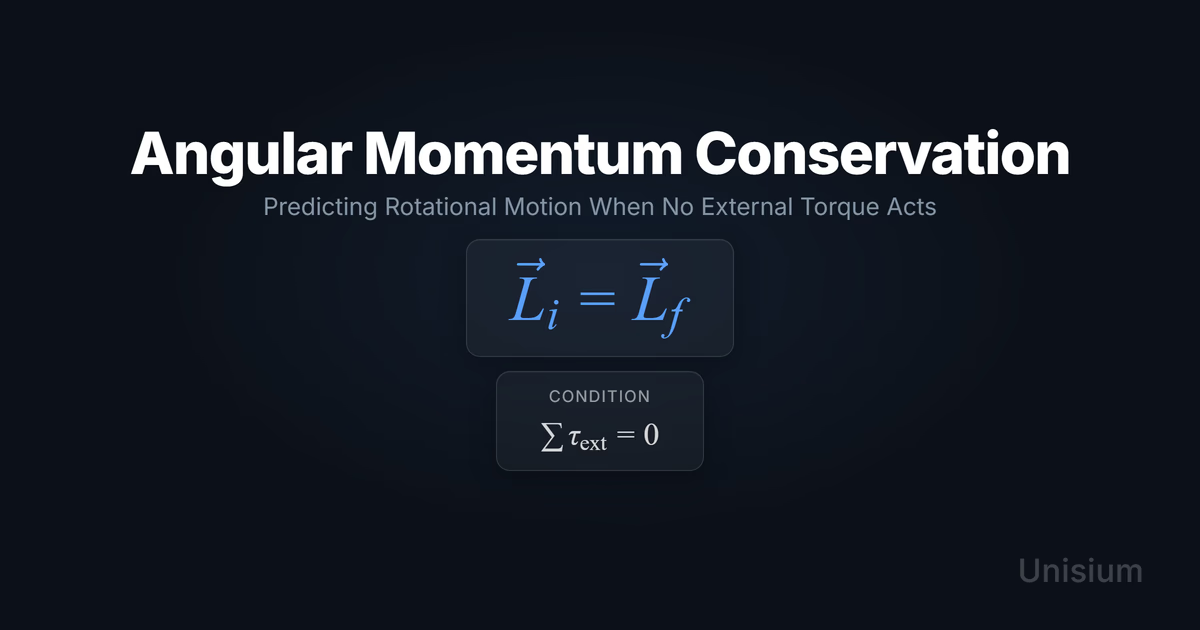
When the net external torque acting on a system is zero (about a chosen axis or point), the total angular momentum of that system (about the same axis or point) remains constant. Individual parts of the system can exchange angular momentum, but the vector sum of all angular momenta stays the same throughout the motion.
Mathematical Form
Where:
- = initial total angular momentum of the system (SI units: kg·m²/s)
- = final total angular momentum of the system (SI units: kg·m²/s)
This can also be written as , emphasizing that no change occurs.
Common evaluation model: For a rigid body rotating about a fixed axis, angular momentum can be calculated as . When this model applies and angular momentum is conserved:
Alternative Forms
In different contexts, this appears as:
- Change form: (emphasizing no change occurs)
- Scalar form for fixed axis: (when direction doesn’t change)
Conditions of Applicability
Condition:
This condition means the net external torque on the system must be zero about the chosen axis or point. Note that:
- Internal action-reaction force pairs don’t change the total angular momentum of the system (by Newton’s third law and the definition of angular momentum about a point)
- External forces can act on the system as long as they don’t produce net torque about the chosen axis
- A force that acts through the rotation axis produces zero torque about that axis
Practical modeling notes
Common situations where this condition is satisfied:
- Isolated systems: No external forces act at all (astronaut in space, far from other objects)
- Symmetric force arrangements: External forces produce torques that cancel (weight acting through center of mass)
- Forces through the axis: External forces act along or through the rotation axis (figure skater’s weight acts through vertical axis)
When It Doesn’t Apply
When net external torque acts on the system, angular momentum changes according to the angular impulse-momentum theorem: (or more generally, ).
- Friction at pivot point: A torque-producing resistance will slow rotation and reduce angular momentum (bearing friction on a spinning wheel)
- External applied torque: Deliberately applied forces create torque (motor driving a shaft, person pushing on a merry-go-round)
- Non-central forces: Forces not aligned with or canceled about the axis (off-center wind force on a rotating object)
Want the complete framework behind this guide? Read Masterful Learning.
Common Misconceptions
Misconception 1: Angular momentum is conserved only when no external forces act
The truth: Angular momentum is conserved when net external torque is zero. External forces can act as long as they produce no net torque about the rotation axis.
Why this matters: In many real problems, forces like gravity and normal forces act but produce zero torque because they pass through the axis or cancel each other. Recognizing that force ≠ torque is essential for identifying when conservation applies.
Misconception 2: When moment of inertia decreases, angular velocity must decrease to keep constant
The truth: When decreases, must increase to maintain constant , since they’re inversely related.
Why this matters: This explains the ice skater effect—pulling arms in decreases , so rotational speed increases dramatically. Getting this direction wrong leads to impossible predictions.
Misconception 3: Angular momentum conservation only applies to single rigid bodies
The truth: Conservation applies to the total angular momentum of a system, which can include multiple objects, deforming bodies, or particles moving in complex paths.
Why this matters: Many problems involve systems like two spinning objects that collide and stick together, or an object that breaks apart. The principle applies to the entire system, even when individual parts’ angular momenta change.
Elaborative Encoding
Use these questions to build deep understanding. (See Elaborative Encoding for the full method.)
Within the Principle
- What does tell us about the relationship between moment of inertia and angular velocity when mass distribution changes?
- Why is angular momentum a vector quantity, and what does its direction represent physically?
For the Principle
- How do you determine whether the net external torque is zero for a rotating system?
- When analyzing a collision between rotating objects, what boundaries define the system for which angular momentum is conserved?
Between Principles
- How does angular momentum conservation ( when ) relate to linear momentum conservation ( when )?
Generate an Example
- Describe a situation where angular momentum is conserved even though the object’s kinetic energy changes significantly.
Retrieval Practice
Answer from memory, then click to reveal and check. (See Retrieval Practice for the full method.)
State the principle in words: _____When the net external torque on a system is zero, the total angular momentum of the system remains constant.
Write the canonical equation: _____
State the canonical condition: _____
Worked Example
Use this worked example to practice Self-Explanation.
Problem
A figure skater is spinning with angular velocity with her arms extended. Her moment of inertia in this configuration is . She pulls her arms in tight against her body, reducing her moment of inertia to . What is her final angular velocity?
Step 1: Verbal Decoding
Target:
Given: , ,
Constraints: No external torque acts; skater is isolated; rotation about fixed vertical axis through center of mass.
Step 2: Visual Decoding
Draw a vertical axis through the skater’s center. Choose positive rotation counterclockwise (viewed from above). Label and both positive.
(So and .)
Step 3: Physics Modeling
Step 4: Mathematical Procedures
Step 5: Reflection
- Units: kg·m²·rad/s divided by kg·m² gives rad/s, which is correct for angular velocity.
- Magnitude: Angular velocity more than doubled (from 3.0 to 7.5 rad/s). Plausible because moment of inertia was cut by more than half (5.0 to 2.0).
- Limiting case: If (no arm movement), then . The equation gives , which is correct.
Before moving on: self-explain the model
Try explaining Step 3 out loud (or in writing): why angular momentum conservation applies, what the diagram shows about the system, and how the equation encodes the physical situation.
Physics model with explanation (what “good” sounds like)
Principle: Conservation of angular momentum applies because no external torque acts on the skater.
Conditions: The skater is isolated (floating on ice with negligible friction at the blade contact). Her weight acts vertically through the rotation axis, producing zero torque. No other external forces or torques are present, so .
Relevance: This principle directly connects the change in mass distribution (moment of inertia) to the resulting change in rotation rate. Since must remain constant, decreasing forces to increase proportionally.
Description: Initially, the skater rotates with arms extended (large , slow ). She then pulls her arms inward, which decreases her moment of inertia by bringing mass closer to the rotation axis. The total angular momentum cannot change because no external torque acts, so the product must stay equal to its initial value.
Goal: We want the final angular velocity . Setting initial angular momentum equal to final angular momentum gives , which we solve algebraically for .
Solve a Problem
Apply what you’ve learned with Problem Solving.
Problem
A merry-go-round with moment of inertia rotates freely at . A child with mass runs tangentially and jumps onto the edge of the merry-go-round at radius from the center. The child’s speed just before landing is in the direction of the merry-go-round’s rotation. What is the final angular velocity of the system (child + merry-go-round)?
Hint: Treat the child as a point mass and remember to include both the merry-go-round’s initial angular momentum and the child’s initial angular momentum about the rotation axis.
Show Solution
Step 1: Verbal Decoding
Target:
Given: , , , ,
Constraints: Merry-go-round rotates freely (negligible friction at bearing); child lands and sticks to edge; rotation about fixed vertical axis through center.
Step 2: Visual Decoding
Draw a top view of the merry-go-round with rotation axis perpendicular to the page at center. Choose positive rotation counterclockwise. Label positive and the child’s velocity tangent in the same direction. Label the final state positive.
(So , child’s angular momentum about center is positive, and .)
Step 3: Physics Modeling
Step 4: Mathematical Procedures
Step 5: Reflection
- Units: Sum of angular momentum terms divided by moment of inertia gives rad/s, which is correct for angular velocity.
- Magnitude: Final angular velocity (0.85 rad/s) is larger than initial (0.50 rad/s), which makes sense because the child added angular momentum in the same direction as the merry-go-round’s rotation.
- Limiting case: If the child’s speed , then , which is less than (adding mass with no angular momentum slows rotation). Our result correctly shows faster rotation when the child brings in angular momentum.
Related Principles
- Classical Mechanics: The Complete Principle Map — see where this principle fits in the full subdomain.
| Principle | Relationship to Conservation of Angular Momentum |
|---|---|
| Angular Momentum (Rigid Body) | Defines , the quantity that is conserved |
| Conservation of Linear Momentum | Analogous principle for translation; conserved when |
| Angular Impulse | Describes angular momentum change when external torque does act: |
See Principle Structures for how to organize these relationships visually.
FAQ
What is conservation of angular momentum?
Conservation of angular momentum states that when no net external torque acts on a system, the total angular momentum of that system remains constant. This means , or equivalently, .
When does conservation of angular momentum apply?
It applies when the net external torque on the system is zero: . This can occur when no external forces act, when external forces produce torques that cancel, or when forces act through the rotation axis.
What’s the difference between angular momentum conservation and linear momentum conservation?
Linear momentum is conserved when net external force is zero (), while angular momentum is conserved when net external torque is zero (). Forces and torques are related but distinct—a force can act without producing torque if it passes through the rotation axis.
What are the most common mistakes with conservation of angular momentum?
The most common mistakes are: (1) assuming no external forces can act (forces can act as long as they don’t produce net torque), (2) confusing the direction of change when changes (decreasing increases , not decreases it), and (3) forgetting to include all parts of the system when calculating total angular momentum.
How do I know when to use versus ?
Use for rigid bodies rotating about a fixed axis. Use (which gives magnitude when velocity is perpendicular to position) for point particles or to find angular momentum about a specific point. For a system, add all individual contributions.
Related Guides
- Principle Structures — Organize conservation of angular momentum in a hierarchical framework
- Rotational Mechanics: Angular Momentum Anki Deck — Drill angular momentum definitions, conservation, and impulse relationships
- Self-Explanation — Learn to explain worked examples step by step
- Retrieval Practice — Make this principle instantly accessible
- Problem Solving — Apply principles systematically to new problems
How This Fits in Unisium
Unisium helps you master conservation of angular momentum through targeted practice in all four learning strategies. The platform schedules retrieval prompts to keep the principle accessible, presents worked examples with self-explanation scaffolding, generates elaborative encoding questions that deepen understanding, and offers spaced problem-solving practice to build transfer.
Ready to master conservation of angular momentum? Check access and join the Unisium waitlist or explore the full learning framework in Masterful Learning.
Masterful Learning
The book behind these guides: a study system for physics, math, & programming built on retrieval, connection, explanation, and problem solving.
Ready to apply this strategy?
Unisium turns these evidence-based techniques into guided study sessions for math and physics. Places are limited during early access. Check current availability to start a trial; joining the mailing list is optional.
See plans and availability Read More GuidesAlready have access? Sign in