Parallel Axis Theorem: Shifting Rotational Inertia
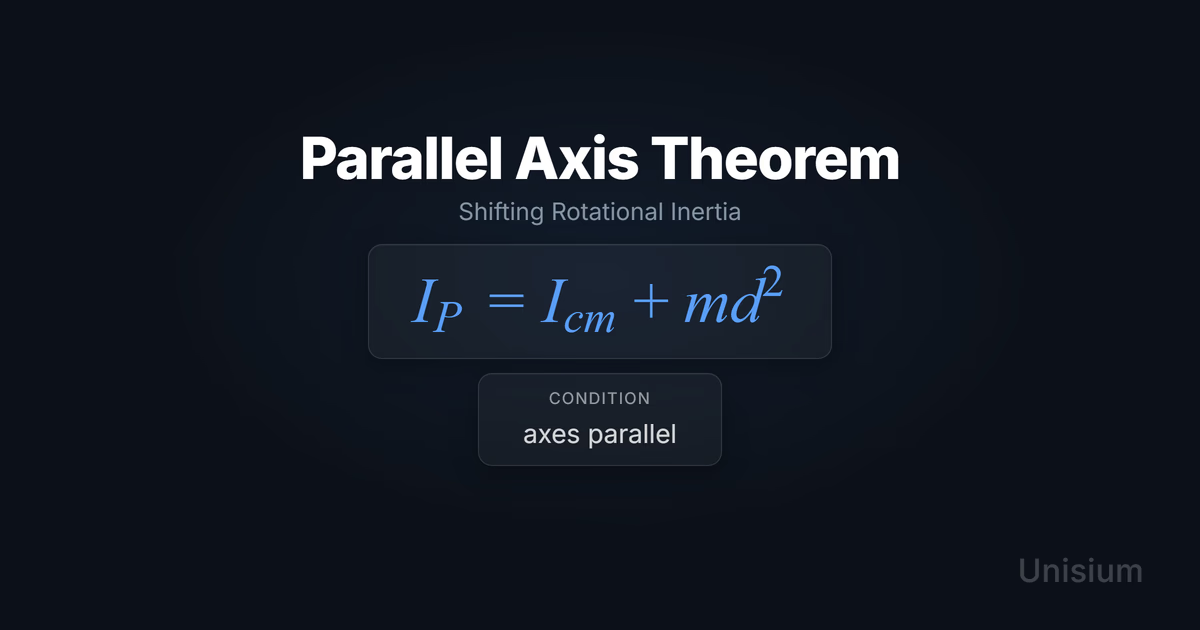
Parallel Axis Theorem lets you shift a rigid body’s moment of inertia from an axis through the center of mass to any other parallel axis: . It applies only when the axes are parallel. Use it when a rigid body rotates about a hinge, pivot, contact point, or any axis offset from its center of mass.
This theorem is essential in rotational dynamics because calculating moment of inertia from first principles (integrating ) can be difficult for arbitrary axes. If you know the moment of inertia about the center of mass—often tabulated or easier to compute—the parallel axis theorem lets you quickly find the moment about any other parallel axis. This is crucial for analyzing objects rotating about hinges, pivots, or axes offset from their centers.
On this page: The Principle · Conditions · Misconceptions · EE Questions · Retrieval Practice · Worked Example · Solve a Problem · FAQ
The Principle
Statement
The moment of inertia of a rigid body about any axis parallel to a center-of-mass axis equals the moment of inertia about that center-of-mass axis plus the product of the body’s mass and the square of the perpendicular distance between the two axes.
Mathematical Form
Where:
- = moment of inertia about the parallel axis (kg·m²)
- = moment of inertia about an axis through the center of mass (kg·m²)
- = total mass of the body (kg)
- = perpendicular distance between the parallel axes (m)
Alternative Forms
- Multiple objects: For a system of bodies rotating about a common axis, apply the theorem separately to each body and sum:
- Shifting from arbitrary axes: To shift between two arbitrary parallel axes (neither through the CM), compute via the CM axis: , where and are the respective distances from the CM
For the theorem itself, the exact statement is still : moving from the center-of-mass axis to a parallel axis adds the net term to the total inertia. It is not a claim that every individual mass-element distance increases.
Conditions of Applicability
Condition: axes parallel
Practical modeling notes
The two rotation axes must be parallel—they lie in parallel planes perpendicular to the same direction. The distance is measured perpendicular to both axes. For planar (2D) problems, this typically means both axes are perpendicular to the plane of motion, and is the straight-line distance between the axis locations in the plane.
When It Doesn’t Apply
- Non-parallel axes: If the axes are skewed or intersect at an angle, the parallel axis theorem does not apply. You must recalculate the moment of inertia from the definition , where is the perpendicular distance from the new axis
- Shifting to a different orientation: The theorem only shifts the axis location, not its direction. Rotating the axis orientation requires recalculating the inertia tensor components for 3D rigid bodies
- Deformable or fluid systems: If the body’s shape or mass distribution changes significantly during rotation, moment of inertia becomes time-dependent and the theorem applies only instantaneously if the axes remain parallel
Want the complete framework behind this guide? Read Masterful Learning.
Common Misconceptions
Misconception 1: The parallel axis theorem works for any two arbitrary parallel axes
The truth: The theorem shifts between a center-of-mass axis and any other parallel axis. To shift between two arbitrary parallel axes (neither through the CM), you must route through the center of mass axis as an intermediate step.
Why this matters: The theorem shifts the axis location (where it intersects a plane) without changing the axis direction (orientation). Students who try to shift directly between non-CM axes without routing through get wrong answers.
Misconception 2: The in the formula is the distance from the center of mass to a point on the object
The truth: is the perpendicular distance between the two parallel axes—the shortest distance between the lines representing the axes—not the distance to a particular mass element or edge of the object.
Why this matters: Using the wrong distance (e.g., the object’s radius instead of the axis-to-axis separation) produces incorrect moment of inertia values. Always draw both axes clearly and measure the perpendicular separation between them.
Misconception 3: The parallel axis theorem reduces moment of inertia when moving the axis closer to the mass
The truth: The theorem always adds a positive term when shifting away from the center of mass, so for any axis parallel to the CM axis. The moment of inertia is minimized at the center of mass and increases as the axis moves farther away.
Why this matters: Recognizing that is the minimum helps you check your work—if you calculate an smaller than the tabulated , you’ve made an error. It also explains why objects rotating about off-center pivots are harder to spin than when rotating about their centers.
Elaborative Encoding
Use these questions to build deep understanding. (See Elaborative Encoding for the full method.)
Within the Principle
- What are the units of each term in , and why must both and have the same units?
- Why does the theorem have a squared distance term rather than just —how does this relate to the definition of moment of inertia ?
For the Principle
- How do you identify which axis passes through the center of mass when applying the parallel axis theorem in a problem?
- When given a moment of inertia about an arbitrary axis, how do you work backward to find for use with a different parallel axis?
Between Principles
- How does the parallel axis theorem relate to the definition of moment of inertia or —why does shifting the axis add exactly ?
Generate an Example
- Describe a physical system (like a pendulum or a door) where you would need the parallel axis theorem because the rotation axis is not through the center of mass.
Retrieval Practice
Answer from memory, then click to reveal and check. (See Retrieval Practice for the full method.)
State the principle in words: _____The moment of inertia about any axis equals the moment of inertia about a parallel axis through the center of mass plus the product of the mass and the square of the perpendicular distance between the axes.
Write the canonical equation: _____
State the canonical condition: _____axes parallel
Worked Example
Use this worked example to practice Self-Explanation.
Problem
A thin uniform rod of mass 2.0 kg and length 0.80 m is pivoted about an axis perpendicular to the rod at a point 0.20 m from one end. What is the moment of inertia of the rod about this pivot axis? (The moment of inertia of a uniform rod about its center is .)
Step 1: Verbal Decoding
Target:
Given: , , ,
Constraints: uniform rod; axis perpendicular to rod; pivot offset from center; formula known
Step 2: Visual Decoding
Draw the rod. Mark the center of mass at the midpoint. Mark the pivot axis at the given location along the rod. Draw both axes as parallel lines (same direction) and label the perpendicular separation as .
Step 3: Physics Modeling
Step 4: Mathematical Procedures
Step 5: Reflection
- Units: kg·m² for both terms, correct for moment of inertia.
- Magnitude: The term is comparable to , and confirms the axis is offset from the center of mass.
- Limiting case: If (axis through the center), then , as expected.
Before moving on: self-explain the model
Try explaining Step 3 out loud (or in writing): why the parallel axis theorem applies, what the diagram shows about the axis locations, and how the single equation shifts the moment of inertia from the center of mass to the off-center pivot.
Physics model with explanation (what “good” sounds like)
Principle: We use the parallel axis theorem because we know the moment of inertia about the center of mass (from the standard formula for a uniform rod) and need the moment about a different parallel axis (the off-center pivot).
Conditions: The two axes are parallel—both are perpendicular to the rod and lie in planes parallel to each other, separated by distance m. The rod is rigid, so the condition is satisfied.
Relevance: Rather than integrating from scratch with the pivot as the origin, we leverage the known and apply the theorem to shift the axis. This is much faster and reduces algebraic errors.
Description: The rod’s center of mass is at its geometric center (0.40 m from each end). The pivot is 0.20 m from the left end, so m. The term comes from the standard result for a uniform rod. The term accounts for the additional rotational inertia due to the shift: every mass element is farther from the pivot than from the center of mass, and the theorem captures this geometric effect exactly.
Goal: We substitute the given mass, length, and computed distance into the parallel axis theorem to find . The two terms add because both contribute to the total resistance to angular acceleration about the pivot axis.
Solve a Problem
Apply what you’ve learned with Problem Solving.
Problem
A thin uniform disk of mass 3.0 kg and radius 0.50 m rotates about an axis perpendicular to the disk and passing through a point on its edge (rim). What is the moment of inertia about this axis? (The moment of inertia of a disk about its center is .)
Hint: The distance is the distance from the center of mass (center of the disk) to the edge (rim).
Show Solution
Step 1: Verbal Decoding
Target:
Given: , ,
Constraints: uniform disk; axis perpendicular to disk; axis through rim; formula known
Step 2: Visual Decoding
Draw the disk from the side. Mark the center of mass at the disk’s center. Mark the pivot axis at the rim edge. Label the distance between the center and rim.
Step 3: Physics Modeling
Step 4: Mathematical Procedures
Step 5: Reflection
- Units: kg·m² for both terms, correct for moment of inertia.
- Magnitude: The result is exactly three times (), which makes sense because rotating about the rim is harder than about the center.
- Limiting case: If (axis through center), then , as expected.
Related Principles
- Classical Mechanics: The Complete Principle Map — see where this principle fits in the full subdomain.
| Principle | Relationship to Parallel Axis Theorem |
|---|---|
| Moment of Inertia (Definition) | The parallel axis theorem derives from the definition by decomposing the distance into center-of-mass and relative components |
| Rotational Newton’s 2nd Law | Once you use the parallel axis theorem to find , you apply to analyze the rotational dynamics about the pivot axis |
| Rotational Kinetic Energy | For rotation about an off-center axis, use with computed via the parallel axis theorem |
See Principle Structures for how to organize these relationships visually.
FAQ
What is the Parallel Axis Theorem?
The Parallel Axis Theorem is a formula that relates the moment of inertia of a rigid body about any axis to the moment of inertia about a parallel axis through the center of mass: , where is the perpendicular distance between the axes. It allows you to compute moment of inertia for off-center rotation axes without recalculating the integral from scratch.
When does the Parallel Axis Theorem apply?
The theorem applies when the two rotation axes are parallel—they lie in parallel planes and point in the same direction. The distance is the perpendicular distance between the axes. It does not apply to non-parallel or skewed axes.
What’s the difference between the Parallel Axis Theorem and the Perpendicular Axis Theorem?
The Parallel Axis Theorem shifts moment of inertia between parallel axes and applies to any rigid body. The Perpendicular Axis Theorem relates moments of inertia about three mutually perpendicular axes for planar (thin, flat) objects only: when all three axes pass through the same point and is perpendicular to the plane.
What are the most common mistakes with the Parallel Axis Theorem?
The top mistakes are: (1) using the wrong distance (e.g., an object dimension instead of the axis-to-axis separation), (2) trying to shift directly between two non-CM axes without going through the center of mass, and (3) forgetting to square the distance in the term.
How do I know which axis to use as the starting point?
Always start with the axis through the center of mass if possible, because is often tabulated or easiest to compute. If you’re given about an arbitrary axis and need about a different axis, first solve for using the distance from the CM to the known axis, then use with the distance to the new axis.
Related Guides
- Principle Structures — Organize this principle in a hierarchical framework
- Self-Explanation — Learn to explain worked examples step by step
- Retrieval Practice — Make this principle instantly accessible
- Problem Solving — Apply principles systematically to new problems
How This Fits in Unisium
Unisium helps you master the parallel axis theorem through spaced retrieval practice, elaborative encoding activities that connect moment of inertia concepts to geometric shifts, self-explanation prompts on worked examples involving off-center pivots, and carefully scaffolded problems that build your skill in applying to diverse rotational scenarios. The platform tracks your progress and identifies gaps, ensuring you can confidently use this theorem when analyzing pendulums, doors, rotating machinery, and compound rigid body systems.
Ready to master the Parallel Axis Theorem? Check access and join the Unisium waitlist or explore the full learning framework in Masterful Learning.
Masterful Learning
The book behind these guides: a study system for physics, math, & programming built on retrieval, connection, explanation, and problem solving.
Ready to apply this strategy?
Unisium turns these evidence-based techniques into guided study sessions for math and physics. Places are limited during early access. Check current availability to start a trial; joining the mailing list is optional.
See plans and availability Read More GuidesAlready have access? Sign in