Angular Impulse Formula: When Torque Over Time Changes Angular Momentum
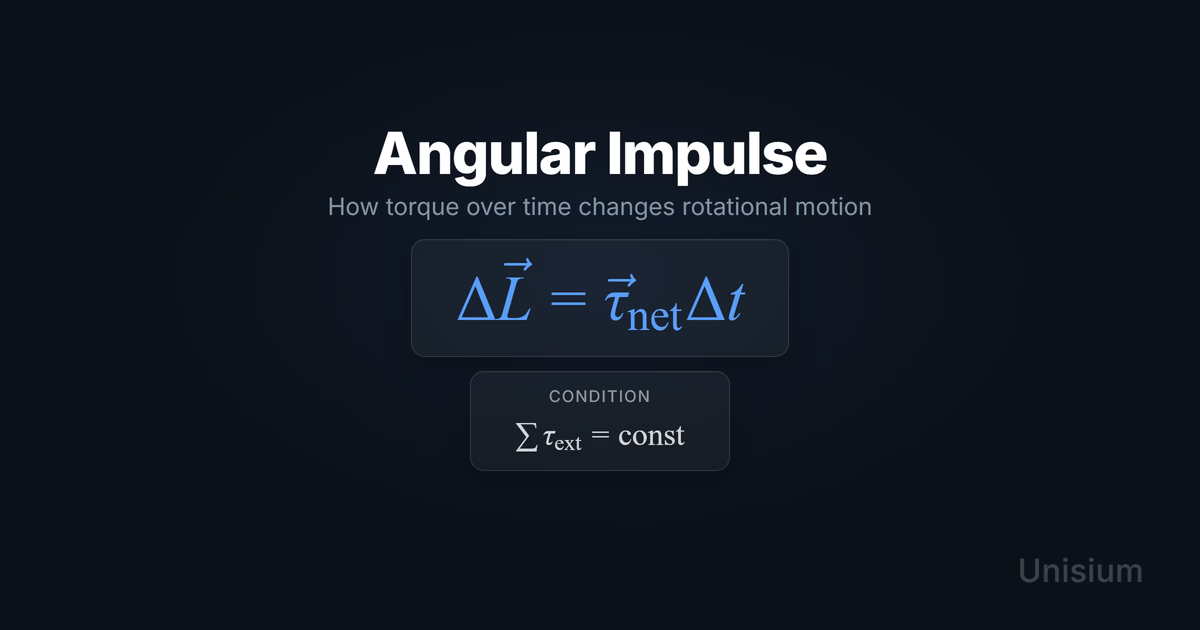
Angular impulse tells you how much angular momentum changes when a constant net external torque acts over a time interval. Use when the torque is constant; if torque varies with time, use the integral form instead.
Angular impulse is the rotational analog of linear impulse: torque acting over time changes angular momentum. Use angular impulse when a net external torque acts over a known time interval and you need the change in angular momentum or the resulting change in angular speed.
Formula:
Condition: the net external torque is constant over the interval
Use it for: braking, spin-up, fixed-axis rotation, and short rotational interactions where torque and time are known
Do not use the algebraic form for: continuously varying torque; use instead
If you are deciding between angular impulse and conservation of angular momentum, ask whether a nonzero external torque changes the system during the interval. If external torque is negligible, use conservation. If external torque acts over time and changes the rotational state, angular impulse is the direct relation.
On this page: Formula | Conditions | Common Mistakes | EE Questions | Retrieval Practice | Worked Example | Solve a Problem | FAQ
Angular Impulse Formula
Statement
When a constant net external torque acts on a rotating object over a time interval, the change in the object’s angular momentum equals the product of the net torque and the time interval. This gives us a direct way to find how much rotational motion changes without tracking the angular acceleration throughout.
Mathematical Form
Where:
- = change in angular momentum (SI unit: )
- = net external torque (SI unit: )
- = time interval (SI unit: )
The direction of follows the right-hand rule for the torque vector: if the torque points along the positive rotation axis, angular momentum increases in that direction.
Physical Interpretation
The equation tells us that torque is the rate of change of angular momentum, analogous to how force is the rate of change of linear momentum. When torque remains constant, we can multiply it by the elapsed time to find the total change in rotational motion. This is particularly powerful because it bypasses the need to integrate angular acceleration or track instantaneous velocity—you go directly from torque history to momentum change.
Doubling either torque or time doubles the angular impulse (and thus ).
Connection to Newton’s Second Law for Rotation
Angular impulse emerges naturally from Newton’s second law for rotation: . When you integrate both sides over a time interval from to , you get:
If is constant during this interval, it factors out of the integral, giving , or simply . This is the angular impulse-momentum relation. When torque is constant, the integral reduces to multiplication. For more complex torque histories, you must return to the integral form.
Alternative Forms
In different contexts, this appears as:
- Component form (fixed axis): — the scalar equation for rotation about a fixed axis (common in introductory problems)
- Final minus initial: — explicitly showing that impulse bridges initial and final states
Conditions of Applicability
Condition:
The net external torque must remain constant throughout the time interval. (Note: is the sum of external torques, equivalent to used in the equation.)
This means:
- All external torques are constant in magnitude and direction
- If multiple torques act, their vector sum is constant
- The constraint allows you to pull out of the integral:
Practical modeling notes
- Simple scenarios: Single constant torque (motor, brake, friction) or balanced forces creating steady net torque
- Piecewise constant: If torque changes abruptly at discrete times, apply angular impulse separately for each constant-torque interval. For example, a motor that switches power levels creates distinct impulse contributions:
- Rigid body shortcuts: For rigid bodies rotating about a fixed axis, combine with to find directly. Since when is constant, you get , giving (consistent with constant angular acceleration)
- Checking constantness: Torque is constant if forces are constant AND their lever arms don’t change. A tangential force at a fixed radius on a rotating disk produces constant torque; a force that moves radially inward produces varying torque
When It Doesn’t Apply
- Varying torque: When torque changes continuously with time (like a sinusoidally varying motor torque or position-dependent friction), use the integral form or integrate if is constant.
- Impulsive torques (collisions): For brief collisions where torque spikes dramatically, the algebraic form still works if you can determine the average torque during contact. Often it’s easier to use conservation of angular momentum when external torques are negligible during the collision.
- Internal torques dominating: Internal torques (between parts of a system) don’t change total angular momentum. Only external torques contribute to .
Want the complete framework behind this guide? Read Masterful Learning.
Common Angular Impulse Mistakes
Misconception 1: Angular impulse applies to any torque history
The truth: The simple form requires constant torque. For time-varying torque, you must integrate: .
Why this matters: Applying when torque varies (like a motor ramping up) underestimates or overestimates . Always check whether torque is truly constant before using the algebraic form.
Misconception 2: Impulse is the same as force or torque
The truth: Impulse (linear or angular) is the effect of a force or torque over time, not the force or torque itself. Impulse has units of momentum ( or ), not force () or torque ().
Why this matters: A small torque acting for a long time can produce the same angular impulse (and thus the same ) as a large torque acting briefly. Understanding this distinction is key to analyzing braking, acceleration, and collision scenarios.
Misconception 3: You can ignore angular impulse if is small
The truth: Even tiny time intervals matter if the torque is large enough. In collisions, is small but is huge, so can be substantial.
Why this matters: During impulsive events (bat hitting a ball, wrench tightening a bolt), neglecting angular impulse because "" misses the entire effect. The product is finite and measurable, even when if grows correspondingly.
Elaborative Encoding
Use these questions to build deep understanding. (See Elaborative Encoding for the full method.)
Within the Principle
- What do the units of angular impulse () tell you? How do they simplify to the units of angular momentum ()?
- Why does the equation involve rather than itself? What does this tell you about what angular impulse measures?
For the Principle
- How do you decide whether a given torque history qualifies as “constant”? What observable features would signal that the torque is changing?
- If you know the torque acting on a rotating object is constant, what additional information do you need to find the final angular velocity ?
Between Principles
- How does angular impulse relate to Newton’s second law for rotation ? Conceptually, how do you go from one to the other?
Generate an Example
- Describe a real-world situation where angular impulse applies accurately (constant torque over a known time interval), and another where it fails because the torque varies. What distinguishes them?
Retrieval Practice
Answer from memory, then click to reveal and check. (See Retrieval Practice for the full method.)
State the principle in words: _____When a constant net torque acts on a rotating object over a time interval, the change in angular momentum equals the torque times the time interval.
Write the canonical equation: _____
State the canonical condition: _____
Worked Example
Use this worked example to practice Self-Explanation.
Problem
A solid disk of mass and radius is initially at rest on a frictionless horizontal axle through its center. A constant tangential force is applied at the rim for . What is the disk’s angular velocity at ?
Step 1: Verbal Decoding
Target: (angular velocity at )
Given: , , ,
Constraints: Solid disk, initially at rest, constant tangential force at rim, fixed axis
Step 2: Visual Decoding
Try drawing the disk viewed from above. Choose a rotation axis: let point out of the page (toward you) along the axle. Choose counterclockwise (when viewed from above) as the positive rotation direction. Label the tangential force at the rim; by the right-hand rule, this produces torque pointing in the direction.
(So is positive, , and the impulse increases angular momentum in the direction.)
Step 3: Physics Modeling
Step 4: Mathematical Procedures
Step 5: Reflection
- Units: emerges from , confirming dimensional consistency (radians are dimensionless).
- Magnitude: A force of 8 N at 0.5 m for 3 seconds spins the disk to 24 rad/s (about 4 revolutions per second), which is physically reasonable for a 4 kg disk.
- Limiting case: If , then and , as expected for no time to accelerate.
Before moving on: self-explain the model
Try explaining Step 3 out loud (or in writing): why the chosen principles apply, what the diagram implies, and how the equations encode the situation.
Physics model with explanation (what “good” sounds like)
Principle: We use angular impulse because a constant torque acts over a time interval. We combine this with for a rigid body rotating about a fixed axis to connect angular momentum to angular velocity.
Conditions: The torque is constant (constant force at constant radius), and the disk rotates about a fixed axis through its center, so the algebraic form of angular impulse applies.
Relevance: We need , and we know the torque and time interval. Angular impulse gives us , and since the disk starts at rest (), we have . Then yields .
Description: The tangential force creates a torque about the center. This torque acts for 3 seconds, delivering angular impulse that changes the disk’s angular momentum from zero to a final value. Dividing by the moment of inertia gives the final angular velocity.
Goal: We compute the torque , then the angular impulse . Since the disk starts at rest, . We calculate from the disk’s geometry, then solve for .
Solve a Problem
Apply what you’ve learned with Problem Solving.
Problem
A solid sphere of mass and radius is spinning at about an axis through its center. A constant braking torque (negative because it opposes rotation) acts on the sphere for . What is the sphere’s angular velocity at ?
Hint: The moment of inertia of a solid sphere about an axis through its center is .
Show Solution
Step 1: Verbal Decoding
Target: (angular velocity at )
Given: , , , ,
Constraints: Solid sphere, axis through center, constant braking torque
Step 2: Visual Decoding
Try drawing the sphere. Choose a rotation axis: let be the direction of the initial (spin axis). The initial angular velocity is positive along this axis. Label the braking torque pointing in the direction (opposes rotation).
(So is positive and is negative, reducing angular momentum along .)
Step 3: Physics Modeling
Step 4: Mathematical Procedures
Step 5: Reflection
- Units: emerges from , confirming correctness.
- Magnitude: The braking torque removed more angular momentum than the sphere initially had, causing it to reverse direction and spin backward at about 52 rad/s. This is physically possible if the torque acts long enough.
- Limiting case: If , then and , as expected for no torque.
Related Principles
- Classical Mechanics: The Complete Principle Map — see where this principle fits in the full subdomain.
| Principle | Relationship to Angular Impulse |
|---|---|
| Newton’s Second Law for Rotation | Angular impulse is the time integral of this law. When is constant, integrating gives . |
| Conservation of Angular Momentum | When , angular impulse is zero, so and angular momentum is conserved. |
| Linear Impulse-Momentum | Angular impulse is the rotational analog: torque replaces force, angular momentum replaces linear momentum. |
| Angular Impulse (Integral) | Calculus upgrade: handles variable torque with the full integral. |
| Impulse-Momentum Theorem (Algebraic) | Translation analog: force impulse equals change in linear momentum. |
See Principle Structures for how to organize these relationships visually.
FAQ
What is Angular Impulse?
Angular impulse quantifies how much a torque changes an object’s rotational motion over time. When a constant net torque acts over a time interval, the angular impulse equals and equals the change in angular momentum.
When does angular impulse apply?
It applies when you know (or can calculate) a constant net external torque and the time interval over which it acts. Common scenarios include motors spinning up, brakes slowing rotation, and brief collisions where average torque can be determined.
What’s the difference between angular impulse and torque?
Torque () is the instantaneous rotational influence, like force in linear motion. Angular impulse () is the cumulative effect of that torque over time, analogous to linear impulse. Impulse has units of momentum, not force or torque.
What are the most common mistakes with angular impulse?
- Applying when torque varies with time (requires integration instead)
- Confusing impulse with torque or force (wrong units and wrong physical meaning)
- Ignoring the sign of torque, leading to incorrect direction of
How do I know when to use angular impulse vs. conservation of angular momentum?
If external torques act, use angular impulse to find . If external torques are negligible or sum to zero, use conservation (). Many collision problems combine both: use conservation during the collision (external torques negligible), then angular impulse before/after if external torques matter.
Can angular impulse be negative?
Yes. If the net torque opposes the rotation (negative torque according to your chosen sign convention), the angular impulse is negative, meaning angular momentum decreases. For example, a braking torque slowing a spinning wheel produces negative angular impulse, reducing the wheel’s angular momentum.
How does angular impulse relate to angular kinetic energy?
Angular impulse changes angular momentum , while torque does work that changes angular kinetic energy . They’re related but distinct: impulse depends on time duration, while work depends on angular displacement. For example, a constant braking torque applied for 2 seconds changes by the same amount regardless of how far the object rotates, but the work done (and thus ) depends on the actual rotation angle , which varies with the object’s speed.
Related Guides
- Principle Structures — Organize this principle in a hierarchical framework
- Self-Explanation — Learn to explain worked examples step by step
- Retrieval Practice — Make this principle instantly accessible
- Problem Solving — Apply principles systematically to new problems
How This Fits in Unisium
Unisium helps you master angular impulse through targeted elaboration (EE questions), spaced retrieval practice (ClozeLine prompts), self-explained worked examples, and progressive problem solving. Each principle connects to your personalized study plan, ensuring you build deep, transferable understanding of rotational dynamics. By linking angular impulse to related principles like conservation of angular momentum and Newton’s second law for rotation, Unisium creates a coherent framework for tackling complex problems.
Ready to master Angular Impulse? Check access and join the Unisium waitlist or explore the full learning framework in Masterful Learning.
Masterful Learning
The book behind these guides: a study system for physics, math, & programming built on retrieval, connection, explanation, and problem solving.
Ready to apply this strategy?
Unisium turns these evidence-based techniques into guided study sessions for math and physics. Places are limited during early access. Check current availability to start a trial; joining the mailing list is optional.
See plans and availability Read More GuidesAlready have access? Sign in