Displacement from Average Velocity — Kinematics 4
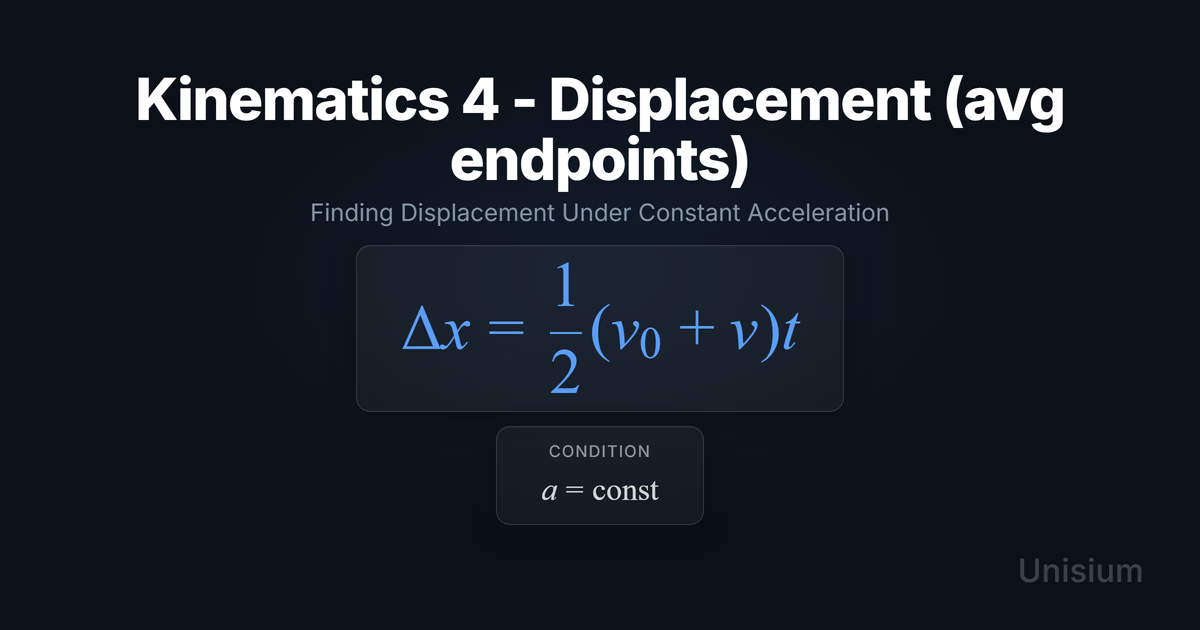
Kinematics 4 - Average Velocity relates displacement to average velocity for motion under constant acceleration. The equation applies when acceleration is constant, letting you find displacement from initial velocity, final velocity, and time. Use it when you know both velocities and time but not acceleration directly.
On this page: The Principle · Conditions · Misconceptions · EE Questions · Retrieval Practice · Worked Example · Solve a Problem · FAQ
This principle is one of four standard kinematics equations for constant acceleration motion. It’s particularly useful when you know velocities and time but not acceleration directly, making it a complement to the other kinematic relationships.
The Principle
Statement
For motion with constant acceleration, the displacement equals the average of the initial and final velocities multiplied by the time interval. This follows from the fact that velocity changes linearly with time when acceleration is constant, so the arithmetic mean of the endpoint velocities gives the average velocity over the interval.
Mathematical Form
Where:
- = displacement (change in position), in meters (m)
- = initial velocity, in meters per second (m/s)
- = final velocity, in meters per second (m/s)
- = time interval, in seconds (s)
Alternative Forms
In different contexts, this appears as:
- Explicit average velocity: , then
- Expanded form: where is the average velocity
Conditions of Applicability
Condition: The equation assumes acceleration is constant throughout the time interval. This is the same condition that applies to all four standard kinematics equations.
Practical modeling notes
- Motion under constant gravitational acceleration near Earth’s surface satisfies this condition (neglecting air resistance)
- Motion with zero net force (constant velocity) is a special case with
- For problems involving changing acceleration, you must break the motion into segments where acceleration is approximately constant
- For rotational problems, use the rotational analog, , under constant
When It Doesn’t Apply
- Variable acceleration: When forces change with position or time (e.g., spring force, air resistance proportional to velocity), you must use calculus-based methods or other kinematic principles
Want the complete framework behind this guide? Read Masterful Learning.
Common Misconceptions
Misconception 1: The average velocity is always halfway between initial and final positions
The truth: Average velocity is displacement divided by time, which for constant acceleration equals the arithmetic mean of initial and final velocities, not positions.
Why this matters: Confusing average velocity with midpoint position leads to incorrect calculations, especially when initial position is not zero.
Misconception 2: This equation works for any motion as long as you know the velocities
The truth: The equation requires constant acceleration; for variable acceleration, the average velocity is not simply .
Why this matters: Applying this formula when acceleration varies (like in circular motion at changing speed) produces wrong answers.
Misconception 3: You need to know acceleration to use this equation
The truth: This equation bypasses acceleration entirely, requiring only velocities and time.
Why this matters: Recognizing when to use Kinematics 4 instead of Kinematics 1 or 2 (which explicitly involve acceleration) saves steps and reduces error propagation.
Elaborative Encoding
Use these questions to build deep understanding. (See Elaborative Encoding for the full method.)
Within the Principle
- Why does the arithmetic mean of and give the average velocity when acceleration is constant?
- What are the units of each term, and how do they combine to give displacement in meters?
For the Principle
- How do you decide whether to use Kinematics 4 versus Kinematics 1 () in a problem?
- When you’re given initial velocity, final velocity, and displacement, why is Kinematics 4 not immediately useful?
Between Principles
- How is Kinematics 4 related to Kinematics 3 (), and when would you use one versus the other?
Generate an Example
- Describe a situation where you know , , and , but Kinematics 4 cannot directly give you the answer you need.
Retrieval Practice
Answer from memory, then click to reveal and check. (See Retrieval Practice for the full method.)
State the principle in words: _____For constant acceleration, displacement equals the average of initial and final velocities multiplied by the time interval.
Write the canonical equation: _____
State the canonical condition: _____
Worked Example
Use this worked example to practice Self-Explanation.
Problem
A car accelerates uniformly from rest to 25 m/s in 8.0 s. How far does it travel during this time?
Step 1: Verbal Decoding
Target:
Given: , ,
Constraints: Uniformly accelerating motion (constant acceleration), starts from rest
Step 2: Visual Decoding
Draw a horizontal axis representing the car’s path. Choose in the direction of motion. Label the initial point (at rest) and final point (moving at 25 m/s). The car moves in the direction throughout. (So and is positive.)
Step 3: Physics Modeling
Step 4: Mathematical Procedures
Step 5: Reflection
- Units: , as expected for displacement.
- Magnitude: 100 m is plausible for a car accelerating to highway speed over 8 seconds.
- Limiting case: If (constant velocity), , which matches uniform motion.
Before moving on: self-explain the model
Try explaining Step 3 out loud (or in writing): why the chosen principle applies, what the diagram implies, and how the equations encode the situation.
Physics model with explanation (what “good” sounds like)
Principle: Kinematics 4 relates displacement to the average of initial and final velocities under constant acceleration.
Conditions: The problem states “uniformly accelerating,” which means constant acceleration, satisfying the condition .
Relevance: We’re given , , and , and asked for . Kinematics 4 directly connects these four quantities without needing to find acceleration first.
Description: The car starts from rest () and reaches 25 m/s in 8.0 s. Because acceleration is constant, the average velocity is simply the arithmetic mean of initial and final velocities. Multiplying this average velocity by time gives the displacement.
Goal: We multiply the average velocity by the time interval to find how far the car travels during its acceleration phase.
Solve a Problem
Apply what you’ve learned with Problem Solving.
Problem
A cyclist slows uniformly from 12 m/s to 4.0 m/s over 6.0 s. What distance does the cyclist travel during this deceleration?
Hint: Even though the cyclist is slowing down, the average velocity formula still applies under constant acceleration.
Show Solution
Step 1: Verbal Decoding
Target:
Given: , ,
Constraints: Uniform deceleration (constant acceleration), moving in one direction
Step 2: Visual Decoding
Draw a horizontal axis representing the cyclist’s path. Choose in the initial direction of motion. Label the initial velocity (12 m/s) and final velocity (4.0 m/s), both positive. The cyclist continues forward but slows down. (So and are both positive.)
Step 3: Physics Modeling
Step 4: Mathematical Procedures
Step 5: Reflection
- Units: , correct for displacement.
- Magnitude: 48 m for 6 seconds of slowing from 12 to 4 m/s is reasonable—average velocity is 8 m/s, so m checks out.
- Limiting case: If the cyclist maintained 12 m/s for 6 s, displacement would be 72 m; if maintained 4 m/s, it would be 24 m. Our answer of 48 m is between these bounds, as expected.
Related Principles
- Classical Mechanics: The Complete Principle Map — see where this principle fits in the full subdomain.
| Principle | Relationship to Kinematics 4 |
|---|---|
| Kinematics 1 | Gives from , , ; combine with K4 when is needed |
| Kinematics 2 | Directly gives from , , without needing final velocity |
| Kinematics 3 | Relates to without time; use when time is unknown |
See Principle Structures for how to organize these relationships visually.
FAQ
What is Kinematics 4 - Average Velocity?
Kinematics 4 is the equation , which calculates displacement from the average of initial and final velocities multiplied by time. It applies to motion with constant acceleration.
When does Kinematics 4 apply?
It applies when acceleration is constant () and you know or can determine initial velocity, final velocity, and time.
What’s the difference between Kinematics 4 and Kinematics 2?
Kinematics 2 () requires knowing acceleration explicitly, while Kinematics 4 uses initial and final velocities instead. If you know , , and but not , use Kinematics 4.
What are the most common mistakes with Kinematics 4?
Using it when acceleration is not constant, confusing average velocity with the average of positions, and forgetting that both velocities must be measured relative to the same reference frame.
How do I know which form of kinematics equation to use?
List what you’re given and what you’re solving for. Kinematics 4 is ideal when you have , , and and need (or vice versa). If acceleration appears explicitly in your givens, consider Kinematics 1 or 2 instead.
Can I use Kinematics 4 when the object reverses direction?
Yes, as long as acceleration remains constant. The velocities will have opposite signs if the object reverses direction, and the equation correctly accounts for this through vector addition.
Why is the average velocity formula valid only for constant acceleration?
Under constant acceleration, velocity changes linearly with time, so the time-average equals the arithmetic mean of the endpoints. For variable acceleration, velocity vs. time is not linear, so you must integrate to find the true average.
How This Fits in Unisium
Unisium helps you master Kinematics 4 - Average Velocity through spaced retrieval practice, elaborative encoding questions that deepen your understanding of when and why the equation applies, and self-explanation prompts that train you to decode problems and select the right principle. By systematically practicing these strategies, you build the fluency needed to recognize when to use the average velocity approach versus other kinematic equations.
Related guides: Principle Structures · Self-Explanation · Retrieval Practice · Problem Solving
Ready to master Kinematics 4 - Average Velocity? Check access and join the Unisium waitlist or explore the full learning framework in Masterful Learning.
Masterful Learning
The book behind these guides: a study system for physics, math, & programming built on retrieval, connection, explanation, and problem solving.
Ready to apply this strategy?
Unisium turns these evidence-based techniques into guided study sessions for math and physics. Places are limited during early access. Check current availability to start a trial; joining the mailing list is optional.
See plans and availability Read More GuidesAlready have access? Sign in