All workbooks

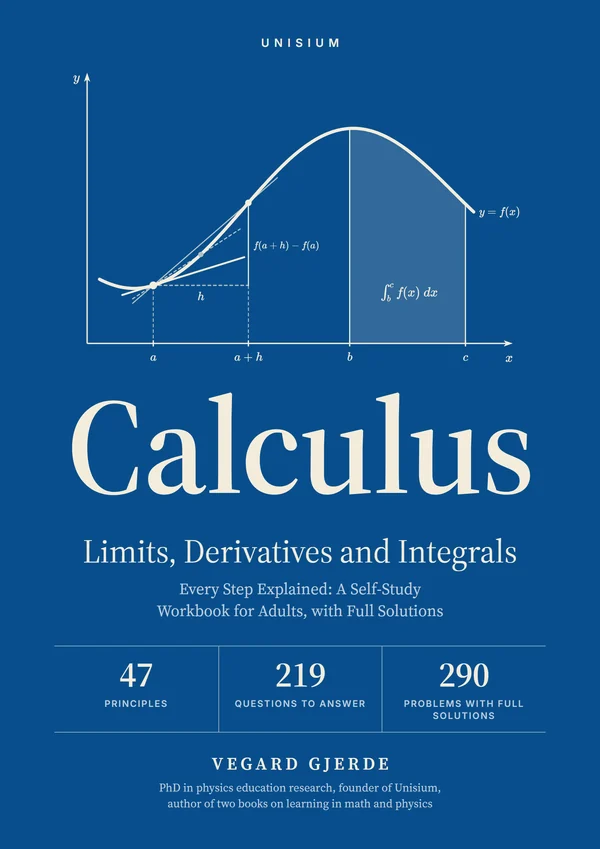
Calculus: Limits, Derivatives and Integrals

Every Step Explained: A Self-Study Workbook for Adults, with Full Solutions

Learn calculus so that it makes sense, stays with you and lets you solve problems on your own. The workbook takes you through single-variable calculus one principle at a time, from limits to Taylor polynomials. A principle is a definition, rule or theorem, such as the chain rule. Every problem has a full solution with an explanation beside each step, so you can check your work and see why each step is allowed.

Working from the book? Go to the AI prompts.

Get the calculus workbook

The PDF edition, which you can fill in on screen, is free by email, together with the book Masterful Learning and two study sheets.

Who the calculus workbook is for

For adults who are learning calculus or coming back to it, often on their own and around a job. You may have passed a calculus course years ago and kept little of it. Or a course, a degree, machine learning, data science, engineering or physics now asks for it. Each principle page states the principle and when it applies, and links a free guide that teaches it. Every problem has a full solution, so you can check your own work without a teacher.

What you will be able to do

  • Solve the problems on your own and check your work against the full solutions.
  • Say what each principle states, what its terms mean and when it applies.
  • Write the principles from memory, on later days too.
  • See which principle a problem needs.
  • Explain each step of a worked solution: what it does and why it is allowed.

How the workbook works

Learn each principle in a loop of four activities. Answering questions builds understanding, and recall on later days makes it stay. Explaining a solution builds your knowledge of how to solve a problem, and solving it yourself builds the skill. Go round the loop in every study session, from the first day.

  1. 1. Answer

    Answer the questions on a principle's page and rate each answer. Come back to them on later days until they are right and complete on two different days.

  2. 2. Recall

    Write the principles you have studied from memory in a recall table, then check them against their pages. Start each study session this way.

  3. 3. Solve

    Try a problem before you look at its solution. Each principle page lists the problems it opens up.

  4. 4. Explain

    Where you get stuck, cover the explanation column of the full solution and explain the steps yourself. Then read the explanations and compare. Log the date, and try the problem again about a week later.

What is inside the calculus workbook

chapters
4 chapters
principles
47 principles
questions to answer
219 questions to answer
problems with full solutions
290 problems with full solutions
  • Full solutions to all 290 problems, step by step, with an explanation beside each step. A step that sets up a principle names it.
  • A page for each principle: its equation, when it applies and its symbols, with questions to answer and a link to the free guide that teaches it.
  • Recall tables in every chapter, to write the principles from memory and check them.
  • A progress log for the problems: the level you reached and the day you try again.
  • Two AI chat prompts: one rates your answers to the questions, one checks your explanations of solution steps.
  • The calculus map, with every principle in the book on one page.
  • 346 A4 pages. In the PDF edition you tick the boxes and type in the fields on screen. You can also print it.
Look inside the calculus workbook

Pages from the PDF edition. Open one to see it full size.

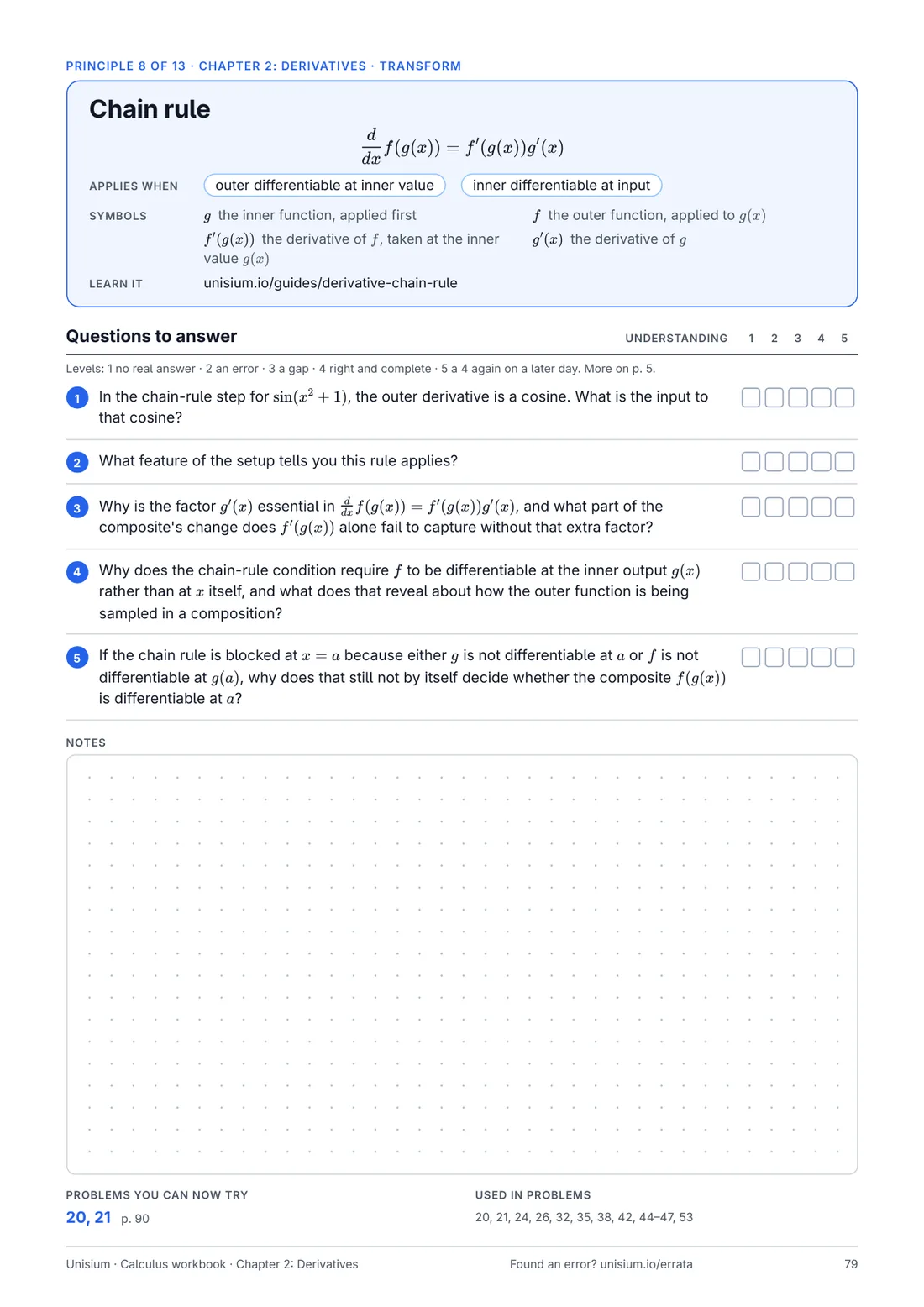
Workbook page for the chain rule: the equation, when it applies, its symbols, five questions to answer with boxes to rate your understanding, space for notes and the problems that use it.
The page for the chain rule, in the derivatives chapter: the equation, when it applies, its symbols and questions to answer.
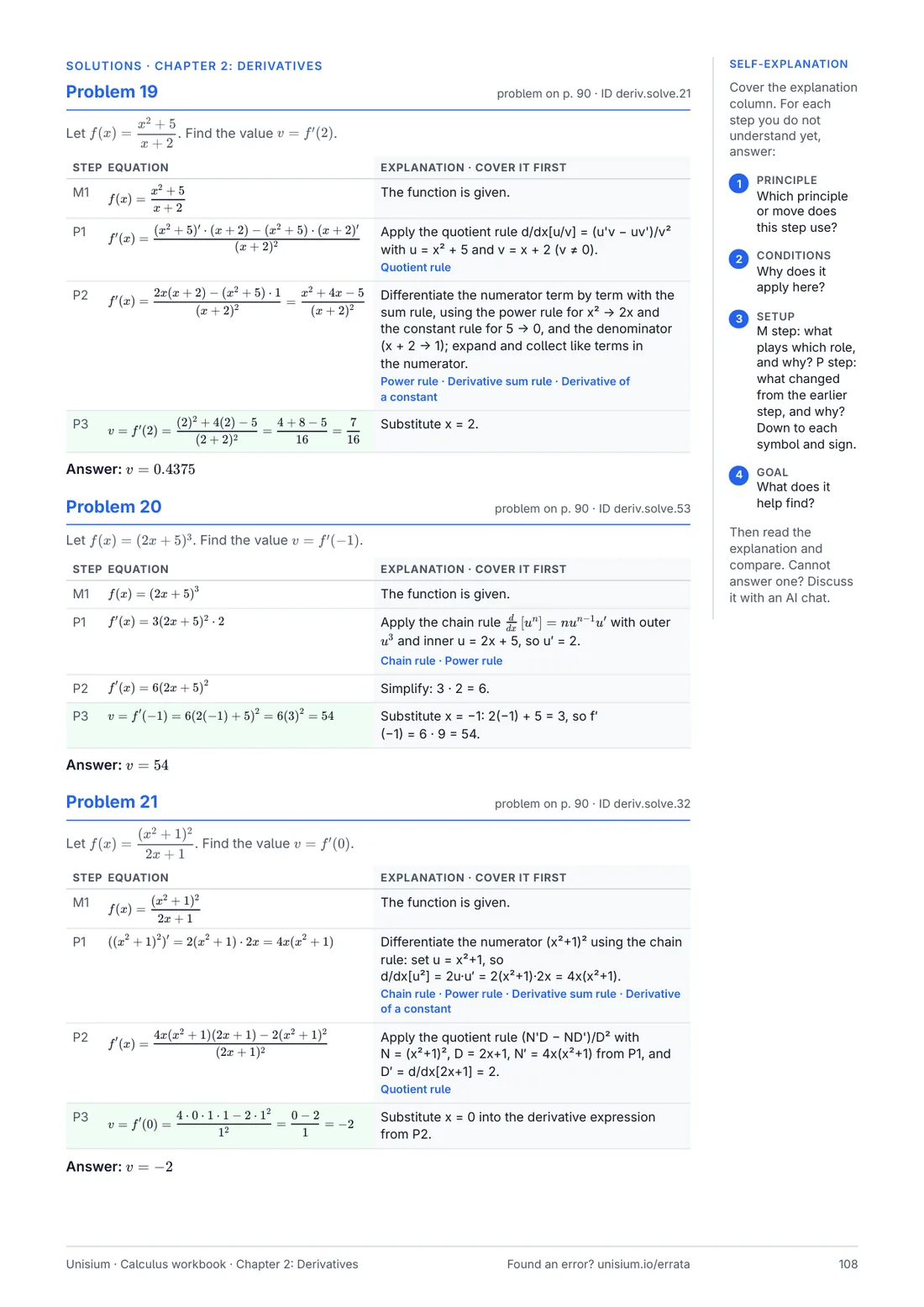
Workbook page with the full solutions to three derivative problems: each step's equation, an explanation beside it and the principles the step uses, with self-explanation prompts in the margin.
Full solutions to three derivative problems, two of them with the chain rule: each step's equation, with an explanation beside it.

The 47 calculus principles, chapter by chapter

One chapter for each column of the calculus principle map: Limits, Derivatives, Integrals and Applications. Each principle links to its free guide.

What it covers, and what it leaves out

Single-variable calculus: limits, derivatives, integrals and their applications, up to L'Hopital's rule, the first and second derivative tests, linear approximation and Taylor polynomials. That is most of a first calculus course, plus integration by parts and Taylor polynomials, which many courses leave to a second. The book does not teach the derivatives and integrals of trigonometric functions, the intermediate and mean value theorems, multivariable calculus, differential equations or epsilon-delta proofs.

Questions about the calculus workbook

Is the calculus workbook PDF free?
Yes. The PDF edition, which you can fill in on screen, is free by email, together with the book Masterful Learning and two study sheets. You join the Unisium mailing list, get the links right away and can unsubscribe at any time. Get them free by email.
What level is it, and what do I need first?
It starts at limits and assumes algebra: solving equations, factoring, the rules for exponents and logarithms, and working with functions. It covers most of a first calculus course, as the principle list on this page shows. To brush up first, use the free guides on the algebra and functions maps.
Does it match a college or AP calculus course?
It covers most of a first college calculus course. It does not teach the derivatives and integrals of trigonometric functions, which AP Calculus and most first courses include.
Do I need the Unisium app?
No. The workbook works on its own, on screen or on paper. Every principle, question and problem in it comes from the Unisium app, where the same material is scheduled, rated and scored for you.
Can I use it without a teacher?
Yes. Every problem has a full solution to check your work against. For the questions, check your answers against the principle page and its free guide, or let an AI chat rate them with the first prompt below. The second prompt checks your explanations of solution steps.
Who wrote it?
Vegard Gjerde. He has a PhD in physics education research and founded Unisium, a study app for math and physics. He wrote Masterful Learning and, with Sivert Hagane and Bodil Holst, Successful Problem Solving in Classical Mechanics (Cambridge University Press).
What if I find an error?
Report it here, with the page number. We answer every report by email. If we change the book because of it, we thank you in the next edition, and the first reader to report it gets one free month of Unisium for a new account. Each fix also corrects the app.

AI prompts for the workbook

The workbook prints two prompts for an AI chat. Copy the one you need here.

Let an AI chat rate your answers

In the book: Answer, rate and check

Paste it once at the start of a chat. Then send a photo of the question and answer it.

I am studying calculus with a workbook. I will send you questions about one principle, as text or as a picture. For each question, wait for my answer. Then rate my answer from 1 to 4: 1 = no real answer: blank, off-topic or it repeats the question. 2 = an error or a misconception in it. 3 = mostly right, but an essential part is missing or unclear. 4 = right and complete for what the question asks. Judge only what the question asks. Tell me what is right and what is missing or wrong. If I have a gap, ask me a follow-up question. Do not give me the full answer before I have tried. If I have tried and cannot answer, give me a hint first, then a short explanation, and then ask me to answer again in my own words.

The AI chat rates from 1 to 4. Level 5 is yours to tick: a 4 again on a later day.

Let an AI chat check your explanations

In the book: How to work on a problem

Paste it once at the start of a chat. Then send a photo of the problem and its solution, with the explanation column covered. Say which steps you explain, and explain them in writing or by voice. If you cannot explain a step, ask the AI to explain it.

I am studying calculus with a workbook. I will send you a worked solution as a picture, and my own explanation of some of its steps. M steps set up a principle for the problem. P steps change an earlier step until they reach the answer. For an M step, I should explain which principle it uses and what it states, why it applies here, how it is set up (what plays which role, down to each symbol and sign) and how it leads to what the problem asks for. For a P step, I should explain which rule or move turns the earlier step into this one, why the move is allowed here, every change from the earlier step and what the step achieves. Rate my explanation as a whole from 1 to 4. The weakest step sets the rating: 1 = no real explanation: blank, off-topic or it repeats the steps. 2 = an error or a misconception. 3 = mostly right, but an essential part is missing or unclear. 4 = right and complete. Then go through the steps I explained: say briefly what is right, and what is missing or wrong and why. Judge the math, not the wording. Small slips with a clear meaning do not count. End with the steps I have now explained right and completely. If I ask you to explain a step, explain it fully. Then ask me to say it back in my own words, and check that the same way.

A step counts as explained and understood when the AI lists it at the end. The 1 to 4 rating is feedback; for the Explain scale in the progress log, count the steps the AI lists. Next time you work on the problem, explain only the steps you do not understand yet.